Published on
April 2, 2026


Want to grow your business without skyrocketing Customer Acquisition Costs (CAC)? Here's the bottom line: scaling can drive up CAC, but you can manage costs by diversifying channels, improving retention, optimizing sales funnels, and using financial data wisely.
Key takeaways:
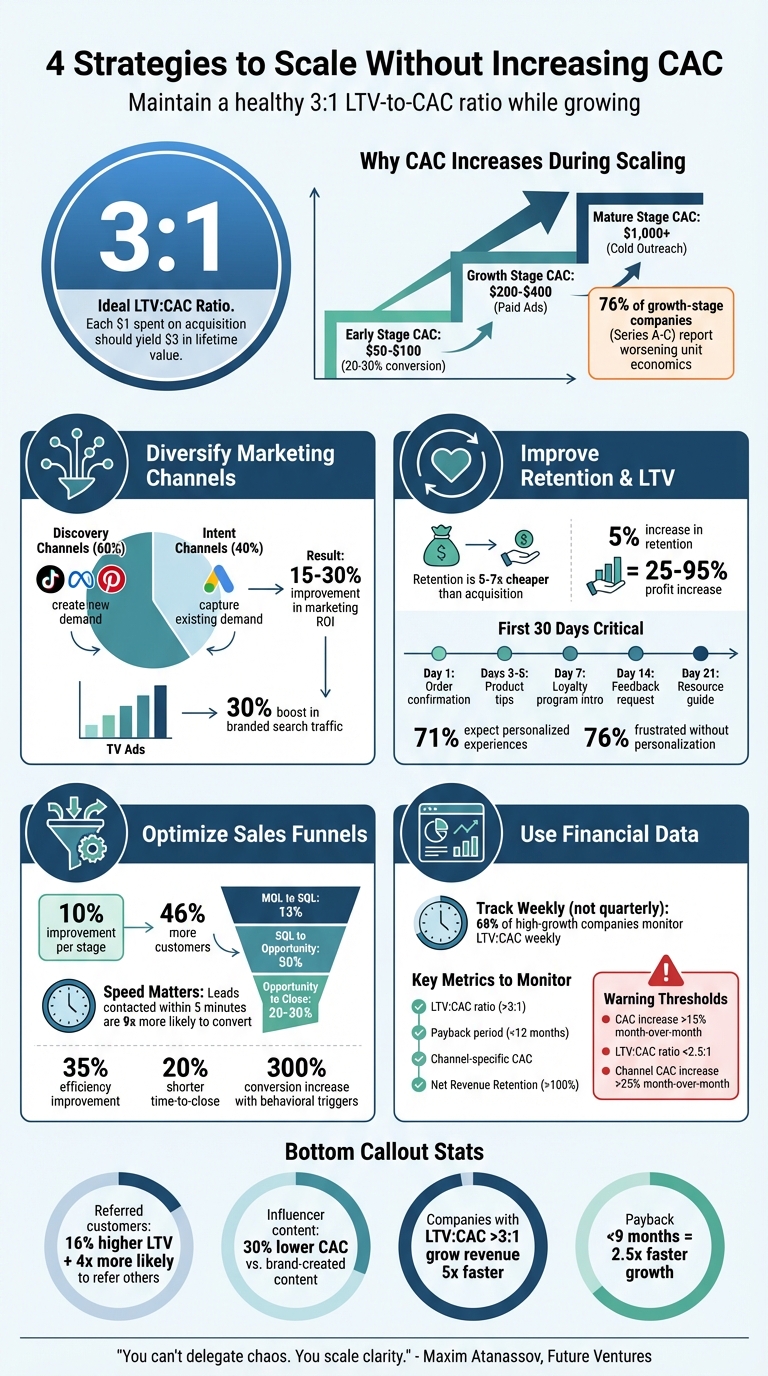
4 Strategies to Scale Business Without Increasing Customer Acquisition Costs
As businesses grow, the pool of easy-to-acquire customers dries up quickly. Every acquisition channel follows a natural saturation curve. Initially, companies target "early adopters" - those actively seeking their solution - who convert at impressive rates of 20–30% for just $50–$100 per customer. But after this high-intent audience is tapped out, companies are forced to target "colder" prospects who need significantly more effort to convert [3].
This transition drives costs up sharply. A company that once enjoyed a $50–$100 CAC during its early organic phase might see that number jump to $200–$400 with paid ads, and eventually surpass $1,000 when relying on cold outreach [3]. At the same time, the lifetime value (LTV) of each customer often remains flat. This imbalance creates a problem: 76% of growth-stage companies (Series A-C) report worsening unit economics as they scale, with CAC rising while LTV stagnates [3]. As a result, companies are forced into less efficient acquisition strategies, pushing costs even higher.
One of the main reasons behind rising CAC is over-reliance on a single channel. Businesses often try to squeeze every last dollar from a single marketing channel until returns diminish. Jason Kiwaluk, a digital strategist, attributes rising CAC to "compounding inefficiencies" that teams mistakenly accept as unavoidable [2]. Instead of diversifying channels or streamlining operations, many businesses double down on strategies that are no longer effective.
Operational complexity also plays a big role. Scaling often involves adding specialized roles - like SDRs, Account Executives, Sales Engineers, and Onboarding teams - which increase overhead without necessarily improving conversion rates. As Kiwaluk puts it, "More heads rarely translate to better outcomes; activity ≠ impact" [2]. In January 2026, his team at Kiwaluk Digital simplified their sales processes by reducing unnecessary roles and focusing on automation. This approach cut CAC by over 50% while helping incremental ARR grow by more than 80%, pushing the company beyond $300 million in ARR [2].
Another factor is the pursuit of cheaper channels that bring in high-churn customers. Research shows that 58% of companies found their CAC “optimization” efforts actually harmed their financial health by attracting customers who churn quickly [3]. This creates a vicious cycle where businesses must constantly replace lost customers, leading to unsustainable growth.
Rising CAC directly impacts a company’s bottom line. When CAC grows faster than LTV, unit economics break down. A healthy SaaS business typically recovers its CAC within 12 months, but escalating costs can stretch this payback period to over 50 months - making the business model unsustainable [3]. Investors notice these trends, and a CAC payback period beyond 24 months or an LTV:CAC ratio below 1.5:1 is considered a major red flag during Series B funding rounds [3].
"Optimizing CAC while LTV remains weak is a race to the bottom: the company acquires cheap customers, the cheap customers churn quickly, the company needs to acquire even more cheap customers just to maintain revenue." - Deconstrainers [3]
The financial consequences go beyond these metrics. Companies with poor unit economics often face valuation cuts of up to 50% compared to competitors with stronger ratios [3]. In some cases, acquiring new customers can actually destroy company value instead of adding to it.
If you want to scale your business without seeing your Customer Acquisition Cost (CAC) skyrocket, it’s crucial to spread your marketing efforts across multiple channels. Many companies fall into the trap of pumping more money into the same channels until they hit a saturation point - where spending more yields little to no return. When this happens, CAC increases because you’re competing for a shrinking pool of potential customers. The solution? Spread your budget across various channels to avoid saturation and maintain efficiency.
Marketing channels generally fall into two categories: discovery channels and intent channels. Discovery channels, like Meta, TikTok, and Pinterest, are all about creating new demand by introducing your brand to people who may not even know they need your product yet. On the other hand, intent channels, such as Google Ads, capture existing demand from users actively searching for a solution.
Here’s the catch: many businesses lean too heavily on intent channels because they deliver quick conversions. But as Prescient AI explains:
"Conversion campaigns don't generate awareness. They harvest it. When you stop planting, you eventually run out of harvest" [6].
Over-relying on intent channels like Google Ads often leads to higher costs over time as you vie for a limited pool of high-intent buyers. Discovery channels, however, help you build brand awareness, which can enhance the performance of your intent campaigns. For example, running awareness campaigns on social media or connected TV can lead to noticeable increases in branded search traffic, organic visits, and direct website hits [4] [6]. A specific case in point: TV ads have been shown to drive a 30% boost in branded search traffic [4].
By combining discovery and intent channels, you’re not just competing for existing demand - you’re also creating new demand that fuels your conversion-focused campaigns. And that’s a game-changer.
Diversification doesn’t stop at simply using more channels. You also need to test their performance regularly and adjust your budget accordingly. The key metric here is Marginal ROI - the return on the next dollar you spend - not just historical averages. Even a channel that performed well in the past can hit a point where spending more no longer makes sense [5].
When you notice diminishing returns on a particular channel, don’t panic. Instead, reallocate your budget gradually - start by shifting 10–15% of your spend in the first month to avoid disrupting your overall strategy [5]. For example, a B2B telecommunications company saw a 10% jump in lead growth by reallocating part of their budget to top-of-funnel activities without increasing their total spend [4].
This methodical approach works. Companies that actively optimize their channel mix can see a 15% to 30% improvement in marketing ROI - all without spending more overall [5].
A good rule of thumb for balancing your budget is the 60/40 split: allocate 60% to discovery-focused brand-building channels and 40% to performance-driven intent channels [5]. This ensures that your intent channels are constantly fueled by fresh demand, setting you up for long-term success while keeping CAC under control.
Keeping existing customers is far less expensive than acquiring new ones - five to seven times cheaper, in fact. Even a small 5% increase in customer retention can elevate profits by 25% to 95% [7]. This makes improving customer lifetime value (LTV) a powerful way to balance the rising costs of acquiring new customers as you scale.
One key metric to watch is the LTV-to-CAC ratio (Customer Acquisition Cost). A healthy benchmark is a 3:1 ratio, meaning each customer generates three times the revenue it cost to bring them in [12][13]. As Christina Wallace, a Harvard Business School professor, puts it:
"A good rule of thumb is that an LTV-to-CAC ratio of three or higher is attractive and indicates a scalable business where you'll be able to cover your marketing costs, overhead, and still make a profit" [13].
Understanding customer behavior is the foundation of effective retention. By analyzing purchase history, browsing patterns, and preferences, you can segment customers into groups like new, VIP, dormant, or at-risk. This allows for more personalized and targeted engagement [7].
The first 30 days after a purchase are especially important for building engagement. A structured onboarding plan can help establish a strong connection with your customers. For example:
This kind of sequence creates a habit loop, keeping customers engaged with your brand [7].
Loyalty programs, whether they’re points-based or tiered, offer incentives for repeat purchases while building a stronger emotional bond with your customers. Personalization is also crucial - 71% of consumers expect tailored experiences, and 76% feel frustrated when they don’t get them. Using first-party data to offer customized recommendations can make a big difference. Additionally, a focused 3–4 week win-back campaign can re-engage inactive customers by emphasizing relevance and value [7].
To truly benefit from retention efforts, you need reliable financial tracking. Calculating LTV isn’t guesswork - it’s a data-driven process. Multiply the average order value by purchase frequency and customer lifespan to get a clear picture of LTV [7]. For a deeper understanding of profitability, calculate Net CLV by subtracting the costs of serving customers from the revenue they generate [8].
A great example of leveraging data comes from Bolt (formerly Taxify). In November 2018, the company used predictive models to analyze recency, frequency, and monetary value. This approach, led by Data Scientist Elizaveta Lebedeva, achieved a 2.8% error rate when comparing predicted versus actual transactions. This allowed Bolt to take proactive steps to reduce churn while scaling [10].
Companies like Phoenix Strategy Group offer FP&A services to help businesses build detailed financial models. By integrating data from CRM, e-commerce, and payment platforms into unified dashboards, businesses can track metrics like Average Purchase Value (APV) and Purchase Frequency Rate (APFR) in real time. These metrics serve as early indicators of customer engagement and product adoption [9][11]. Additionally, monitoring churn signals - such as reduced spending, delayed renewals, or lower purchase frequency - can help businesses intervene before losing customers [8][11].
As Candice Gervase, Salesforce Team Manager at JMP Statistical Discovery, explains:
"Customer lifetime value is a measure of customer satisfaction and commitment. How engaged are they? Are they expanding their usage and renewing each year?" [8].
Using cohort analysis to group customers by their start date can also shed light on how LTV changes over time. This helps you evaluate the success of your retention strategies. By combining accurate financial insights with targeted retention efforts, you can not only keep customers but also increase their value - improving your LTV-to-CAC ratio and supporting sustainable growth.
After diversifying channels and focusing on retention, the next move is refining your sales funnel. By addressing inefficiencies in the conversion process, you can significantly lower your CAC. Even a 10% improvement in conversion rates at each stage can lead to 46% more customers without increasing your marketing spend [16]. The key? Identifying where prospects drop off and fixing those weak points.
B2B sales funnels often lose prospects at three critical stages. At the top of the funnel, poor data quality is a major problem - sales reps waste time chasing outdated contacts or poorly matched prospects. In the middle, about 60% of leads stall after demos, often due to weak social proof or slow follow-ups [15]. Finally, at the bottom, deals frequently fall apart during procurement because of unclear next steps or misalignment among decision-makers [15].
The first step to fixing these leaks is tracking conversion rates at every stage. Industry benchmarks suggest the following rates: 13% from MQL to SQL, 50% from SQL to Opportunity, and 20–30% from Opportunity to Close [15]. If your numbers are below these thresholds, you've likely pinpointed the problem. Speed is also crucial - leads contacted within five minutes are 9 times more likely to convert [15]. Implementing a strict five-minute response SLA for high-intent leads can dramatically improve your conversion rates in the middle of the funnel. Once you have accurate tracking in place, you can begin automating processes for even greater efficiency.
Jason Kiwaluk tackled this issue by streamlining his team's processes, cutting unnecessary handoffs between SDRs, AEs, and Sales Engineers. The result? Higher efficiency and a noticeable drop in CAC [2].
Automation can help eliminate repetitive tasks that slow down deals and inflate costs. For example, automated lead routing ensures prospects are instantly directed to the right sales rep. Behavioral triggers - like sending an ROI calculator within an hour of a prospect visiting the pricing page - can increase conversion rates by 300% [16]. Multi-dimensional lead scoring, which considers demographics, engagement, and product usage, helps sales teams focus on high-value opportunities, improving efficiency by up to 35% and shortening time-to-close by 20% [16].
Another tactic to control costs is setting bid caps on digital ad campaigns. This ensures you don’t overspend on underperforming channels [15].
As Jason Kiwaluk succinctly puts it:
"Default to automation & AI before people... headcount grew modestly (~10%), but ARR multiplied dramatically" [2].
Instead of hiring more staff, focus on automation to streamline outreach, workflows, and lead qualification. This approach avoids the trap of overextending your marketing channels, which often results in higher CAC without equivalent returns [2].
Scaling a business effectively requires sharp financial oversight, and that's where Phoenix Strategy Group steps in. They offer advanced financial models and real-time data to help businesses make quick, informed decisions. A key metric they focus on is the LTV:CAC ratio, with a recommended benchmark of 3:1. This ratio helps determine whether acquisition costs are justified by the long-term revenue they generate [14].
By combining financial expertise with advanced tools, businesses can identify where to channel resources for the best outcomes.
Phoenix Strategy Group develops integrated financial models tailored for growth-stage companies. These models take the guesswork out of resource allocation by using historical data and revenue trends to identify high-return opportunities. For example, their Integrated Financial Model connects data from CRM and ERP systems, offering a complete picture of how acquisition costs impact overall business performance. This level of forecasting precision ensures businesses avoid overfunding underperforming channels while maximizing cost-efficient strategies like SEO or referral programs [14].
In addition to financial models, real-time data plays a critical role in refining growth strategies. Phoenix Strategy Group’s real-time data synchronization allows businesses to continuously monitor acquisition costs and make quick adjustments to avoid wasting resources. Their Monday Morning Metrics system provides weekly updates on key performance indicators like funnel performance, churn, and LTV. This immediate insight enables businesses to reallocate budgets as needed, rather than waiting for quarterly reviews. This is especially important given that 82% of customers spend less than 10 minutes searching for an item [17].
Keeping an eye on the right metrics is crucial to ensure your scaling efforts don’t spiral into unsustainable spending. Key areas to monitor include Customer Acquisition Cost (CAC), Customer Lifetime Value (LTV), the LTV-to-CAC ratio, payback period, churn rate, and Net Revenue Retention (NRR) [20][21]. These metrics provide a clear snapshot of how well your customer acquisition and retention strategies are performing.
The LTV-to-CAC ratio is particularly revealing. Companies with a ratio above 3:1 tend to see revenue grow five times faster, while those with a ratio below 1:1 risk cash burn in 75% of cases [24]. Another critical metric is the payback period - the time it takes to recover acquisition costs. Ideally, this should be under 12 months. Businesses recouping costs in less than nine months often grow 2.5 times faster [25]. Interestingly, 68% of high-growth companies now track their LTV-to-CAC ratio weekly, rather than waiting for quarterly updates [26].
Channel-specific CAC also warrants close attention. To calculate it, divide total spend for a channel by the number of customers acquired through that channel [18]. For instance, if paid search results in a $500 CAC with a $2,000 LTV (a 4:1 ratio), while social media shows an $800 CAC with a $1,800 LTV (around 2.25:1), reallocating budget to paid search would be the smarter move. Review these metrics monthly, and watch for red flags like a CAC increase of more than 15% month-over-month, declining conversion rates at any stage of the funnel, or retention rates dropping by over five percentage points [19].
Before scaling, establish a baseline by calculating your current CAC across all channels and determining the average LTV based on historical data. A general rule of thumb: your CAC should not exceed one-third of your LTV. For example, if your average LTV is $3,000, your CAC shouldn’t go over $1,000 [22]. It’s equally important to set thresholds for each channel since CAC varies depending on the marketing platform [18][19].
Review these thresholds quarterly, but be prepared to act quickly if certain triggers occur - such as a monthly CAC increase of more than 20%, an LTV-to-CAC ratio dropping below 2.5:1, or a channel-specific CAC rising by over 25% month-over-month [19]. Leveraging AI-driven tools can also help reduce CAC recovery time by 20% compared to traditional methods [27]. Lastly, aim to maintain net revenue retention above 100%. This ensures revenue growth from existing customers helps balance the costs of scaling new acquisitions [23].
Growing your business while keeping customer acquisition costs (CAC) under control requires a thoughtful approach. Four key strategies can help: diversifying marketing channels, improving customer retention, optimizing sales funnels, and working with data-driven financial advisors. These strategies work together - better retention insights can reveal which channels to focus on, funnel optimization ensures your marketing dollars are spent wisely, and financial visibility helps avoid overspending. Together, they create a system that improves CAC and supports sustainable growth.
The rising costs of acquiring customers highlight the importance of these strategies. For example, referred customers typically have a 16% higher lifetime value and are four times more likely to refer others [1]. Additionally, using influencer-created content can reduce acquisition costs by around 30% compared to content produced by brands themselves [1]. These kinds of gains can be the difference between steady growth and financial strain. As Maxim Atanassov, Founder of Future Ventures, wisely said:
"You can't delegate chaos. You scale clarity" [28].
Pay close attention to your key metrics. Numbers like your LTV-to-CAC ratio, payback period, channel-specific CAC, and net revenue retention aren’t just data points - they’re critical indicators of whether your business is scaling effectively or veering into costly territory. Many fast-growing companies now monitor these metrics more frequently, knowing that delayed insights can lead to expensive mistakes.
This is where Phoenix Strategy Group’s expertise comes into play. Their services, ranging from real-time data engineering to fractional CFO support, help turn raw numbers into actionable insights. By integrating financial models with strategic planning, they provide the clarity needed to grow revenue without ballooning acquisition costs. When it comes to scaling your business efficiently, having the right guidance to align data and strategy is essential.
When trying to figure out if your Customer Acquisition Cost (CAC) is rising for the wrong reasons, look at how it aligns with changes in your Customer Lifetime Value (LTV). If your LTV is dropping, it likely means you're delivering less value per customer - not just facing higher acquisition expenses.
To get an accurate Lifetime Value (LTV) calculation, you need to measure the total revenue a customer brings in during their time with your business. Key metrics to consider include revenue, retention rates, and churn. Don't forget to adjust for the average customer lifespan to refine your estimate.
For a deeper look into profitability, use net LTV. This version factors in direct costs, such as customer support expenses or refunds, giving you a more precise picture of how much value a customer truly contributes. This method helps you better understand both customer worth and your business's overall performance.
Optimizing your referral program is a smart first move. Referral programs often come with the lowest customer acquisition cost (CAC) - averaging about $150 for B2B SaaS businesses. This makes them one of the most efficient ways to quickly bring down your CAC while driving new customer growth.