Published on
March 22, 2026


Cash flow is the backbone of every business. But the way businesses manage it depends on whether they're seasonal or operate year-round. Seasonal businesses, like ski resorts or landscaping services, face income spikes during peak months but must stretch that revenue to cover slower periods. Year-round businesses, on the other hand, benefit from steady revenue, making cash flow easier to predict and manage.
Key Takeaways:
Quick Comparison:
| Feature | Seasonal Business Model | Year-Round Business Model |
|---|---|---|
| Revenue Pattern | Peaks during specific months, drops off-season | Consistent throughout the year |
| Cash Flow Volatility | High; depends on external factors like weather | Low; stable and predictable |
| Expense Management | Requires saving surplus for lean months | Easier; aligns with steady revenue |
| Staffing | Temporary hires during peak seasons | Stable workforce year-round |
| Risk Exposure | High; vulnerable to bad seasons | Lower; spread over time |
Both models require tailored strategies to manage cash flow effectively. Seasonal businesses must focus on saving during peak months and forecasting for slow periods, while year-round businesses prioritize maintaining steady margins and planning for growth.
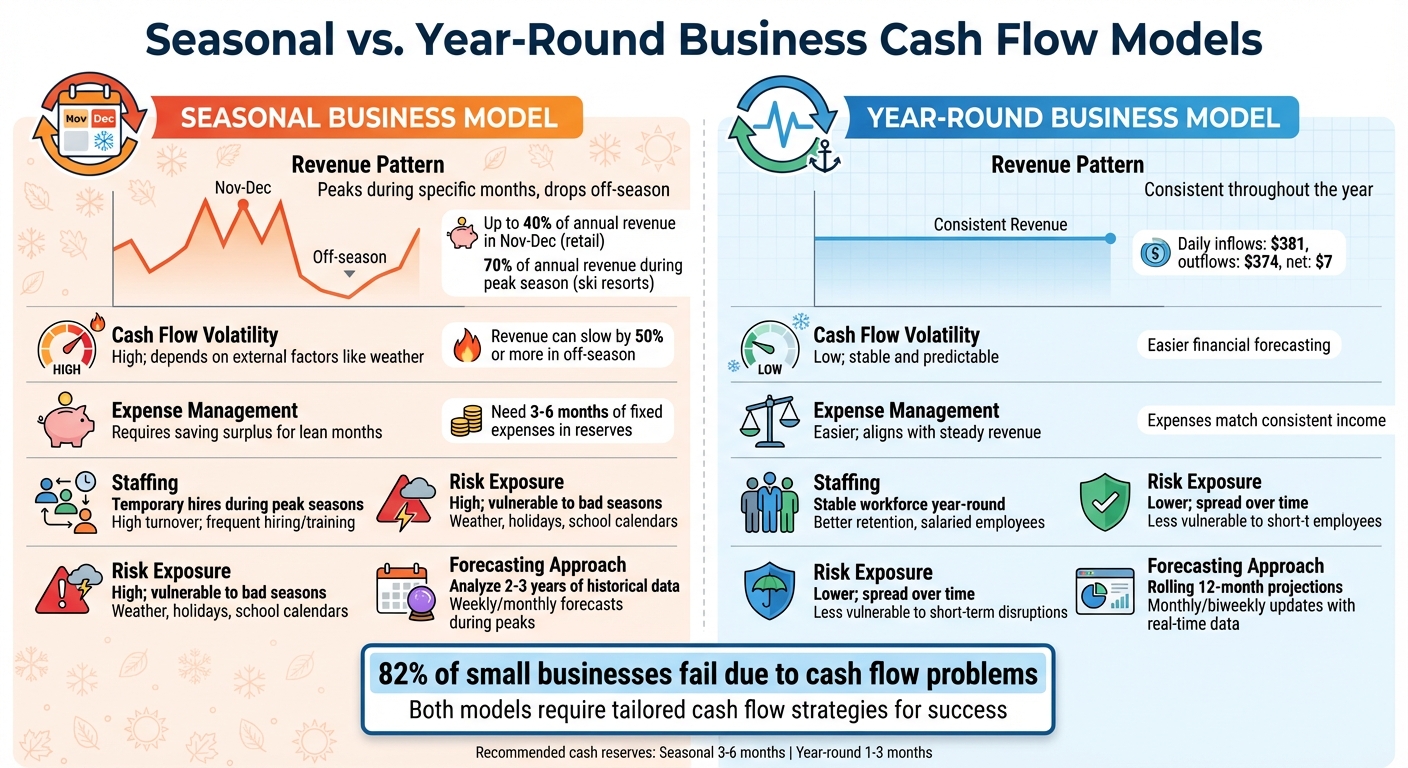
Seasonal vs Year-Round Business Cash Flow Comparison
Seasonal businesses operate on a distinct revenue cycle. Their cash flow is marked by intense revenue spikes during peak seasons, followed by prolonged slow periods. This creates a tricky balancing act: businesses must earn enough during their busiest months to cover expenses for the entire year. Let’s dive into how this cycle shapes their financial challenges.
The peak season is when seasonal businesses shine. Revenues soar as they ramp up spending on inventory, hire temporary staff, and increase marketing efforts to handle the surge in demand. For instance, retail businesses can earn up to 40% of their annual revenue in just November and December [3].
But once the season ends, the challenges pile up. Customer demand plummets, yet fixed expenses like rent, utilities, and insurance remain constant [2]. To make matters worse, some businesses face delayed payments, with revenue trickling in weeks or even months after the goods or services were delivered. This delay can create a cash crunch, even after a successful peak season.
External factors add to the unpredictability of seasonal cash flow. Weather plays a huge role - a mild winter can cripple ski resorts, while unexpected rain can ruin a key weekend for outdoor vendors. Other factors like school calendars, holiday schedules, and changing consumer habits introduce even more uncertainty [2].
This volatility makes financial planning especially tough. Experts advise seasonal businesses to analyze at least two to three years of financial data to identify patterns and better predict cash flow fluctuations [3]. Additionally, maintaining a robust cash reserve is critical - seasonal businesses often need a much larger financial buffer compared to year-round operations to weather these ups and downs. Without this safety net, a single bad season could lead to costly emergency loans or, in worst cases, force businesses to shut down before they can prepare for the next peak.
Although seasonal businesses face these unique hurdles, year-round operations enjoy steadier cash flow - a topic we’ll explore next.
Year-round businesses operate in a financial environment that's far more stable than the unpredictable cycles faced by seasonal operations. Instead of alternating between periods of abundance and scarcity, these companies enjoy a steady stream of revenue. This consistency allows them to approach cash flow management in a more calculated and strategic way, avoiding much of the volatility that seasonal businesses often encounter.
The key to stable cash flow for year-round businesses lies in offering products or services that remain in demand throughout the year. Subscriptions and everyday essentials are great examples of offerings that provide reliable income streams[5]. Unlike seasonal businesses that depend on factors like weather changes, holidays, or school schedules, year-round businesses benefit from steady consumer habits and predictable buying patterns[3][2].
This dependable revenue makes managing expenses much easier. For example, one small business reports daily cash inflows of $381 and outflows of $374, leaving a net gain of $7[5]. With this kind of balance, financial forecasting becomes a simpler task. Year-round businesses often rely on standard cash flow forecasting methods to evenly project cash movement across months[3]. This predictability enables finance teams to focus on long-term growth strategies instead of scrambling to address sudden cash shortages.
Thanks to their steady revenue, year-round businesses are less exposed to the external risks that can disrupt seasonal operations. For instance, they don’t face the financial strain of a weak season causing major revenue dips or inventory mismanagement[1][2]. Additionally, with a consistent workforce and salaried employees, they avoid the costs and challenges of hiring and training temporary workers during peak periods[2]. This operational steadiness directly contributes to financial resilience. Considering that 82% of small businesses fail due to cash flow problems[5], the year-round model offers a level of protection that seasonal businesses simply don’t have.
Next, we’ll dive into how forecasting strategies differ between these two types of business models.
Cash flow forecasting methods vary significantly between seasonal and year-round business models. Seasonal operations must navigate sharp revenue fluctuations, while year-round businesses focus on maintaining steady growth and consistency. These differences require distinct strategies to predict cash inflows and outflows, ensuring the forecasts align with each type of business's unique financial rhythm.
Seasonal businesses thrive on understanding patterns from past performance. Using 2–3 years of historical data is crucial to identify recurring trends and cycles [2]. Breaking forecasts into smaller timeframes, such as monthly or even weekly segments, provides better oversight during high-activity periods. For example, during peak seasons, a weekly forecast can closely track opening balances, expected income, and planned expenses.
In addition to financial data, non-financial indicators such as website traffic, booking volumes, and weather trends can offer valuable insights [2]. Take an HVAC company, for instance - it might monitor temperature trends to predict spikes in demand. Similarly, businesses can refine their forecasts by factoring in seasonal triggers like holiday shopping patterns or the school calendar.
To manage expenses effectively, it's essential to separate fixed costs (like rent or salaried employees) from variable costs (such as raw materials or commissions) [2]. This differentiation helps identify which costs can be adjusted during slower periods. Regular updates to the forecast ensure it reflects actual performance and adapts to changing conditions.
Year-round businesses, with their steady revenue streams, benefit from rolling forecasts. A rolling 12-month projection, which updates continuously as new data comes in, offers more flexibility than a static annual forecast [2]. This approach helps businesses adapt gradually to changes in revenue or expenses without major disruptions.
Scenario planning plays a key role in these models. Testing various assumptions - like the financial impact of hiring more staff or losing a significant client - shifts the focus from reacting to problems toward planning for sustainable growth. Tools like Float, Pulse, and Fathom streamline this process by automating rolling forecasts and providing real-time visualizations. Since customer behavior tends to remain consistent, year-round businesses often prioritize internal sales pipeline analysis over external factors when refining their forecasts.
Both seasonal and year-round business models come with their own set of challenges and advantages, especially when it comes to cash flow and forecasting. For instance, seasonal businesses often see revenue spikes during specific periods. Take a ski resort, for example - it might generate 70% of its annual revenue during the winter months alone [6]. This means they need to save aggressively during peak months to cover fixed costs like rent, insurance, and utilities when revenue drops by 50% or more in the off-season [1]. On the other hand, year-round businesses enjoy steady, predictable income streams, which naturally align with ongoing expenses [6].
From an operational perspective, the two models differ significantly. Seasonal businesses can cut variable costs during slower periods by reducing temporary staff, halting marketing efforts, and scaling back inventory orders. However, this flexibility comes at a price - frequent hiring and training cycles, plus the risk that a single bad season could jeopardize the entire operation [1][2]. Year-round businesses, in contrast, maintain stable payrolls and enjoy better employee retention, but they also face fixed overhead costs that are harder to reduce during revenue slumps.
"Managing cash flow in a seasonal business is difficult. You may have a lot of money coming in for three or four months, and then it slows by 50% or more."
– Ariel Gottfeld, Cash Flow Frog [1]
External factors also play a big role. Seasonal businesses are particularly susceptible to disruptions like unpredictable weather, climate shifts, or sudden market changes, which can severely impact their peak season performance [1][6]. In contrast, year-round businesses spread their risks over time, making them less vulnerable to short-term disruptions but still exposed to broader economic trends [6]. Financial advisors often suggest that seasonal businesses maintain cash reserves to cover 3–6 months of fixed expenses to survive lean periods [2].
| Feature | Seasonal Business Model | Year-Round Business Model |
|---|---|---|
| Revenue Predictability | Low; heavily reliant on specific seasons and weather | High; steady monthly or quarterly income |
| Expense Management | Requires stretching peak earnings for off-season costs | More straightforward; expenses align with revenue |
| Risk Exposure | High; vulnerable to weather and market changes | Lower; risks spread over longer periods |
| Staffing | High turnover; frequent hiring and training needed | Stable; better long-term retention |
| Cash Flow Strategy | Save aggressively during peak months | Focus on steady monthly margins and reinvestment |
| Marketing Strategy | Heavy spending during peak seasons | Consistent branding throughout the year |
Next, we’ll explore practical strategies for managing cash flow under these distinct business models.
Managing cash flow requires tailored strategies depending on whether a business operates seasonally or year-round. Seasonal businesses face the challenge of balancing peak revenue months with leaner periods, while year-round operations focus on maintaining steady cash flow and preparing for unexpected shifts. Let’s dive into how each model can navigate these challenges.
For seasonal businesses, planning ahead is non-negotiable. A smart move is to automate savings during peak revenue months. By setting up automatic transfers to a dedicated savings account, you can ensure surplus cash is preserved for the off-season when it’s needed most [2].
Forecasting plays a huge role here. Use historical revenue data to map out monthly trends in expenses, staffing, and marketing. Timing is everything - schedule discretionary expenditures like marketing campaigns, office improvements, or new hires during high-revenue periods to conserve cash during slower months [2]. On the supplier side, negotiate extended payment terms (30–60 days) for the off-season and aim for volume discounts or early-payment perks during peak months [2]. Additionally, tools like revolving lines of credit or invoice factoring can help convert outstanding invoices into immediate cash when needed [4][2].
Year-round businesses benefit from consistent income, but that doesn’t mean cash flow takes care of itself. The key is to analyze 24–36 months of financial data to identify recurring patterns and subtle trends [3]. Rolling forecasts, updated monthly or biweekly with real-time performance data, can help you detect and address cash flow issues before they escalate.
Speeding up receivables is another priority. Use automated invoice reminders, tighten credit policies for new clients, and offer early-payment discounts to encourage faster payments [2]. On the payables side, negotiate extended terms (30–60 days) during tighter months or take advantage of early-payment discounts when cash flow is strong [2]. Over time, these strategies can significantly boost your working capital. Even with consistent revenue, it’s wise to maintain a cash reserve that covers 1–3 months of operating expenses to cushion against unexpected downturns [3].

Phoenix Strategy Group tailors its cash flow strategies to meet the unique demands of both seasonal and year-round businesses. Whether your business grapples with seasonal revenue swings or operates steadily throughout the year, their advisory services are designed to optimize financial management. With fractional CFO services, FP&A systems, and data engineering, they equip growth-stage companies to forecast effectively, build financial reserves, and make smarter decisions - all without the cost of a full-time executive team.
Seasonal businesses face unique challenges, especially when cash flow fluctuates between revenue peaks and off-season slumps. Phoenix Strategy Group helps by analyzing historical sales data to identify when cash shortfalls are likely to occur. From there, they create proactive strategies to bridge those gaps. Their fractional CFO services focus on key areas like inventory timing, renegotiating supplier payment terms, and allocating surpluses from peak months to cover off-season needs.
They also guide businesses in exploring revenue diversification strategies to stabilize income during slower periods. For example, a ski resort might introduce summer hiking tours, or a business could invest in off-season marketing with loyalty programs. With Phoenix Strategy Group's FP&A systems, you’ll have the data to make these decisions with confidence. Additionally, their Weekly Accounting System and KPI tracking tools ensure you stay on top of cash reserves and adapt your strategies as conditions evolve.
Phoenix Strategy Group doesn’t just specialize in seasonal businesses - they also provide robust support for companies with consistent, year-round revenue. Even with steady income, careful cash flow management is essential. Their Integrated Financial Model brings together data from across your operations, offering real-time visibility into receivables, payables, and working capital. Paired with their Monday Morning Metrics dashboard, you’ll have the insights needed to anticipate and address potential issues before they arise.
For year-round businesses, their fractional CFO services include regularly updated forecasts - monthly or even biweekly - so you can pivot quickly in response to market changes. They’ll help you tighten credit policies, speed up collections through automated invoice reminders, and negotiate more favorable payment terms with vendors. Beyond managing day-to-day cash flow, Phoenix Strategy Group’s expertise in data engineering and M&A advisory positions you to scale, secure funding, and prepare for eventual exits with a solid financial foundation.
The key distinction between seasonal and year-round cash flow models lies in predictability versus volatility. These differences influence not just revenue patterns but also the specific forecasting strategies each model requires. As Ariel Gottfeld explains, "Managing cash flow in a seasonal business is difficult. You may have a lot of money coming in for three or four months, and then it slows by 50% or more" [1]. In contrast, year-round operations enjoy steady income streams, making it easier to forecast and reinvest consistently.
Forecasting methods must be tailored to each model's unique challenges. Seasonal businesses often rely on detailed scenario planning to anticipate both high and low periods [6]. On the other hand, year-round businesses focus on linear projections and real-time monitoring, allowing for quick adjustments to market changes. These strategies directly influence how cash flow is managed.
For seasonal businesses, building resilience means saving surplus revenue from peak months in dedicated funds to cover fixed costs during slower periods [6]. In comparison, year-round businesses benefit from maintaining strong supplier relationships, ensuring flexibility in operations. Both models can enhance their cash flow management with real-time monitoring tools, which help control spending and indicate when financing may be necessary [1].
Ultimately, success requires aligning financial strategies with operational realities. Whether dealing with fluctuating revenues or consistent growth, businesses thrive through accurate forecasting, maintaining cash reserves, and making informed, data-driven decisions. These practices turn financial challenges into opportunities for long-term stability and growth.
Your cash reserve acts as a safety net for short-term operational needs and unexpected shifts in cash flow. A widely accepted rule of thumb is to keep enough liquidity to cover 3 to 6 months of operating expenses.
For seasonal businesses, it’s especially important to save during peak periods to support operations during slower times. Using forecasting tools and analyzing seasonal trends can help you figure out the ideal reserve size by accounting for revenue fluctuations and expense patterns.
When creating a cash flow forecast, it's essential to focus on the key elements that help you manage your business’s finances effectively. Start by projecting cash inflows and outflows - this includes revenue, operating expenses, and any irregular costs like equipment purchases or unexpected repairs. Don’t forget to factor in seasonal trends that could impact your cash flow, as overlooking these can lead to inaccurate predictions.
Make it a habit to update your forecasts regularly and compare them against actual results to identify any variances. This practice helps you adjust quickly to changing circumstances. By combining detailed short-term projections with a broader long-term view, you’ll be better equipped to handle day-to-day obligations like payroll and bills, while also planning for growth opportunities.
To keep cash flow steady during the off-season, start by creating a detailed 12-month cash flow forecast. This will help you pinpoint periods where income might dip and allow you to set aside reserves during busier times. Dive into past revenue data to identify patterns in seasonal trends and adjust your financial models to reflect these shifts. By factoring in seasonal variations and consistently updating your projections, you can better manage expenses and maintain a more stable cash flow throughout the year.