Published on
May 12, 2026

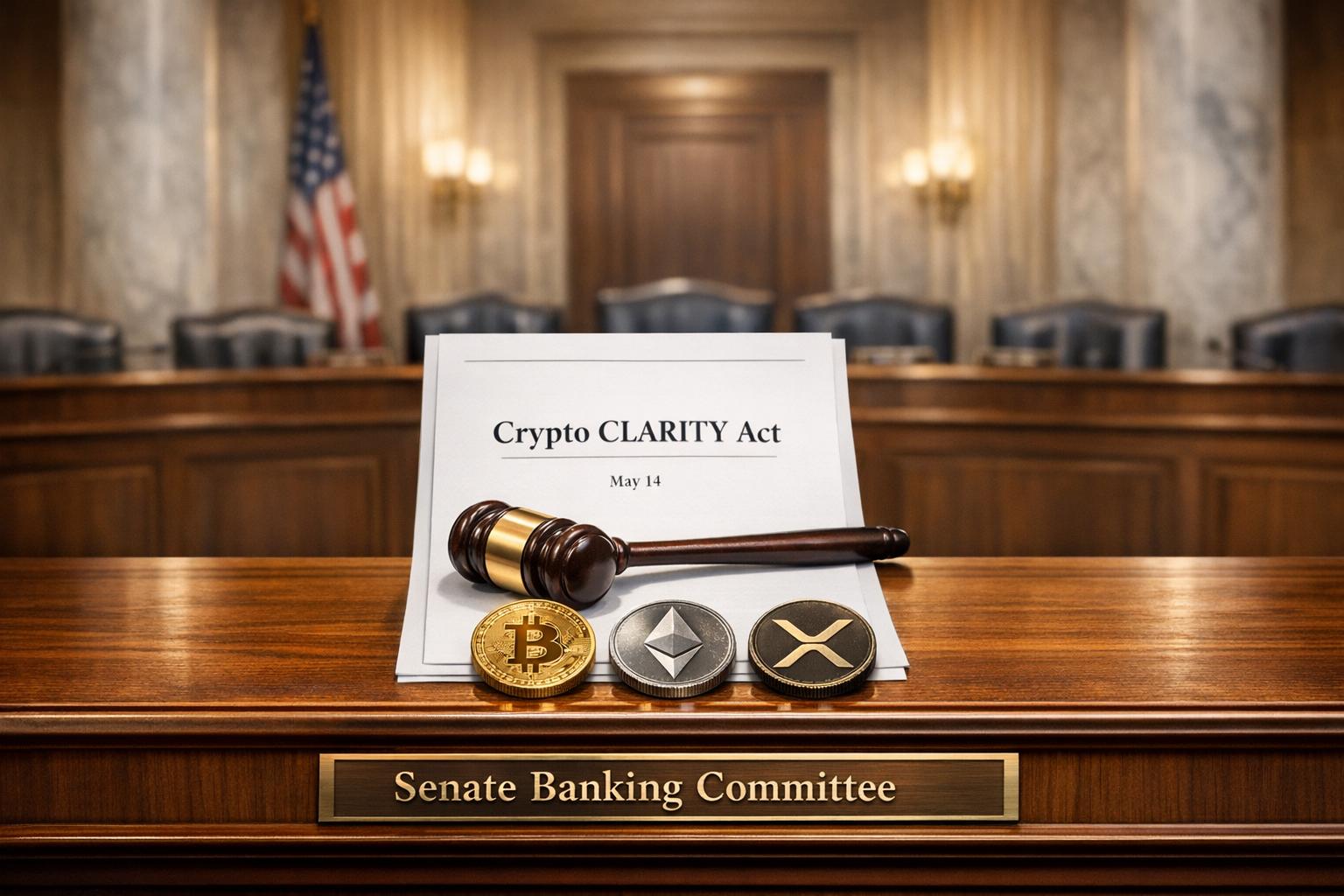
The United States Senate Banking Committee is gearing up for a pivotal vote on May 14 that could transform the country’s approach to digital asset regulation. The committee will hold its first formal markup session of the Digital Asset Market Clarity Act of 2025, a comprehensive bill that aims to resolve long-standing uncertainties surrounding cryptocurrency regulation.
If passed, this legislation, known as the CLARITY Act, would establish clear federal rules for digital assets, addressing a murky regulatory landscape that has stifled innovation and investor confidence in the U.S. crypto sector for years.
The stakes of this committee vote are high. The CLARITY Act, formally titled H.R. 3633, is designed to settle one of the most pressing issues in the digital asset market: determining which federal agencies have jurisdiction over various types of cryptocurrencies and the rules they must follow. The bill draws a clear line between digital commodities, regulated exclusively by the Commodity Futures Trading Commission (CFTC), and assets classified as securities, which will remain under the purview of the Securities and Exchange Commission (SEC).
This distinction resolves a regulatory grey zone that has left crypto projects forced to navigate conflicting rules - or face years of costly litigation. A key provision of the CLARITY Act also introduces protections for decentralized finance (DeFi) developers and clear operating standards for exchanges, brokers, and custodians.
The bill passed the U.S. House of Representatives in July 2025 with bipartisan support and is now poised for the Senate Banking Committee's vote - a critical step before heading to the Senate floor.
The journey to this hearing has been tumultuous. Since its introduction in May 2025 by House Financial Services Chairman French Hill, the bill has faced numerous challenges, including disagreements over stablecoin yield provisions. Banks argued that allowing stablecoins to generate passive interest would destabilize the financial system by diverting deposits from traditional banks. Crypto firms countered that such concerns were overblown and driven by competitive self-interest. The resulting standoff stalled the bill for much of late 2025.
A breakthrough came earlier this month when Senators Thom Tillis and Angela Alsobrooks reached a bipartisan compromise. The updated language prohibits passive yield on stablecoins but permits activity-based rewards tied to transactions and platform usage. This compromise has attracted broad support, including from Coinbase, whose CEO Brian Armstrong had previously withdrawn support for the bill but reversed course after reviewing the revised draft.
"This is one of the most important weeks for crypto regulation in years", tweeted industry analyst @wiseadvicesumit. "The CLARITY Act officially heads for a Senate Banking Committee markup vote on Thursday...the FIRST ever committee vote on a full U.S. crypto market structure bill."
The CLARITY Act’s implications extend across the digital asset ecosystem. For Bitcoin, the bill would permanently enshrine its classification as a digital commodity into federal law, offering statutory certainty that no future administration can reverse. This is expected to bolster institutional confidence and drive greater investment in Bitcoin-related products, including ETFs.
Ethereum, another cornerstone of the crypto world, also stands to benefit. The bill codifies Ethereum's status as a digital commodity and provides explicit legal protections for developers of decentralized finance protocols. Under the proposed framework, developers who do not custody user funds or operate centralized platforms are shielded from being classified as broker-dealers or exchanges - removing a significant legal risk hanging over Ethereum’s ecosystem.
XRP, however, may see the most dramatic impact. The asset has been weighed down by years of regulatory overhang from the SEC’s lawsuit against Ripple Labs, which alleged that XRP was an unregistered security. The CLARITY Act makes XRP’s classification as a digital commodity federal law, eliminating this uncertainty. Analysts predict that this clarification could unlock pathways for XRP ETFs and attract billions in institutional investment.
Recent polling underscores the broad public support for clear crypto regulation. A national survey conducted by HarrisX, surveying 2,008 registered voters between May 1 and May 4, found that 52% of respondents supported the CLARITY Act after reviewing a summary of the bill. Public support crossed party lines, with 58% of Republicans, 55% of Democrats, and 42% of independents favoring the legislation. The survey also highlighted a growing perception that the U.S. is falling behind globally, with 70% of voters saying the country should have already passed crypto legislation.
The geopolitical stakes are equally pressing. Countries such as the European Union, Singapore, and the United Arab Emirates have already implemented comprehensive digital asset frameworks. U.S. Treasury Secretary Scott Bessent warned in an April op-ed that the lack of federal regulation is pushing blockchain developers and crypto firms to relocate abroad. According to Bessent, adopting the CLARITY Act is critical to maintaining U.S. leadership in digital finance.
The upcoming May 14 executive session at the Dirksen Senate Office Building marks a key milestone for the CLARITY Act. If the Banking Committee approves the bill, it will be combined with the Senate Agriculture Committee’s version before heading to the Senate floor for a full vote. Analysts estimate the bill’s passage odds at 75% for 2026, but challenges remain. Reaching the Senate’s 60-vote threshold will require at least seven Democratic senators to cross party lines, and lingering debates over stablecoin provisions and anti-money laundering measures could complicate negotiations.
The outcome of this vote will shape the future of U.S. crypto markets. As Ripple CEO Brad Garlinghouse emphasized recently, "Failure to move the bill within the next two weeks could push the issue deeper into the 2026 U.S. midterm political cycle...and drop [its chances] precipitously."
The Senate Banking Committee’s decision on May 14 has the potential to not only clarify the rules of engagement for digital assets but also set the stage for a new era of institutional adoption and innovation in the U.S. crypto industry. All eyes will be on Capitol Hill as lawmakers take this historic step forward.