Published on
May 11, 2026

Net profit margin is a key financial metric for SaaS companies. It shows how much of your revenue remains after covering all expenses. For SaaS businesses, a healthy net profit margin usually ranges from 10% to 30%, with top performers exceeding 15%. Unlike gross margin, which focuses on direct costs, net profit margin accounts for all expenses, including sales, marketing, and operational costs.
Here’s what you need to know:
SaaS Net Profit Margin Benchmarks and Key Financial Metrics
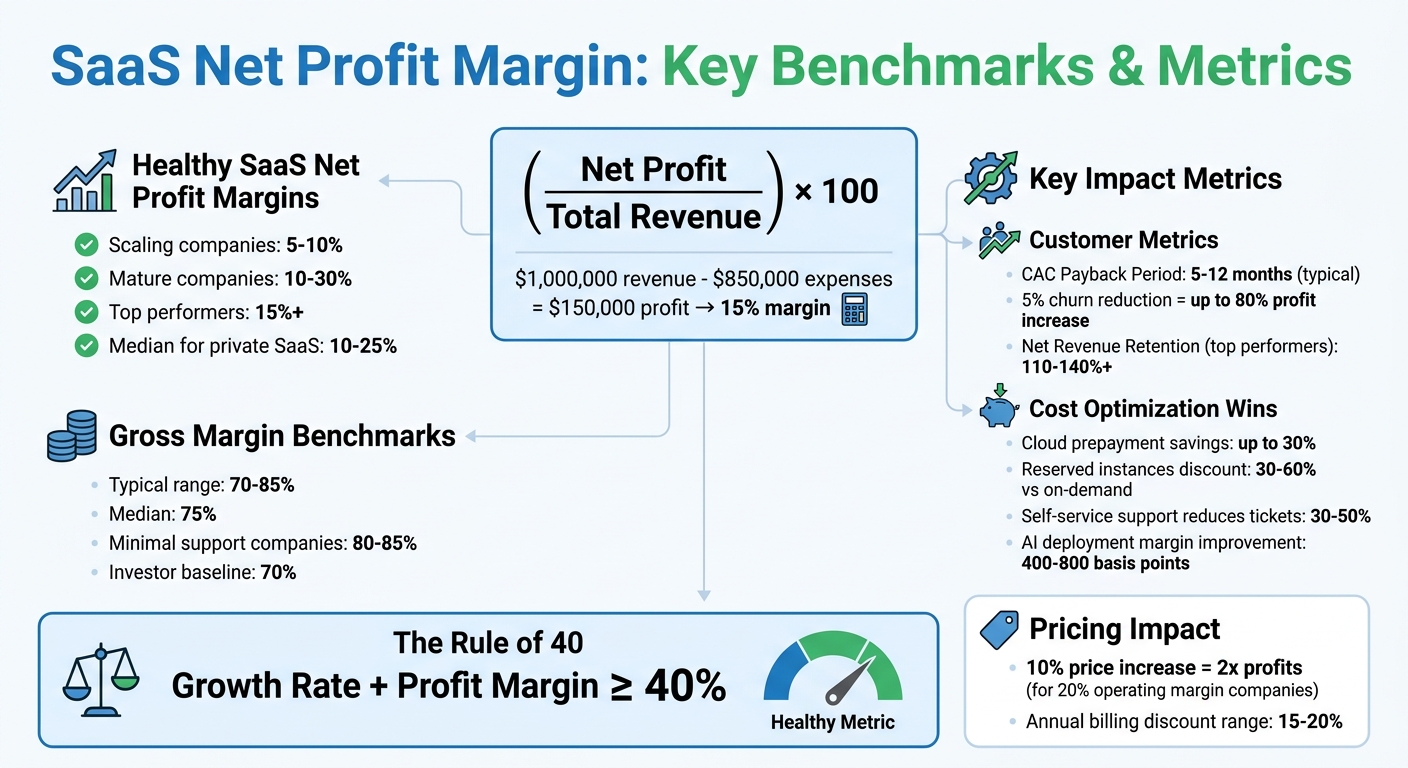
Net profit margin measures the percentage of revenue left after covering all expenses - both direct and indirect. The formula is simple: (Net Profit / Total Revenue) x 100 [4][5]. For example, if a SaaS company generates $1,000,000 in revenue and earns $150,000 in profit, its net profit margin is 15%.
This metric is crucial because it shows whether a company’s growth is actually profitable or just increasing costs. As Baremetrics explains:
Net profit margin... tells SaaS founders whether scaling is actually generating profit or just generating costs [4].
For most mature SaaS businesses, net profit margins typically fall between 10% and 25% [6].
Unlike gross margin - which focuses only on the direct costs of delivering a product - net profit margin takes into account the entire cost structure. This includes sales and marketing expenses, engineering salaries, administrative costs, interest payments, and taxes [6][8].
Understanding this metric is key to grasping how SaaS companies manage their unique cost structures and profit dynamics.
The way SaaS businesses operate sets them apart from traditional companies, and this is reflected in their profit margins. The recurring revenue model, driven by Monthly Recurring Revenue (MRR), ensures a steady and predictable income stream, but it also introduces distinct cost challenges [1]. SaaS companies often enjoy high gross margins - usually between 70% and 85% - because delivering software to additional users comes with minimal incremental costs [1][6]. However, net profit margins are typically lower, ranging from 10% to 30%, due to significant reinvestments in areas like customer acquisition and product development [1][8].
Take Slack as an example. By focusing on enterprise customer retention and refining its pricing strategies, the company achieved a net profit margin exceeding 20% [1]. This demonstrates how SaaS companies can scale their fixed costs, like engineering and infrastructure, across a growing customer base. However, this scalability is often balanced by the ongoing need to invest in sales, marketing, and continuous product improvement.
The gap between high gross margins and comparatively lower net margins highlights the impact of indirect expenses. For many SaaS businesses, Customer Acquisition Cost (CAC) is the largest expense. Reducing customer churn by just 5% can significantly boost profitability - potentially increasing overall profits by up to 80% [1]. This is because retaining customers longer spreads the initial acquisition cost over more months of recurring revenue, making the investment more efficient over time.
Customer Acquisition Cost (CAC) represents the total sales and marketing expenses needed to win a customer. The payback period measures how long it takes for the revenue from that customer to cover the acquisition cost. A shorter payback period means quicker recovery of investment, which fuels growth. Keeping an eye on CAC in relation to net profit margin is essential to ensure that high acquisition costs don’t eat into profits.
The CLV to CAC ratio evaluates the lifetime revenue a customer generates against the cost of acquiring them. A strong ratio shows that customers provide long-term value relative to what it costs to bring them in. By tracking this metric, companies can confirm that their growth strategies are yielding sustainable returns. This ratio also complements gross margin analysis by emphasizing the long-term benefits versus upfront spending.
Gross margin and operational costs are core drivers of net profit margin in SaaS. Gross margin, in particular, lays the groundwork for profitability. For private SaaS companies, the median gross margin is about 75%, while companies with minimal support and service needs can achieve 80–85% [9]. As Team culta puts it:
If your gross margin is weak, nothing downstream can save you - not growth, not fundraising, not cost-cutting elsewhere [9].
Even a 5% improvement in gross margin can significantly boost enterprise value, adding 1–2x to revenue multiples [9]. Investors typically consider a 70% gross margin the baseline for a viable SaaS business model [9]. To maintain these margins, SaaS companies must keep a close watch on their Cost of Goods Sold (COGS), which includes expenses like cloud infrastructure, hosting, and customer support. Over-provisioning cloud resources - sometimes by as much as 30–50% - can lead to unnecessary costs [9]. Opting for reserved instances or committed-use discounts can cut cloud expenses by 30–60% compared to on-demand pricing [9].
Operational costs, particularly in Sales & Marketing, also play a huge role in safeguarding net profit margins as a company scales. Transitioning from reactive customer support to self-service options, such as documentation, in-app guidance, and community forums, can reduce support tickets by 30–50% [9]. This approach allows customer success costs to grow more in line with revenue rather than requiring proportional increases in headcount, helping to preserve profitability as the business expands.
Creating a dashboard to track net profit margin starts with identifying the right metrics. It's essential to clearly separate COGS (like hosting fees and customer support wages) from OPEX (such as marketing expenses and administrative salaries) [1]. This breakdown helps you understand where your money is going and highlights areas where efficiency can be improved.
The most effective dashboards focus on key drivers like Monthly Recurring Revenue (MRR), Customer Acquisition Cost (CAC), and Churn Rate [1]. Austin Caldwell, Senior Product Marketing Manager at NetSuite, explains:
SaaS metrics, when well-chosen, give you a real-time indicator of business health and growth [12].
Instead of relying solely on monthly reports, real-time monitoring lets you detect trends early and adjust strategies before minor issues escalate into bigger challenges. These insights also set the stage for automating financial processes, making operations smoother and more efficient.
Automation plays a major role in reducing errors and speeding up tasks like month-end close. Tools that handle recurring billing, expense reconciliation, and revenue recognition ensure financial data remains accurate and current. In fact, 93% of finance leaders reported faster month-end close times after adopting integrated cloud ERP systems like NetSuite [12]. Additionally, automated billing systems can help recover lost revenue. For example, Stripe's recovery tools and workflows helped users reclaim over $6.5 billion in revenue in 2024 [10].
For SaaS companies managing various revenue streams - such as subscriptions, usage-based billing, and professional services - automation becomes even more essential [12]. These systems can calculate metrics like the CAC payback period (typically 5–12 months) to safeguard net profit [12]. Joe Church Woods from Sage highlights the benefits of automation:
AI-powered solutions provide real-time visibility into your most important metrics, helping you monitor performance, forecast cash flow, and respond quickly to trends or issues [7].
Building on automation, integrating real-time data systems ensures seamless communication between financial and operational data. This involves connecting platforms like subscription management tools, cloud infrastructure monitoring, and accounting software to enable continuous data sharing. SaaS companies often track 10–24 performance metrics to assess business health beyond standard GAAP reporting [7].
Cloud infrastructure management tools are particularly useful for monitoring hosting and server costs in real time, as these are major components of COGS [11]. Integrating balance sheet data and deferred revenue allows for accurate cash flow forecasting, preventing issues like "cashless profits" [13]. Mark Wald from SPRCHRGR emphasizes:
A good financial forecast model that considers deferred revenue and balance sheet activity is necessary to have a full picture of how much actual cash the business will generate and burn each month into the future [13].
Linking financial data with operational indicators - such as Monthly Active Users (MAU) and conversion rates - offers a forward-looking perspective on profitability [13].
Boosting your net profit margin involves focusing on three key areas: cutting operational costs, fine-tuning revenue streams, and keeping customers loyal. These strategies directly impact profitability and help SaaS companies achieve long-term growth.
Cutting costs doesn’t have to mean cutting corners. The trend in SaaS is shifting from "cost-as-headcount" to "cost-as-orchestration", where AI takes over repetitive tasks once handled manually [3]. As Peter Vogel, Founder of peppereffect, explains:
SaaS margins are the engineered output of an operating model - not a residual that emerges if growth holds [3].
Start with your cloud infrastructure. Prepaying for services like AWS or Google Cloud can save you up to 30% [1]. Use strategies like "rightsizing" (aligning resources with actual usage) and auto-scaling to avoid paying for unused capacity [2]. AI-powered FinOps tools can identify and eliminate 15–25% of cloud waste in just two months [3].
AI isn’t just for cloud savings - it can also slash costs across departments. For example, autonomous AI agents can reduce customer success costs by 30–50%, cut qualified lead costs in sales and marketing by 60–85%, and lower general and administrative (G&A) expenses by 20–30% [3]. In mid-sized companies, deploying AI across multiple departments can improve operating margins by 400–800 basis points within a year [3]. To stay on track, aim to keep G&A expenses between 10–15% of revenue [3].
But cost-cutting is only part of the equation. Optimizing your revenue streams can take your profitability even further.
Once you’ve tightened up your expenses, look at your pricing strategies. Even small adjustments can make a big impact. For instance, increasing prices by 10% can more than double profits for a company with a 20% operating margin, assuming costs and customer numbers stay the same [14]. Hybrid usage-based pricing - combining a base subscription with additional charges for extra usage - can help you cater to different customer needs [14].
Another smart move? Offer clear upgrade paths. Reserve premium features or set limits on lower-tier plans to encourage customers to upgrade [14]. If your win rates are above 80% or customers rarely push back on pricing, it might be time to reevaluate - you could be underpricing your service [14]. Switching to annual billing can also help. While annual discounts typically range from 15–20%, the upfront cash flow and better retention often outweigh the discount’s cost [14].
Keep an eye on Net Revenue Retention (NRR), which measures how much revenue you’re generating from existing customers. Top-performing SaaS companies hit NRR rates of 110–140% or more, thanks to upsells and cross-sells [15].
Finally, improving customer retention is the glue that holds these gains together.
Reducing churn, even slightly, can have a big impact on profitability by unlocking more expansion revenue [1]. Retaining customers is far cheaper than acquiring new ones, and satisfied customers are more likely to spend more over time.
One effective tactic is multi-threading - building relationships with multiple stakeholders in an account. This minimizes risk if your main point of contact leaves the company [16]. Cybersecurity firm Cobalt used a champion tracking strategy in 2022 to monitor former users who moved to new roles. This approach generated $1.7 million in new business pipeline, contributing 8% of the company’s total new logo revenue that year [16]. Corrina Owens, Chief Evangelist Officer at purple cork, underscores the importance of this approach:
You cannot depend on one sole champion, or one sole person internally because they could leave [16].
Use first-party intent data - like product usage trends, website activity, and support ticket volume - to flag accounts at risk of churning [16]. Hosting cross-functional deal review meetings, where teams like sales, product, and customer success collaborate to save high-risk accounts, is another powerful retention strategy [16]. As your business grows, scaling your customer success team and offering self-service options can help maintain consistent margins [2].
Tracking your net profit margin gives you a clear picture of your SaaS business's financial health. While growth metrics often steal the spotlight, your margin is what shows whether your business model can stand the test of time. Gene Godick from G-Squared Partners sums it up well:
To be able to manage profit, companies must first be able to measure it: including all of the drivers and drainers on their profit margins. [2]
Keeping an eye on your margins helps you spot early warning signs, like increasing customer acquisition costs or inefficiencies in operations, that could hurt your profits. Examples from the industry show that balancing growth with profitability is the key to long-term success.
Using the metrics and tracking methods covered earlier, you can create a strong foundation for financial performance. Generally, scaling SaaS companies aim for margins between 5%–10%, while more established ones target 10%–30%. Additionally, the Rule of 40 - where your growth rate and profit margin add up to 40% or more - is a reliable indicator of financial health [1].
As discussed, AI tools now make it easier than ever to measure and manage profitability. Whether it's pre-paying for cloud services to save up to 30% or analyzing data to identify your most profitable features, every small improvement adds up. Start measuring today to ensure profitability tomorrow.
At Phoenix Strategy Group, we’re here to equip your SaaS business with the insights and tools needed for sustainable growth.
Net profit margin in the SaaS world accounts for all the expenses involved in delivering and supporting the product. This includes direct costs of revenue, customer acquisition costs, operational expenses, and other related expenditures. These costs are critical for determining the net profit after everything has been deducted.
SaaS companies need to keep a close eye on their net profit margin. Many experts suggest reviewing it at least once a month. Why? Regular monitoring helps you catch trends early - whether positive or negative - so you can take action quickly to fine-tune your financial performance.
To quickly improve net profit margins in SaaS, two primary strategies stand out: cutting costs and maximizing revenue. One effective approach is automation, which helps reduce variable costs in areas like customer support. Another crucial focus is on unit economics, ensuring that the revenue generated per unit consistently outweighs the associated costs. Beyond that, revisiting pricing strategies, lowering customer acquisition costs, and tackling inefficiencies - such as unnecessary cloud expenses - can make a noticeable difference in profitability.