Published on
May 11, 2026


Funding biotech startups is challenging - especially in early stages when costs are high, risks are significant, and revenue is years away. With development expenses often exceeding $50–$100 million and fewer than 10% of therapies reaching the market, securing the right funding at the right time is critical.
Here’s a breakdown of six common funding sources for biotech startups:
Key takeaway: Combining funding sources based on your company’s stage and milestones - like grants for early R&D, angels for seed funding, and VC for scaling - can help manage costs and equity dilution effectively.
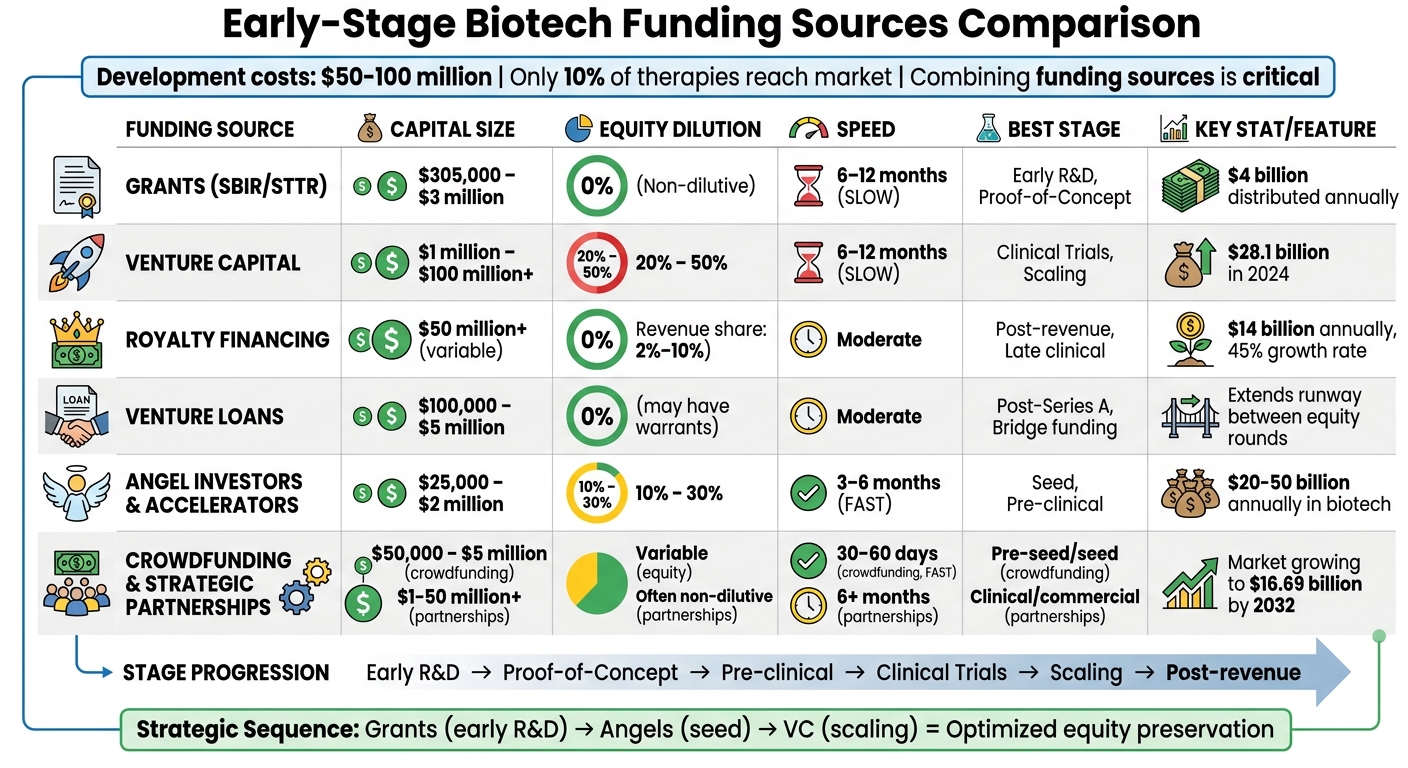
Biotech Startup Funding Sources Comparison: Capital, Equity, Speed & Stage
Grants provide a way to secure funding without giving up any ownership or control of your company. In the U.S., programs like SBIR and STTR collectively distribute more than $4 billion annually, with the NIH SEED program alone contributing approximately $1.3 billion in 2023 [6][10].
Federal grants operate in phases. SBIR Phase I funding typically ranges from $50,000 to $500,000 and supports feasibility studies lasting 6–12 months [10]. If successful, companies can move to Phase II, where funding increases to $750,000–$2 million or more, covering full R&D and prototyping for up to two years [10]. Private foundation grants, on the other hand, vary widely, offering anywhere from $10,000 to over $500,000 depending on the specific disease focus and foundation goals [7].
One of the biggest advantages of grants is that they don’t dilute equity - your cap table stays intact. This is a stark contrast to venture capital, where founders often give up 15%–25% of their company [8]. Beyond the financial benefits, receiving a grant like one from the NIH can serve as a badge of credibility, potentially increasing your company’s valuation when you pursue equity funding later [6][9]. Elizabeth Smith from Fzata aptly describes the program:
I consider this federal grant program to be the largest public venture capital initiative [2].
The grant funding process requires patience. Writing a proposal typically takes 60–90 days, followed by a peer review period of 3–6 months [10]. For funding, Phase I awards take 6–12 months, while Phase II awards may take 12–24 months. While this timeline doesn’t work for urgent funding needs, it aligns well with long-term strategic planning.
Grants are particularly suited for preclinical and early-stage R&D. At these stages, technical risks are higher, and private investors may hesitate to commit. First-time applicants for SBIR Phase I grants have a success rate of 15%–25%, but securing Phase I funding improves the odds of winning Phase II funding to 40%–50% [10]. These funds are invaluable for generating preclinical data, which can make a company more attractive to investors in future funding rounds [2]. For early-stage biotech companies, grants offer a way to fund high-risk R&D while minimizing financial exposure.
Venture capital plays a major role in driving growth-stage biotech startups. These firms typically invest starting at $1 million, with later rounds often exceeding $100 million [11]. In 2024, biotech VC funding hit $28.1 billion, a jump from $21.2 billion in 2023, with the total deal value projected to reach $109.6 billion by 2025 [11]. These numbers highlight the immense financial requirements of drug development, where bringing a single therapeutic to market can cost anywhere from $50 million to over $100 million [5]. Unlike non-dilutive funding, venture capital focuses on rapid scalability through substantial financial backing.
Venture capital usually comes into play during Series A or B rounds, after a startup has demonstrated proof of concept or early clinical data [11]. Series A rounds typically range from $10 million to $25 million [3], offering the resources needed for Phase I and Phase II trials. For instance, AusperBio raised $73 million in a Series B round in 2025 to advance its lead asset, AHB-137, into Phase II trials. Similarly, Ottimo Pharma secured over $140 million in a Series A round to develop its bifunctional antibody [11].
In return for their investments, venture capitalists often acquire a significant equity stake - usually between 20% and 50% - along with board seats and veto rights [11][2]. Carter Caldwell from Penn Medicine's Co-Investment Program explains:
In biotech, capital follows leadership. Without a credible, experienced team, it is very difficult to attract institutional capital [12].
However, founders giving up 40% equity early on may find themselves holding just 10%–15% by the time of an IPO [5].
Securing VC funding now involves a more rigorous process, with due diligence taking 6–9 months as firms scrutinize regulatory and commercial strategies [12]. While this slows the timeline, it ensures that the funding is aligned with long-term goals. As David H. Crean from Cardiff Advisory points out:
The biggest mistake I see founders make is treating each funding round as a discrete event rather than a continuous narrative. The story you tell at seed has to be architected to survive phase two data even if the science pivots [12].
Venture capitalists generally prefer clinical-stage companies that have de-risked assets and milestones such as IND acceptance, first-patient dosing, and large addressable populations (over 100,000) [11][3]. Therapeutics developed by experienced, serial founders show 2.3 times higher success rates in Phase II compared to those from first-time teams [3]. Timing fundraising efforts around key milestones - like IND clearance or positive Phase I results - can boost valuation while reducing equity dilution [5].
Royalty financing stands out as a non-dilutive funding option for companies with strong clinical data. Instead of giving up equity, companies agree to share a percentage of future product sales or licensing revenue with investors. This type of financing has grown significantly, now generating around $14 billion annually, with a rapid growth rate of 45% per year [13]. A notable example is Nanobiotix, which, in November 2025, secured a $50 million upfront payment through a royalty financing deal with HCRx, providing much-needed capital without diluting ownership [13].
Royalty financing can provide substantial upfront funding, often exceeding $50 million, especially for assets with promising clinical potential [13]. This funding mechanism is particularly well-suited for biotechs that have solid clinical data, a clear commercialization strategy, or partnered assets. It's increasingly being used for Phase II or III trials, where pivotal milestones are within reach [13].
One of the biggest advantages of royalty financing is that it avoids equity dilution. Founders can maintain full ownership and control of their companies, sidestepping the significant ownership losses often associated with venture capital. A Deloitte survey revealed that 55% of biopharma leaders are showing more interest in royalty funding due to its non-dilutive nature, and 75% of executives plan to use it alongside traditional equity or debt [14]. A biotech CFO succinctly put it:
Royalty funding will always be part of the equation … it will be considered at par with equity in the future. [14]
This approach offers a distinct advantage over traditional equity funding, making it an attractive option for companies at the right stage of development.
Royalty financing is best suited for late-stage biotechs or companies with partnered assets that have a clear path to generating revenue. Investors typically look for well-defined clinical milestones and regulatory approvals to reduce risk, which makes this option less practical for early-stage or preclinical companies. However, companies must carefully model their projected revenue streams because royalty obligations can hurt long-term profitability if a product fails to meet expectations [13]. Sagar Agrawal of Qubit Capital highlights this balance:
The line between smart and dangerous here is all about discipline: matching structure to stage, aligning repayments with real inflection points, and protecting your IP. [13]
Venture loans, also known as venture debt, offer a financing option that sits between traditional equity funding and grants. These loans need to be repaid over time with interest, regardless of a company's future success. Unlike convertible notes, venture debt doesn’t automatically transform into equity [5]. It’s often used to fill financial gaps between larger equity rounds, making it a complementary option to earlier funding methods.
Venture loans are typically used to cover key expenses like clinical trials, purchasing equipment, or working capital when future revenue is expected. While loan amounts can vary, this type of funding is designed to extend a company’s financial runway without requiring another significant equity raise [5]. It provides breathing room for startups to focus on achieving critical milestones before seeking larger funding rounds.
One of the main advantages of venture debt is that it is mostly non-dilutive. However, lenders may request warrants, which could result in some minor dilution [5]. Compared to the substantial equity dilution that often comes with venture capital rounds, venture loans allow founders to maintain a larger share of ownership.
Venture loans are best suited for startups that have already completed a Series A funding round and secured institutional backing [6]. Lenders typically require proof of this support before offering venture debt. For early-stage or pre-Series A companies, this option is usually off the table unless they have significant institutional backing. Venture loans work effectively as a bridge between equity rounds, helping companies hit important scientific or regulatory milestones. After Series A, this form of financing pairs well with grants and royalty financing, offering a way to minimize equity dilution while preparing for the next major funding round.
Angel investors and accelerators play a crucial role in providing seed funding for biotech startups, bridging the gap between early development and larger institutional investments. They are often willing to take on high-risk, preclinical ventures [11]. Let’s break down their contributions in terms of capital, equity, and speed.
Individual angel investors typically invest amounts ranging from $25,000 to $250,000 per startup [11]. When angels band together in syndicates, their collective investments can grow to $50,000–$2 million [4][17]. For example, groups like Mass Medical Angels in Boston focus on life sciences and offer funding between $250,000 and $3 million, aiming for a 5× return within five years [18].
Accelerators, on the other hand, generally provide funding between $25,000 and $500,000 in exchange for equity. Notable examples include Y Combinator, which offers $500,000 for 7% equity (as of 2025), and Techstars Healthcare, which provides $220,000 for 6% equity [4]. On an annual basis, angel investment in biotech is estimated at $20 billion to $50 billion, far surpassing the $3–$5 billion contributed by venture capital at similar stages [17].
Angel investors typically take an equity stake between 10% and 25%, while accelerators usually secure 6% to 7% in exchange for their funding [4][11]. This level of equity dilution is often more favorable compared to venture capital firms, which may require 20% to 50% ownership [11]. Interestingly, while life science deals make up only 12% of total angel deal volume, they account for 23% of angel capital deployed. This reflects the larger check sizes and longer investment horizons often associated with biotech ventures [3].
Angel investors generally take 3–6 months to make funding decisions [4]. Accelerators, however, operate on fixed 3–6 month programs that combine funding with mentorship, lab access, and networking opportunities with investors [4]. This faster timeline can appeal to founders who need quicker access to capital compared to the 6–12 months typically required for venture capital or government grants.
Angels and accelerators are particularly effective at the pre-seed and seed stages. They help fund critical early-stage activities like R&D, intellectual property development, proof-of-concept studies, and IND-enabling research [3][11]. Beyond money, they often provide mentorship from industry professionals, such as former medtech executives or practicing physicians who bring deep knowledge of clinical workflows and regulatory landscapes [4].
However, their funding usually isn’t sufficient for the high costs associated with Phase II or III trials. At that point, startups typically transition to venture capital for additional financing [11]. Notably, during 2022–2023, life sciences accounted for one-third of all angel deals, even surpassing enterprise software in deal volume [17]. This early-stage support is essential for setting the stage for future funding rounds and long-term growth.
Crowdfunding and strategic partnerships offer biotech startups two distinct avenues for securing funding, each with its own set of opportunities and challenges. Crowdfunding opens the door to small-scale investors, making funding more accessible, while strategic partnerships connect startups with established pharmaceutical or healthcare companies seeking compatible technologies. Here's a closer look at how these models stack up.
Crowdfunding campaigns typically raise anywhere from $50,000 to $1 million, with some equity-based efforts reaching as high as $5 million under SEC Regulation Crowdfunding limits. The global medical crowdfunding market is also on the rise, projected to grow from $6.92 billion in 2025 to $16.69 billion by 2032, reflecting a 13.4% annual growth rate [4][1].
On the other hand, strategic partnerships provide access to much larger funding pools. These deals often range from $1 million to over $50 million, delivered through upfront payments, milestone rewards, and research funding [4][1]. For instance, in March 2025, Syneron Bio secured a partnership with AstraZeneca worth up to $3.4 billion to develop treatments for oncology and other diseases using AI technology [15]. Similarly, AirNexis Therapeutics received $40 million from Haisco Pharmaceutical Group in January 2026, alongside a 20% equity stake [15].
Crowdfunding involves equity dilution, as startups must distribute shares among a large pool of small investors. Platforms may also impose service fees or take a portion of the ownership [4][5]. Individual investors are limited by SEC rules, with caps based on income or net worth - typically the greater of $2,200 or 5% of their income/net worth [1].
Strategic partnerships, in contrast, often provide non-dilutive funding through licensing agreements or joint development deals. These arrangements focus on milestone payments and royalties rather than equity. However, some partnerships do include equity stakes. For example, the AirNexis-Haisco deal included a 20% equity position, and Gilgamesh Pharmaceuticals secured a $1.2 billion licensing deal with AbbVie while spinning off other programs into a separate entity [15].
"A new platform may be needed to enable development of modalities, such as cell and gene therapies. This is where companies can benefit from having strategic collaborations to help de-risk and accelerate innovation." - Ronak Savla, Director of Strategic Ventures, Catalent Pharma Solutions [16]
Crowdfunding campaigns are relatively fast, typically requiring 3–6 months of preparation followed by a 30–60 day campaign. While faster than traditional venture capital processes, these campaigns demand significant effort to manage [4].
Strategic partnerships, on the other hand, take longer to finalize. Negotiations often extend beyond six months, reflecting the complexity of these arrangements [4].
Crowdfunding is ideal for startups in their pre-seed or seed stages, especially for consumer-focused medical devices with strong public appeal. It’s particularly useful for early R&D, proof-of-concept development, and IP creation when institutional investors may still be hesitant. However, startups must comply with FDA regulations, avoiding pre-sales of unapproved Class II+ devices [4][11].
Strategic partnerships are better suited for startups in the clinical or commercialization stages. These deals typically involve companies with established IP and early-stage data demonstrating feasibility. Beyond funding, strategic partnerships offer additional benefits like access to sales networks, manufacturing resources, and regulatory support, which help accelerate market entry [4][5].
Many biotech startups now adopt a phased approach: using grants to validate their science, bridging funding gaps with crowdfunding or angel investors, and scaling with strategic partnerships once they’re ready for clinical trials or commercialization [4][11].
| Feature | Crowdfunding | Strategic Partnerships |
|---|---|---|
| Capital Size | $50,000 – $5 million [4] | $1 million – $50 million+ [4] |
| Equity Dilution | Dilutive (equity ownership) [4] | Often non-dilutive (licensing/joint development) [4][2] |
| Speed | 3–6 months preparation; 30–60 day campaign [4] | Slow; lengthy negotiation processes [4] |
| Primary Benefit | Market validation and community feedback [4] | Market access, regulatory expertise, and scale [4] |
| Stage Suitability | Pre-seed/seed; consumer-oriented products [4] | Clinical/commercial stage; complementary tech [4] |
For biotech founders, choosing between these funding strategies depends on your current stage, capital needs, and long-term goals. Balancing these factors is critical to achieving growth while preserving equity.
Here’s a breakdown of six funding sources, comparing them based on factors like capital size, equity dilution, funding speed, and suitability for different stages of development.
| Funding Source | Capital Size | Equity Dilution | Speed of Funding | Stage Suitability |
|---|---|---|---|---|
| Grants | $305,000 – $3 million [4] | 0% (Non-dilutive) [19] | Slow (6–12 months) [4] | Early R&D, Proof-of-Concept |
| Venture Capital | $1 million – $100 million+ [4] | 20% – 50% [11] | Slow (6–12 months) [4] | Clinical Trials, Scaling |
| Royalty Financing | Variable | 0% (Revenue share: 2%–10%) [4] | Moderate | Post-revenue |
| Venture Loans | $100,000 – $5 million [4] | 0% (may have warrants) [5] | Moderate | Post-revenue, Bridge |
| Angel Investors | $25,000 – $2 million [4] | 10% – 30% [11] | Fast (3–6 months) [4] | Seed, Pre-clinical |
| Crowdfunding | $50,000 – $5 million [4] | Variable (Equity) [4] | Fast (30–60 days) [4] | Consumer-oriented, Early |
This table shows the trade-offs of each funding option, which can help guide your decision-making.
Grants are an excellent source of non-dilutive funding, but the process can be lengthy - often taking 6 to 12 months. They’re ideal for early research and proof-of-concept stages. Venture capital, on the other hand, offers large sums for scaling and clinical trials, though it comes with significant equity dilution, often between 20% and 50% [11].
For quicker funding with less equity dilution, angel investors are a strong option. They’re particularly suited for seed and pre-clinical stages, with decisions typically made within 3 to 6 months [11]. Crowdfunding is another fast alternative, often completed in 30 to 60 days, and is especially useful for consumer-focused products [4].
If preserving equity is a priority, royalty financing and venture loans are worth considering. Royalty financing involves revenue sharing (usually 2%–10%), while venture loans may require collateral or warrants. Both are better suited for post-revenue stages [4][5].
Many biotech startups use a combination of these funding sources over time. For example, they might start with grants to validate their science, turn to angel investors for bridging gaps, and then rely on venture capital to scale once clinical data demonstrates reduced risk [4][2]. As Vaibhav Totuka of Qubit Capital explains:
The biotech angel vs VC decision is not about who writes the bigger check. It is about stage, risk tolerance, scientific depth, and control [11].
Each funding source - grants, angel investment, and venture capital - offers distinct benefits that, when used in the right order, can help startups optimize funding while protecting equity. Carefully planning the sequence of these funding sources is key to balancing risk and ownership as a company grows.
Non-dilutive grants, like SBIR and STTR, are perfect for early-stage R&D and proof-of-concept work. Angel investors come into play next, providing flexible funding with moderate equity dilution, typically ranging from 10% to 30%. When companies reach the clinical development phase, where capital needs are higher, venture capital becomes essential, although it often involves greater equity dilution - around 20% to 50% [11]. By starting with grants, moving to angel funding, and saving venture capital for later stages when clinical data reduces risk, companies can boost their valuation and maintain more ownership [2][4].
For technology platforms capable of producing multiple therapies, early funding rounds in 2025-2026 are trending larger compared to single-asset companies [5]. Combining various funding sources at the right milestones is critical for managing both risk and equity.
Timing matters just as much as the funding source. Securing capital around major value inflection points - like IND clearance or Phase I safety results - can maximize valuation. It’s also wise to maintain at least 24 months of runway, as clinical trials come with fixed costs that can’t easily be paused during economic downturns [5][3]. Securing FDA designations, such as Orphan Drug or Breakthrough Therapy, can further attract investors and boost a company’s appeal [3].
The biotech funding landscape for 2025-2026 is expanding, with venture capital in the sector reaching $28.1 billion in 2024 and healthcare now making up 32% of all VC investments [11][4]. Success lies in pairing the right funding source with your company’s stage and forming partnerships with investors who offer both capital and industry expertise.
When a biotech startup finds that grants can no longer cover its expanding capital needs or when it needs to scale quickly, it’s time to consider equity funding. Grants work well in the early stages, such as during proof-of-concept development. However, as the company moves closer to clinical trials and commercialization, equity funding becomes a more practical option. Making this transition at the right moment provides access to larger funding sources and strategic partnerships, all while helping to avoid unnecessary early dilution of ownership.
Founders can protect their ownership by negotiating better deal terms, staying informed about market norms, and avoiding giving away equity unnecessarily. Exploring non-dilutive funding options - like grants, tax credits, or government programs - can also help maintain control. The key lies in strategic planning: understanding your company's valuation and ensuring funding terms are fair across every round.
Investors often step in to fund early-stage biotech companies once they hit certain critical milestones. These milestones typically include achieving proof-of-concept or validating the scientific idea, which is usually demonstrated through preclinical studies or early experimental results.
Having a skilled and experienced team in place, along with a well-defined scientific and commercial strategy, is equally important. Additionally, securing grants or other forms of non-dilutive funding, as well as meeting regulatory or technical benchmarks like preclinical safety studies, can significantly enhance investor confidence.