Published on
April 2, 2026

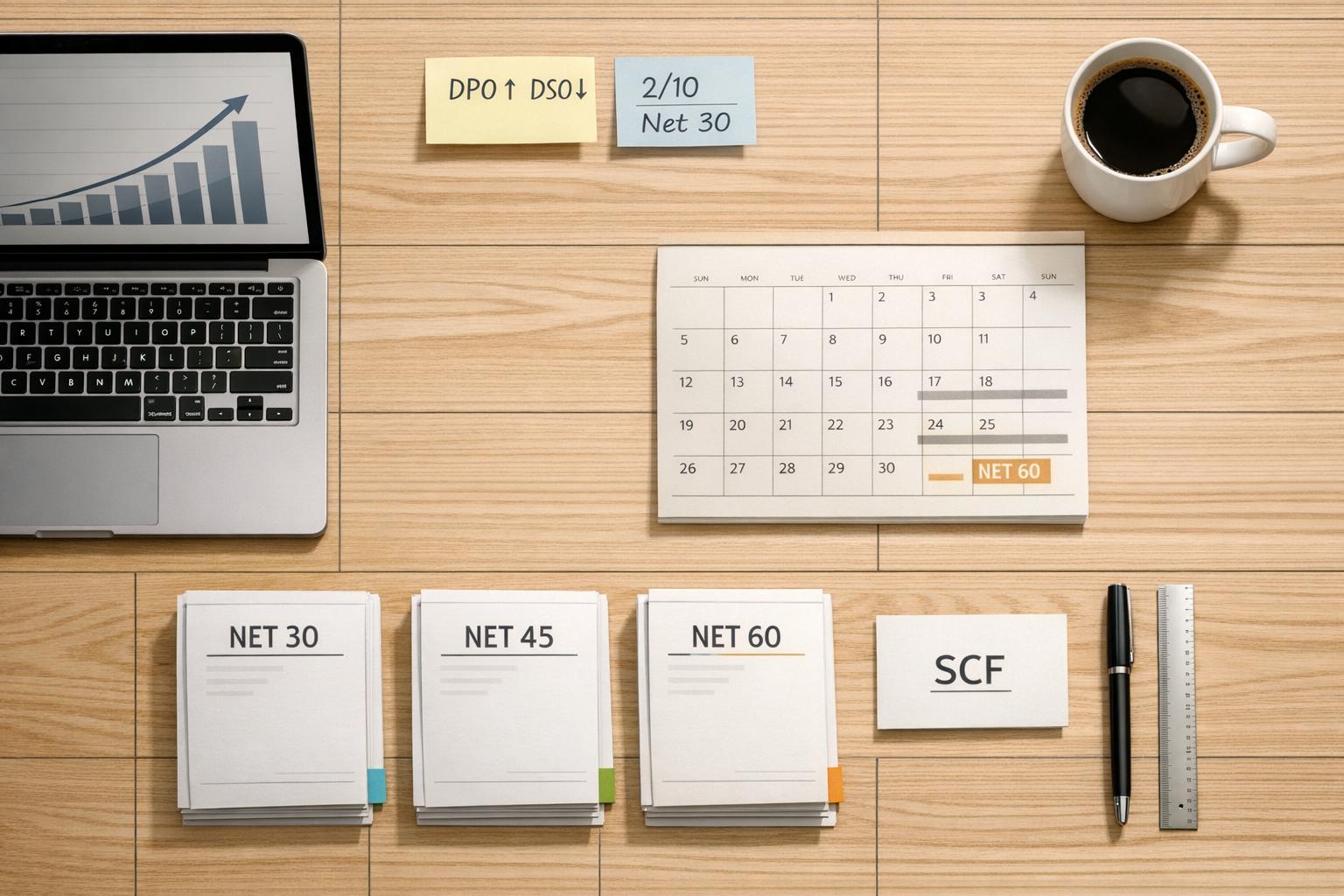
Optimizing supplier payment terms is a powerful way to improve cash flow without relying on external financing. By extending payment terms, tracking key metrics like Days Payable Outstanding (DPO), and leveraging tools like dynamic discounting and supply chain finance, businesses can maintain liquidity, support growth, and strengthen supplier relationships.
Key takeaways:

5-Step Supplier Payment Terms Optimization Framework
Supplier payment terms define the conditions under which you pay a seller for goods or services. These terms determine when money leaves your business, directly influencing your cash flow. As Paystand explains, "Setting your payment terms means you set the cash life cycle." Common examples include Net-30 and Net-60, where payments are due 30 or 60 days after the invoice date. Other terms you might encounter are:
Some suppliers also offer early payment discounts, such as a 2% reduction if you pay within 7–10 days, encouraging quicker payments. Payment terms often vary by industry. For instance, agriculture businesses usually expect payment within 0–3 days, construction companies may operate on 30–90 day terms, and large enterprises can take up to 60–90 days to settle invoices [3].
Understanding these terms is essential for managing your cash flow effectively. They serve as the foundation for analyzing financial metrics, which provide insights into your company's financial health.
Once your payment terms are clear, it’s time to monitor key financial metrics like Days Payable Outstanding (DPO) and Days Sales Outstanding (DSO). These metrics help you measure how well your business is managing cash flow.
By analyzing DSO alongside DPO, you can ensure a healthy cash flow balance and avoid liquidity problems. Together, these metrics form your Cash Conversion Cycle - a measure of how efficiently your company converts investments into cash.
Tracking these metrics doesn’t just provide a snapshot of your financial health. It also equips you with the insights needed to refine your payment terms and improve cash flow management in the future.
Not all suppliers require the same payment approach. Start by categorizing them using the Kraljic Matrix, which organizes suppliers into four categories: Strategic, Leverage, Bottleneck, and Non-critical. For example, strategic suppliers are those providing essential, hard-to-replace goods or services, while non-critical ones handle more commoditized products with less impact on your operations.
Another useful approach is the Pareto Principle: 20% of your suppliers likely account for 80% of your spending. By focusing on this smaller group of high-impact vendors, you can make meaningful improvements to your working capital.
Also, compare your cost of capital with that of your suppliers. If your business enjoys lower interest rates than a smaller supplier, you can negotiate extended payment terms or explore supply chain finance options that benefit both sides. This kind of analysis provides a solid foundation for informed, effective negotiations.
With these insights, you’ll be ready to move toward agreements that support both your business and your suppliers.
Once you've segmented and prioritized your suppliers, the next step is negotiating terms that work for everyone involved. Preparation is key here, and it starts with gathering data. Research your suppliers' financial health and market position using tools like LinkedIn, company websites, or industry reports. Keep an eye on real-time developments like leadership changes, growth announcements, or shifts in their market - these can create opportunities for productive discussions.
Avoid generic negotiation tactics. Tailor your proposals to highlight mutual benefits. For instance, you could explain how better cash flexibility on your end might result in larger or more consistent orders for the supplier. As Sievo puts it:
Optimizing payment terms is the most direct way to increase working capital [1].
Additionally, standardize terms across various locations or departments for the same supplier. This not only lowers administrative costs but also strengthens your negotiation leverage [1].
Early payment discounts, like the common 2/10 Net 30 (offering a 2% discount for payments made within 10 days, with the full amount due in 30 days), can be a great way to improve cash flow while fostering goodwill with suppliers. To take advantage of these, though, you’ll need precise cash flow forecasting to ensure you have enough liquidity without disrupting daily operations [4].
Target these discounts toward high-value vendors where the savings will have the most impact. For smaller, non-strategic suppliers, consider using corporate cards to earn volume-based rebates, aligning with the 10/90 rule [2]. Automating processes like electronic workflows and digitized invoicing can also help you capture discounts before they expire, reducing approval delays [1][4].
For even more flexibility, look into dynamic discounting programs. These allow suppliers to discount their invoices for earlier payment based on your cash position. This approach transforms payment negotiations into a win-win scenario, leveraging interest rate differences to lower the supplier’s financing costs while extending your Days Payable Outstanding (DPO) [2].
Once you've streamlined basic payment processes, methods like dynamic discounting and supply chain finance (SCF) can take cash flow management to the next level. Dynamic discounting builds on the concept of early payment discounts but introduces a flexible, sliding scale. The closer the payment is to the invoice due date, the smaller the discount offered. For instance, a supplier could receive a 3% discount for immediate payment, 2% for payment 45 days early, and 1% for payment 30 days early [5].
The primary distinction between these two methods lies in their funding sources. Dynamic discounting relies on your company's surplus cash, while SCF uses third-party financing. This allows suppliers to access early payments without shortening your payment terms [5][7]. Antonio Berga, Co-Founder and Co-CEO of Embat, explains:
"SCF and dynamic discounting are financial tools designed to integrate payment management with supply chain financing, enabling organisations to optimise cash flow and strengthen supplier relationships." [5]
Take the example of TechWare, a UK-based consumer electronics company. In January 2025, they adopted both SCF and dynamic discounting to manage relationships with international suppliers. By applying 60-day terms alongside a sliding discount scale (3% for immediate payment, 2% for 45 days early, and 1% for 30 days early), TechWare kept production costs low while ensuring their medium-sized suppliers had sufficient liquidity. This strategy is especially beneficial for smaller suppliers that often struggle with extended payment cycles.
If you’re considering these methods, start by evaluating whether your company has excess liquidity to fund dynamic discounting or if SCF, with its third-party financing, is a better fit. Use a platform that integrates seamlessly with your ERP system to automate discount calculations and clearly communicate the benefits to your suppliers - like better cash flow and reduced reliance on costly financing [5][6]. Regularly track supplier participation to fine-tune your approach.
After rolling out advanced discounting techniques, it's a good idea to audit your existing payment terms to uncover additional areas for improvement. This process can identify inefficiencies or missed opportunities. Procurement analytics software is particularly useful here, as it can analyze invoice data and highlight unusual payment patterns or areas for optimization at the category and supplier levels [1]. Michelle Golembieski, Executive Director of Corporate Treasury Consulting at J.P. Morgan, observes:
"We see companies building complex technology ecosystems to gain working capital efficiencies because their existing systems can't accomplish what they need." [4]
To gauge how your payment terms compare with others in your industry, benchmark your Days Payable Outstanding (DPO) against public competitors by reviewing their quarterly and annual reports. Simulating shifts in payment terms - such as moving from Net 30 to Net 60 - can help model potential gains. For example, one scenario showed that extending DPO by 15 days resulted in a $175 million cash flow improvement, while a 30-day extension delivered $348 million [2]. These figures can help persuade internal stakeholders of the value of optimization.
During the audit, look for opportunities to harmonize terms with strategic suppliers. Often, the same supplier may have different payment terms across various locations or departments, which can lead to inefficiencies. Standardizing these terms can simplify processes and improve cash flow [1]. Focus your efforts on high-impact suppliers - those that account for roughly 80% of your total spend but only 20% of payment volume [2].
Finally, ensure your master data is accurate. Errors in payment terms or overlooked rebates can result in lost savings, so standardized and accurate data entry is essential [1].
To ensure your optimization efforts are paying off, keep a close eye on a few key performance indicators (KPIs). One of the most important is Days Payable Outstanding (DPO), which tracks how long your company takes to pay suppliers. Compare your DPO to the industry standard of 30–45 days to see how you stack up [8].
Another critical metric is your Cash Discount Utilization Rate - this shows how effectively you're taking advantage of early payment discounts. Streamlined workflows can help you capture terms like "2% net 10", improving your savings [8]. Aim for a 95%+ Payment Compliance Rate with strategic suppliers to maintain strong relationships and avoid penalties [8]. On top of that, monitor your Cost per Invoice, which includes administrative and transaction costs, to confirm that automation is lightening your workload and cutting expenses [9].
Tacto Technology GmbH puts it best:
Key Performance Indicators (KPIs) are the lifeblood of your Accounts Payable (AP) department... they are the pulse that monitors the health of your AP operations [10].
These KPIs not only measure efficiency but also pinpoint areas that need improvement. For example, optimizing payment terms can boost liquidity by 15–25%, while automation can slash invoice processing times by up to 70% [8]. By focusing on these metrics, you set the stage for continual improvement.
KPIs are only useful if you act on them. Use the data to refine your payment strategies as market conditions and supplier needs evolve. Payment term optimization isn't a one-and-done deal - it requires regular reviews. With the cash flow benefits from optimized terms, plan quarterly evaluations to adjust based on performance data and trends [8].
To make smarter decisions, consider using procurement analytics tools to test "what-if" scenarios. For instance, simulate the cash flow impact of moving from Net 30 to Net 60 terms before making any changes [1].
Supplier segmentation also needs regular updates to reflect shifting priorities. Real-time analytics can help you align supplier conditions with your cash flow strategies. AI-powered tools, for example, can analyze payment patterns and liquidity in real time, identifying the best opportunities to renegotiate terms or offer early payments [8]. This approach ensures that while improving your payment terms, you’re also maintaining supplier relationships and stability.
Optimizing these metrics often requires the oversight of a full stack finance team to ensure long-term stability.
Optimizing payment terms isn’t just a financial adjustment - it’s a strategic move that transforms accounts payable into a powerful cash flow tool. By carefully extending your Days Payable Outstanding (DPO), you can unlock working capital that fuels production, supports market growth, and funds strategic initiatives - all without leaning on external financing. Even small shifts in DPO can lead to meaningful liquidity gains, giving your business the flexibility it needs to thrive.
But success here is about balance. As Erkki Seikkanen, Campaign Manager at Sievo, explains:
"Optimizing cash flows is a give-and-take process that is never finished. However, the more you can free up cash, the more you will produce, the higher your profits, and the more contingent business you will have" [1].
This balance comes from a mix of targeted strategies. For instance, focusing on high-impact suppliers during negotiations while streamlining routine transactions with efficient payment methods keeps operations smooth. Programs like Supply Chain Finance and dynamic discounting offer a win-win approach - they extend your payment terms while reducing suppliers' financing costs, strengthening relationships instead of straining them. To put it into perspective, a standard 2% discount for payment within 10 days (on Net 30 terms) translates to an annual interest rate of roughly 36% [8], showcasing the financial value of these strategies.
The role of technology in this process cannot be overstated. Digital workflows can cut processing times by up to 70% [8], freeing up teams to focus on strategic tasks like negotiations. Pair this with AI-driven analytics that pinpoint real-time opportunities for renegotiation, and you’ve got a system that adapts to both market shifts and supplier needs.
Cross-functional collaboration is the final piece of the puzzle. Treasury, Finance, Procurement, and Technology teams must work together to ensure ongoing reviews, industry benchmarking, and strong payment compliance - aiming for at least 95% with key partners [8]. The payoff? Optimized payment terms can improve liquidity by 15–25% [8], providing the cash needed to fuel growth and secure a competitive edge.
Phoenix Strategy Group turns fractional CFO services into a strategic tool for optimizing working capital. With experience supporting over 200 clients [11], they use their expertise to forecast cash flow and design payment strategies that help businesses get the most out of their working capital.
The team focuses on essential metrics like Days Payable Outstanding (DPO), aiming for the industry standard of 30–45 days [8], while carefully balancing cash flow needs with maintaining strong supplier relationships. Their AI-powered FP&A tool, Dear CFO, integrates seamlessly with platforms like QuickBooks, CRM systems, and Google Analytics. It provides deep insights, runs "what-if" scenarios, and identifies opportunities to fine-tune payment terms. Ethan Lu from Phoenix Strategy Group describes its capabilities:
"We're rolling out Dear CFO: AI FP&A copilot... It can analyze financials and marketing, forecasts, cut costs, and create valuation reports and board presentations - all while integrating with tools like QuickBooks, CRM, Google Analytics, etc." [11].
By combining real-time analytics with strategic financial planning, Phoenix Strategy Group ensures your cash flow management remains aligned with your business goals and supplier partnerships.
Building on their financial expertise, Phoenix Strategy Group develops tailored growth plans designed to fit your business model. They use advanced data engineering to create personalized working capital strategies, including supplier segmentation and staggered payment schedules that balance discounts with supplier priorities.
Their AI tools analyze payment trends and supplier risks in real time, uncovering opportunities to negotiate better terms or capitalize on discounts. Automated payment workflows, which can reduce invoice processing times by up to 70% [8], give your team more time to focus on high-level negotiations. For businesses exploring advanced financing options, they offer solutions like Supply Chain Finance and dynamic discounting models. These strategies allow suppliers to access early payments while enabling you to extend payment terms - strengthening supplier relationships without putting a strain on cash flow.
Extending payment terms can put suppliers in a tough spot, especially if it disrupts their cash flow or threatens their financial stability. To avoid creating unnecessary strain, it's important to evaluate whether they can manage longer payment terms without significant hardship. Equally crucial is maintaining open and honest communication throughout the process. This approach helps protect the business relationship and ensures both parties are on the same page when it comes to financial expectations.
When you're looking to offer early payment discounts to suppliers and have extra cash on hand, dynamic discounting is a great tool. It not only helps improve cash flow for suppliers but also strengthens your partnership with them.
On the other hand, supply chain finance (SCF) is ideal if your goal is to extend payment terms without putting a strain on your suppliers' cash flow. SCF allows suppliers to access early payments through financing options, making it a useful strategy for managing liquidity and optimizing working capital on a larger scale.
The fastest way to spot payment term issues in your accounts payable (AP) data is by using automated analysis tools. These tools can instantly identify problems such as duplicate payments, incorrect invoices, or mismatched terms. Adding predictive analytics into the mix takes it a step further, helping you catch issues with even greater precision while cutting down on manual work. This makes managing AP data smoother and more efficient.