Published on
April 2, 2026

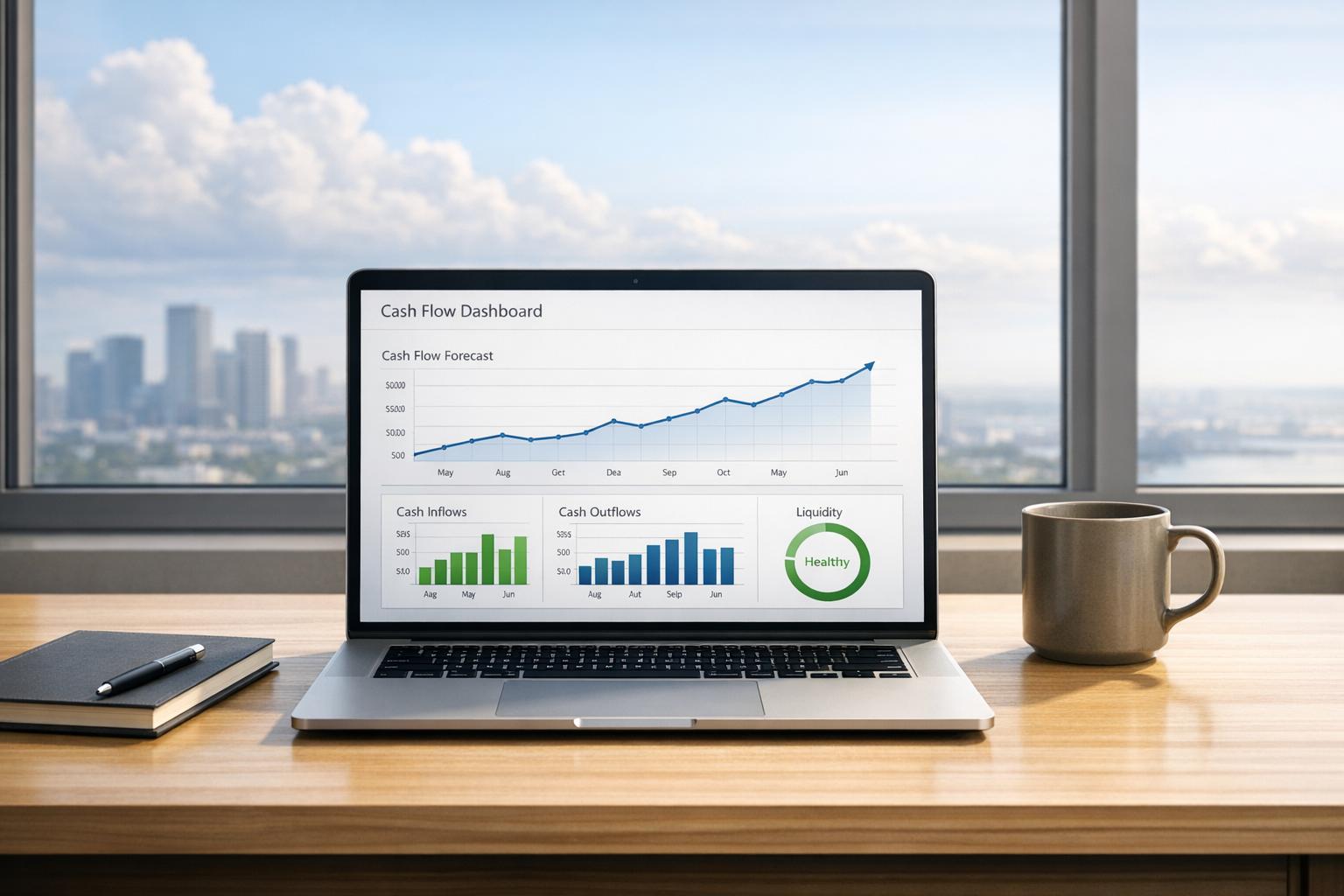
Cloud cash flow forecasting helps businesses replace error-prone spreadsheets with automated tools that use real-time data from accounting systems, bank accounts, and operational metrics. This shift improves accuracy, saves time, and enables faster decision-making. Companies using these platforms report a 25% boost in forecast accuracy and 30% faster decision-making.
Key takeaways:
For growth-stage companies, these tools simplify cash flow management, reduce risks, and support scaling efforts. Start by reconciling bank balances, collecting historical data, and involving key departments to build accurate forecasts. Regular updates and variance analysis are critical to maintaining reliability.
Growth-stage companies often find themselves in a tricky spot when it comes to cash flow. They're growing fast, which is exciting, but that same growth brings unpredictability. Traditional forecasting methods just can't keep up. Relying on manual CSV exports or copy-paste workflows can lead to errors and delays - right when accuracy matters most[4][6]. As revenue climbs and hiring ramps up, outdated data can cause serious problems, like missing payroll or delaying vendor payments.
The challenge gets even bigger when financial data is scattered across multiple bank accounts and entities. Consolidating all this information is a slow, tedious process that leaves room for liquidity risks to slip through the cracks. Instead of diving into strategic insights, finance teams end up spending their time reconciling accounts[4][6].
"Unless you can manage these micro issues [daily/weekly cash reports], confidence will be lacking when you try to plan on the macro scale." - Nigel Sapp, Numeric[4]
Another major hurdle is accounts receivable (AR). Many forecasts fail to account for how quickly AR collection rates drop over time. Current AR might have an 80–90% collection rate, but after 90 days, that number plummets to just 10–30%[4]. Spreadsheet-based forecasts often miss this reality, leading to overly rosy projections that don't reflect actual cash flow.
That's where cloud-based platforms come in. These tools pull real-time data from ERPs, accounting software, and banking APIs[5][6], giving companies an up-to-date picture of their cash position. And this isn't just about making life easier - improving forecast accuracy by 15% can boost pre-tax business performance by 3% or more[6]. For companies navigating funding rounds, big hires, or major investments, that level of precision can make all the difference. With a unified view of financial data, growth-stage companies can lay the groundwork for better forecasting and advanced scenario planning.

Short-Term vs Mid-Term Cash Flow Forecasting: Key Differences
Cloud-based cash flow platforms tackle common financial challenges by automating processes and improving accuracy. These platforms can reduce manual errors by up to 80% [7][8], freeing finance teams to focus on higher-level tasks. For mid-market companies, this shift can save 20–30 hours each week that would otherwise be spent managing spreadsheets [9].
Another advantage is real-time data synchronization, which ensures finance teams have access to the latest information. These platforms integrate with live bank feeds and ERP systems, updating data every few minutes [8][10]. This means that if a payment is delayed or an unexpected expense arises, teams can react immediately, adjusting spending plans as needed. Companies using this approach have seen a 25% drop in cash shortfalls [8][10].
Predictive analytics take forecasting to the next level. By using machine learning to analyze past trends and run "what-if" scenarios, these tools can increase forecast accuracy from 60% (manual methods) to 95% [7][11]. This level of precision is particularly helpful when presenting financial projections to investors or lenders.
For companies experiencing growth, scalability is key. Cloud platforms handle increased transaction volumes and complexity without requiring costly infrastructure upgrades. For example, a business scaling from $10 million to $100 million in revenue can continue using the same platform. These systems also support multi-entity consolidations and global operations, ensuring consistent reporting in US dollars ($USD) and MM/dd/yyyy date formats. This scalability supports flexible forecasting horizons, making these platforms a strong fit for growth-stage businesses.
Cloud platforms provide tailored forecasting options to meet both immediate and long-term financial needs.
Short-term forecasting (1–13 weeks) focuses on operational liquidity, ensuring there’s enough cash for payroll, vendor payments, and other immediate obligations. These forecasts are updated daily or weekly, maintaining an impressive 95% accuracy [12]. This is particularly important for companies with weekly cash burns of $100,000 or more. However, the trade-off is that short-term forecasts are more tactical and less useful for strategic planning.
Mid-term forecasting (3–12 months) shifts attention to strategic goals like capital expenditures, hiring, and funding rounds. Updated monthly or quarterly, these forecasts typically achieve 85% accuracy [12], as they rely on more assumptions about future conditions. They’re ideal for growth-stage companies projecting annual cash needs of $5 million or more. However, they are more sensitive to market fluctuations and changing business conditions.
| Aspect | Short-Term (1–13 Weeks) | Mid-Term (3–12 Months) |
|---|---|---|
| Use Cases | Daily liquidity, payables management | Strategic planning, funding, expansions |
| Frequency | Daily/Weekly | Monthly/Quarterly |
| Accuracy | High (95%) due to granular data | Moderate (85%) due to assumptions |
| Trade-offs | Tactical focus | Broader insights with higher uncertainty |
Many cloud platforms allow users to combine short- and mid-term forecasts into rolling forecasts. This gives businesses both the precision needed for daily operations and the broader perspective required for long-term planning [8][12].
At Phoenix Strategy Group, we leverage these advanced tools to help growth-stage companies scale effectively, secure funding, and navigate complex financial challenges.
Creating a cloud-based cash flow forecasting system involves selecting the right software, ensuring clean data, involving various departments, and identifying clear cash drivers. Interestingly, nearly 90% of treasurers in large companies describe their cash flow forecasting accuracy as "unsatisfactory" [13]. Yet, businesses that emphasize visibility across departments can achieve up to 90% accuracy on quarterly forecasts [15].
Start with reconciled bank balances. Using unreconciled accounts or manual CSV exports can lead to errors that snowball over time [4]. Your opening cash position should reflect verified balances - not estimates. To understand the true drivers of cash flow, gather input from teams like sales, procurement, and operations. Kevin Briscoe, Managing Partner at CFO Selections, underscores this point:
"Your output is only going to be as effective as your input" [13].
It’s also crucial to differentiate between cash and revenue. Revenue tracks when a sale is recorded, but cash flow measures when money actually moves. For instance, a sale might be recorded in one period but not convert to cash until later, often causing cash flow targets to fall short [15].
In August 2024, a national health services company partnered with EY-Parthenon to create a model connecting operational teams with cash forecasting. The result? Variances reduced by $450–$535 million, allowing for smarter borrowing and fewer surprises [15]. Assigning accountability for forecast variances to specific individuals can also help build a strong "cash culture" within your organization.
To maintain accuracy over time, conduct variance analyses regularly. By comparing actual results to forecasts, you can refine assumptions and improve future projections [13][4].
Your forecasting timeframe should match your business goals. Short-term forecasts (1–13 weeks) focus on immediate needs like payroll and vendor payments. Mid-term forecasts (3–12 months) are better suited for planning initiatives like hiring or capital investments.
The method you choose matters, too. The direct method tracks actual cash transactions and is ideal for short-term precision. The indirect method starts with net income and adjusts for non-cash items, making it better for mid-term planning. Many companies combine both: using the direct method for liquidity management and the indirect method for long-term reporting. For added resilience, incorporate historical trends, market signals, and expert insights (e.g., the Delphi method) [4].
Once you’ve decided on your timeframe and method, collect historical data to guide your cash inflow projections.
Accurate inflow projections start with clean historical data. Gather 12–24 months of transaction history, focusing on accounts receivable (AR) aging, customer payment trends, and seasonal patterns. This data gives you a realistic view of customer behavior beyond basic invoicing dates.
When projecting inflows, assign collection probabilities to each AR aging bucket. For example, invoices aged 0–30 days might have an 80–90% collection probability, while those over 90 days might drop to 10–30% [4]. Here’s an example:
| AR Aging Bucket | Probability Collected | Example Projection (on $200k Total) |
|---|---|---|
| Current (0–30 days) | 80–90% | ~$85,000 |
| 31–60 days | 50–70% | ~$30,000 |
| 61–90 days | 30–50% | ~$12,000 |
| 91+ days | 10–30% | ~$4,000 |
Using automated tools like bank feed integrations and ERP systems can streamline data updates and reduce manual errors, ensuring your projections stay accurate [4][15].
Once inflows are projected, move on to categorizing and scheduling outflows. Divide outflows into operating expenses (e.g., payroll, rent, subscriptions) and non-operating expenses (e.g., debt payments, equipment purchases, taxes). Operating expenses can often be modeled using historical data, while non-operating expenses may require scenario analysis due to their unpredictability [4].
Align vendor payment terms with forecast periods. For example, ensure tax payments are recorded in the correct timeframe rather than spread across periods.
To calculate net cash flow, subtract total outflows from total inflows for each period, then add this figure to your opening cash balance. If your ending cash position is negative, consider strategies like securing financing, delaying payments, or accelerating collections.
Cross-department communication is key. For example, sales teams might extend payment terms without consulting finance, creating blind spots in your forecast [13][15]. Regular meetings with department heads can help catch and address these issues early.
With inflow and outflow estimates in hand, create rolling forecasts that adapt to real-time changes. Unlike static forecasts, rolling forecasts are updated continuously, incorporating actual results and extending the horizon - such as updating a 13-week forecast weekly [4][14].
Scenario planning further enhances rolling forecasts. Develop at least three scenarios: a base case (most likely), a best case (optimistic), and a worst case (conservative). For example, your base case might assume an 80% AR collection rate, while the best and worst cases adjust for potential gains or setbacks.
In August 2024, a US retail company improved its data connectivity and operational forecasts, reducing its liquidity buffer and unlocking potential savings of up to $610 million [15]. Scenario planning like this can help leadership optimize working capital while maintaining liquidity.
Choose data buckets that align with your forecast horizon. For instance, daily buckets work well for weekly forecasts, while weekly buckets are sufficient for a 13-week forecast [4].
Real-time data integration keeps your forecasts up to date. By syncing live bank feeds and ERP systems with your cloud platform, you can automatically update forecasts as transactions occur. This minimizes manual input and reduces the risk of outdated or inaccurate information.
Modern cloud-based cash flow platforms are taking forecasting to a whole new level with AI-driven tools that refine liquidity management. Instead of relying on time-consuming manual spreadsheets, these platforms use automated APIs to pull and standardize data from multiple sources like ERPs, bank portals, CRMs, and payroll systems. Machine learning models then analyze historical payment patterns to predict timing more accurately, slashing forecast errors by roughly 15% [17].
Where older methods required days to model scenarios, today’s AI platforms can generate "what-if" analyses in just minutes. They also feature real-time anomaly detection to flag unusual cash movements or data mismatches, while automated variance analysis dives deeper into discrepancies, going beyond basic categorization [18]. Ameya Deshmukh explains the shift perfectly:
"The goal of cash flow forecasting AI is to replace heroic effort with a system that produces confidence - daily if needed - so the business can operate with more options" [16].
For instance, in March 2025, King's Hawaiian adopted DataRobot's AI-driven Cash Flow Forecasting App to handle fluctuations in grocery and retail channels. By combining AI insights with ERP data, they cut interest expenses by more than 20% and avoided funding gaps that had previously disrupted production. Advanced predictive techniques like gradient boosting and LSTM networks also enabled better management of seasonal and data variations [20].
Customizable dashboards further enhance control, allowing users to compare best-case, base-case, and worst-case scenarios. This is especially useful for planning hiring surges or inventory adjustments. Over half of finance teams plan to increase their AI investments, with embedded AI in cloud ERP systems expected to speed up the financial close process by about 30% by 2028 [17]. To ensure compliance, these platforms include features like role-based access, detailed change logs for every update, and human approval checkpoints for critical decisions. A good starting point is to establish a "Chart of Cash" - a structured taxonomy that organizes AR, AP, payroll, tax, and debt data consistently across systems [16].
These advancements not only improve forecasting accuracy but also give businesses the agility to respond quickly to financial challenges. For growth-stage companies eager to adopt these tools, Phoenix Strategy Group offers fractional CFO services to help integrate advanced cloud-based cash flow forecasting into your financial strategy, complementing the steps outlined in this guide.
Improving your cloud-based cash flow forecasting isn’t a one-and-done task - it’s a process that evolves over time. The foundation of any accurate forecast starts with a precise opening cash balance. This should always be reconciled using automated bank feeds to ensure every number aligns. As Nigel Sapp from Numeric emphasizes:
"Forecasts are only as good as their underlying data, making modern data tools invaluable for teams who want to deliver high-quality forecasts" [4].
Keeping your forecasts current is crucial. For example, refresh your 13-week forecast weekly. Replace outdated projections with actual results, analyze variances, and roll it forward by one week [4]. Adjust your timeframes as needed: use daily buckets for short-term decisions like payroll, weekly buckets for liquidity monitoring over three months, and monthly buckets for annual budgeting.
To refine near-term cash estimates, regularly update accounts receivable (AR) collection probabilities. Many growth-stage businesses use these benchmarks:
This method prevents overestimating cash inflows and flags potential collection issues early.
For a more dynamic forecast, blend multiple approaches. Start with a baseline using percent-of-sales or historical trends. Then, layer in inputs from sales, operations, and department leaders [4]. SaaS businesses, in particular, should account for factors like customer churn, net dollar retention, and upfront costs for growth - such as new laptops or software licenses for recently hired employees - since these expenses often precede revenue generation [19].
Variance analysis is an essential practice. By comparing forecasted numbers to actual results, you can uncover timing issues, structural shifts, or incorrect assumptions [4]. Jim Bullis, Head of Pre-Sales & Solutions at Cube, underscores its importance:
"More accurate cash forecasts lead to more accurate decisions for FP&A and the business" [19].
Modeling different scenarios - such as on-plan, above-plan, or below-plan - helps you anticipate changes in sales or customer payment behavior. Considering that poor cash flow forecasting is a top reason businesses fail [21], building flexibility into your forecasts is a must for navigating uncertain markets.
If you’re looking to take your forecasting to the next level, Phoenix Strategy Group offers advisory services that integrate advanced technology and real-time data to streamline and improve your cash flow processes. Learn more at Phoenix Strategy Group.
Cloud-based cash flow forecasting offers measurable advantages for mid-market companies. These include real-time visibility, which can cut cash shortages by up to 30%, and rolling forecasts with scenario planning, which improve accuracy. Additionally, advanced techniques can enhance forecast precision by 25–40% [1][22]. By adopting this approach, businesses can better position themselves for strategic growth, secure funding, and improve operational flexibility.
In practice, companies often see a 15–25% increase in cash flow accuracy and make decisions 20–50% faster within the first quarter of implementation [1][23]. To achieve these results, start by evaluating your current cash flow processes using the framework outlined here. Then, consider running a three-month rolling forecast trial to measure improvements in net cash flow metrics. Notably, around 70% of growth-stage firms report immediate ROI from such initiatives [2][3].
It’s important to regularly review and update your forecasting models. Experts suggest quarterly reviews to maintain accuracy above 90%. Without these updates, static forecasts have been linked to failure in as many as 40% of growth-stage companies [3][22].
For tailored support, Phoenix Strategy Group offers expert services to help growth-stage companies scale effectively, secure funding, and prepare for successful exits. Their specialties include fractional CFO services, FP&A systems, and data engineering. Ready to transform your cash flow management? Visit Phoenix Strategy Group to get started.
Selecting the right forecast horizon comes down to your financial goals and how your cash flow behaves. Here's a breakdown of options to consider:
Make sure the forecast timeline you choose works seamlessly with your liquidity management and decision-making processes.
To create real-time cash forecasting, you'll need to gather critical financial data. This includes details from accounts payable (AP), accounts receivable (AR), payroll, debt, and taxes. These components are essential for building accurate cash flow projections that align with your current financial position.
To turn scenario planning into something you can actually use, start by building cash flow models for three key scenarios: best-case, worst-case, and baseline. Use data that matters, make assumptions that are grounded in reality, and test your models against both historical trends and extreme situations. Keep these projections up-to-date by incorporating real-time data regularly. This method gives leaders a clear view of potential risks and opportunities, enabling them to make informed, forward-thinking decisions based on solid financial insights.