Published on
March 25, 2026


Urban areas are increasingly impacted by climate challenges like extreme weather, rising temperatures, and natural disasters. This has created a $1 trillion market opportunity across six key investment areas that address these challenges while offering financial returns. Here's a quick breakdown:
Investors can tap into these opportunities through public-private partnerships, infrastructure funds, and green bonds. Each $1 spent on pre-disaster mitigation saves up to $33 in future costs, making these areas both financially and socially impactful.
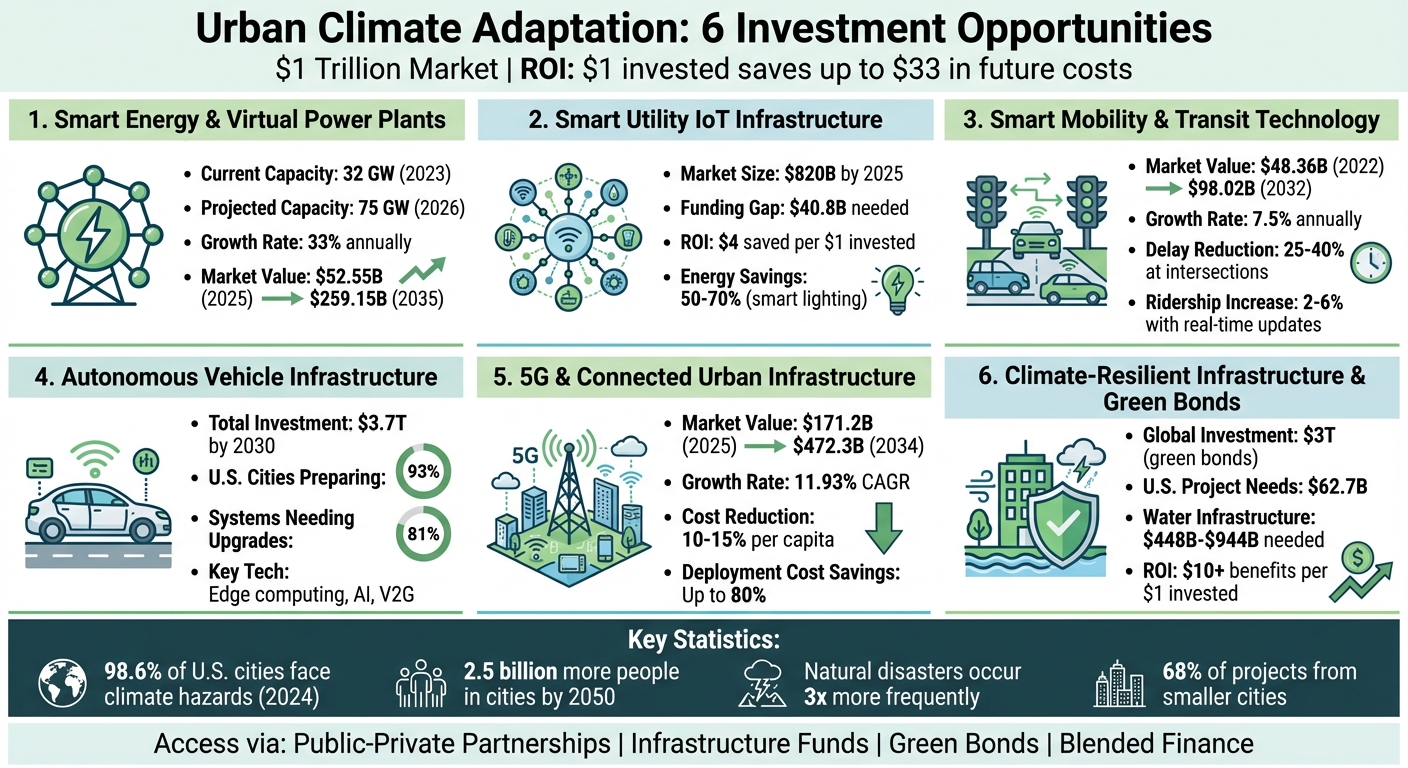
6 Urban Climate Adaptation Investment Opportunities Market Overview
Virtual Power Plants (VPPs) are transforming how urban grids handle increasing energy demands and climate challenges. By combining digital intelligence with distributed energy resources, VPPs help stabilize grids during extreme weather events. What started as experimental projects has now become a core part of energy infrastructure. Global VPP capacity is projected to rise from 32 GW in 2023 to 75 GW by 2026, representing a 33% annual growth rate. In the same year, annual revenues hit $6.4 billion, with over 640 active programs managing 8.5 million distributed energy assets [5]. This growth underscores the role of VPPs in addressing urban climate resilience and energy needs.
The smart grid market is on a rapid growth trajectory. It was valued at $52.55 billion in 2025 and is expected to surge to $259.15 billion by 2035, growing at a 17.30% annual rate [4]. Urbanization is a major driver, with 2.5 billion more people expected to live in cities by 2050. Current infrastructure simply can't keep up [6]. To address this, the focus has shifted from traditional hardware to advanced "Grid Edge Intelligence" - AI systems designed to predict and manage grid stress. For example, North America's Vehicle-to-Grid capacity reached 37.5 GW in 2024, using electric vehicles as portable power sources [4].
Significant funding is fueling these advancements. In October 2024, the U.S. Department of Energy allocated $4.2 billion to 46 projects aimed at modernizing the grid for climate resilience [4]. Siemens Energy also reported a record order backlog of €136 billion for fiscal year 2025, with its Grid Technologies division contributing €38 billion, a 32% increase from the previous year [4]. Falling battery costs are another game-changer, dropping by 40% in 2024 to around $150/kWh, making energy storage more affordable [8]. Additionally, institutional funds have $5–15 billion available for deployment in grid-related investments [6][8].
Regulatory changes and technological advancements are accelerating VPP adoption. One key development is FERC Order 2222, which became fully effective across all U.S. Independent System Operators in 2026. This order allows distributed energy resources - like residential solar panels and batteries - to participate directly in wholesale energy markets [5]. For example, in December 2024, Xcel Energy partnered with Itron to implement a Distributed Energy Resource Management System in Colorado, turning residential battery storage into a functional VPP [4]. Innovations like AI-driven bidding platforms, IoT-connected devices, and edge computing are also enabling real-time grid management [6].
VPPs earn revenue through revenue stacking, a strategy that combines multiple income streams. Residential participants typically earn $200–800 annually, while commercial operators can generate $15,000–60,000 per MW [5]. For instance, during California's 2024–2026 summer heatwaves, the Emergency Load Reduction Program enrolled 3,800 MW of capacity, achieving a 2,100 MW load reduction in September 2024. This cost $280/kW-year, a fraction of the $1,200/kW-year required for gas peaker plants [5]. Similarly, Lunar Energy raised $232 million in 2026 to manage 650 MW of distributed energy devices across multiple regions using its AI-powered Gridshare platform [10]. Australia's Hornsdale Power Reserve, a 150 MW / 194 MWh battery system, earned $29 million in its first year from frequency services, recovering its full capital costs in just 2.5 years [9].
| Revenue Stream | Annual Value ($/kW enrolled) | Market Maturity |
|---|---|---|
| Capacity Market Payments | $40–120 | Mature (PJM, ERCOT) |
| Energy Arbitrage | $30–80 | Mature (where ToU rates exist) |
| Frequency Response | $25–60 | Emerging (FERC Order 841) |
| Demand Response Events | $15–40 | Mature |
| Total Potential Revenue | $120–335/kW-year | Varies by market |
The concept of smart utility IoT infrastructure has evolved from being a policy objective to a critical investment priority. Cities are now leveraging connected sensors across water, energy, and waste systems to optimize resource management and mitigate climate-related risks. Traditional infrastructure alone can't meet these demands without digital enhancements. What’s changing is the movement from small-scale pilot programs to fully integrated urban systems, all supported by unified digital frameworks like fiber optic networks that serve multiple utilities simultaneously [6].
The global market for smart city technology is expected to hit $820 billion by 2025, spurred by decreasing IoT sensor costs and resilience measures introduced post-pandemic [11]. However, funding remains a challenge. In 2024, 124 U.S. cities identified a combined need for $62.7 billion in climate infrastructure investments but faced a $40.8 billion funding shortfall [2]. Despite this gap, the financial benefits are clear: every $1 invested in climate resilience saves an average of $4 in future repair and rebuilding costs [8]. Some analyses suggest even higher returns, showing that 320 adaptation investments delivered over $10 in benefits per dollar spent over a decade, with returns averaging 27% [8]. These figures highlight the economic rationale for innovative funding approaches.
Annual global grid investment currently totals $400 billion, but this figure must increase by 50% to meet rising costs, including a near doubling of grid component prices from 2020 to 2025 and annual insurance premium hikes of 18–30% [8]. These financial pressures are pushing cities to adopt public-private partnerships (PPPs), which align municipal goals with private-sector funding and expertise. PPPs have become a go-to strategy for bridging the gap between limited public funds and the high upfront costs of smart infrastructure [6][11].
IoT networks have become indispensable for modernizing urban infrastructure to withstand climate challenges. Federal disaster preparedness funding is becoming less reliable, prompting cities to pursue local sustainability mandates that enforce measurable emissions reductions [1][2]. In Europe, regulators are increasingly allowing resilience-related capital expenditures to qualify for inflation-protected returns [8]. On the technology front, advancements in 5G, AI-driven predictive maintenance, edge computing, and digital twin modeling are enabling real-time optimization of utility systems [11][6]. For instance, smart street lighting can cut energy use by 50–70%, while IoT-based water leak detection helps reduce non-revenue water losses, which account for 20–40% of supply in aging systems [11].
Smart utility IoT systems deliver financial returns by enabling predictive maintenance, cutting operational costs, and extending the lifespan of infrastructure. For example, demand response programs in smart grids can lower peak electricity loads by 10–15%, reducing the need for costly peaker plants [11]. Additionally, IoT networks generate continuous data streams that can be monetized through data licensing or performance-based service contracts [6]. Jeff Bartel, Chairman and Managing Director of Hamptons Group, explains:
"Revenue streams can diversify beyond tolls, rents, or usage fees into data licensing, performance-based service contracts, and integrated platform plays" [6].
In regulated markets, utilities can negotiate to include investments in resilience and grid-hardening measures as part of their regulated asset base, ensuring stable, inflation-protected cash flows [8].
Urban transit is evolving rapidly, moving away from rigid, fixed routes toward flexible, data-driven systems that can adapt in real time to traffic patterns and environmental conditions. These advanced networks integrate various transit options through Mobility-as-a-Service (MaaS) platforms, helping to cut down on emissions by reducing vehicle idling and improving traffic flow. The ultimate goal? To encourage people to rely less on private cars. Beyond just improving efficiency, these advancements also strengthen cities' ability to handle climate-related challenges, marking a major shift in how urban transit systems operate.
The numbers tell a compelling story. The global market for intelligent transportation systems was valued at $48.36 billion in 2022 and is expected to more than double, reaching $98.02 billion by 2032, with an annual growth rate of 7.5% [14]. North America is leading the charge, with the U.S. and Canada investing heavily in infrastructure for autonomous and connected vehicles. Meanwhile, the broader smart cities market, which includes mobility platforms, is projected to grow from $767.75 billion in 2024 to over $4.6 trillion by 2032 [13]. On a practical level, adaptive signal control systems are already making a difference, cutting delays at intersections by 25–40%. Similarly, providing real-time arrival updates has been shown to increase transit ridership by 2–6% [11].
Making smart mobility a reality requires significant financial investment, especially in hardware, software, and ongoing maintenance. Public-private partnerships (PPPs) are a common way to share the financial and operational risks, allowing cities to tap into private expertise. Venture capital firms are also stepping up, with $8 billion expected to flow into urban tech deals by 2025 [6][12]. For smart mobility companies in the growth stage, funding rounds now range between $75 million and $200 million, provided they can show solid government purchase orders [12].
Government regulations and environmental, social, and governance (ESG) mandates are playing a big role in driving the adoption of smart mobility solutions. At the same time, technologies like AI and edge computing are making transit systems more efficient by minimizing maintenance downtime and ensuring the safety of autonomous vehicles [14][6]. These innovations also help cities achieve measurable reductions in carbon emissions, aligning with broader climate adaptation goals. As Jeff Bartel, Chairman and Managing Director of Hamptons Group, puts it:
"A modern transport hub is no longer just a physical interchange; it is a data-rich environment that optimizes passenger flow, reduces maintenance downtime through predictive analytics, and integrates seamlessly with electric vehicle charging networks" [6].
Smart mobility systems are finding ways to generate revenue through data licensing from IoT-enabled transit infrastructure and performance-based contracts tied to specific outcomes, like reducing congestion or cutting energy use [6]. The results speak for themselves. For example, Pittsburgh's Surtrac system reduced travel times by 26%, idling by 41%, and emissions by 21% [11]. Helsinki's Whim MaaS platform integrated multiple transport modes into one app, leading to a 10% drop in private car use among its subscribers [11]. In Barcelona, the "superblocks" initiative redirected through-traffic, reducing roadside NO₂ levels by 25–30% and lowering ambient temperatures in pedestrian zones by 1–2°C (1.8–3.6°F) [11]. These examples highlight how smart mobility not only helps cities adapt to climate challenges but also delivers tangible cost savings and efficiency gains.
Autonomous vehicle corridors are changing the way cities think about transportation. These aren't just regular roads or highways - they combine physical components like dedicated lanes and charging stations with advanced digital systems such as edge computing, IoT sensors, and AI-driven traffic management. The aim? To create data-rich environments that support self-driving vehicles while also bolstering urban resilience against climate challenges. With transportation being one of the top three sectors where cities are actively seeking funding [2], these corridors are a smart investment, addressing both mobility and climate adaptation needs. Below, we’ll dive into the market potential, funding strategies, enabling technologies, and revenue opportunities tied to this emerging infrastructure.
The financial landscape for smart city infrastructure is massive, with investments expected to hit $3.7 trillion by 2030 [15]. In the U.S. alone, 93% of cities are gearing up for driverless vehicles over the next five years. However, there’s a catch - 81% of municipal tech leaders say current systems need major upgrades to handle connected vehicle technology [15]. This gap highlights an urgent need for investment, with autonomous vehicle corridors standing out as a top priority for cities aiming to modernize transportation while also addressing climate resilience.
Creating these corridors isn't cheap. It demands significant upfront spending on construction and integrating cutting-edge technology. Public-Private Partnerships (PPPs) have emerged as the go-to funding model, helping cities share risks and leverage private sector expertise. For investors, thorough due diligence is crucial - not just on the physical infrastructure but also on the capabilities of the technology partners involved [6]. Climate-resilient projects have shown strong financial returns, making autonomous corridors a promising investment, especially when paired with long-term operational strategies. That said, investors must also plan for rising costs - grid component prices have nearly doubled in the past five years, and insurance premiums for infrastructure assets are climbing by 18% to 30% annually [8].
Regulatory and technological advancements are key to making autonomous vehicle corridors work efficiently. Three technologies are driving this shift:
Modern infrastructure is moving away from isolated projects toward integrated urban systems. For example, a single fiber network might now support traffic cameras, environmental sensors, and autonomous vehicle corridors all at once [6]. Meanwhile, innovations like Vehicle-to-Grid (V2G) technology allow autonomous vehicles to charge during low-demand hours and return energy to the grid during peak times, effectively turning vehicles into dynamic energy storage units [15]. Jeff Bartel, Chairman and Managing Director at Hamptons Group, sums it up well:
"The value proposition lies in owning and operating assets that improve over time through iterative technological upgrades" [6].
Autonomous vehicle corridors open up multiple revenue streams beyond traditional tolls. Investors can generate income through data licensing, performance-based contracts, and integrated platform strategies [6]. One promising model is the "Giga Hub", which syncs autonomous vehicle charging with the city’s electrical grid. Operators can buy energy during off-peak hours and sell it back during peak demand, creating a profitable energy loop [15]. Additionally, many infrastructure projects use availability payment structures, where revenue depends on how often the asset is operational. This makes climate resilience a critical factor in ensuring steady cash flow [8]. To maximize profitability, pairing long-term capital with flexible management practices is key, allowing for seamless tech upgrades without costly retrofits [6].
5G networks are at the heart of modern urban transformation, presenting opportunities to bridge a reported $40.8 billion funding gap in climate-related infrastructure. This shortfall underscores the untapped potential of integrated 5G systems [2]. These networks deliver the high-speed, low-latency connectivity needed for autonomous transportation, smart grids, and real-time environmental monitoring [16]. Today’s connected urban systems rely on a unified 5G or fiber backbone to power services like public Wi-Fi, traffic management, utility metering, and sensor networks [6]. This shift builds upon earlier innovations in smart grids and IoT, further strengthening urban areas against climate-related challenges.
The smart cities market in the U.S. is poised for substantial growth. Valued at $171.2 billion in 2025, it is projected to grow to $472.3 billion by 2034, with a compound annual growth rate (CAGR) of 11.93% [16]. Another forecast predicts an increase from $192.5 billion in 2025 to $374.0 billion by 2030, reflecting a CAGR of 14.2% [23, 24]. The Northeast accounts for about 35% of the market share [16]. Smart city technologies are expected to lower per-capita urban costs by 10–15% through better resource management [11]. This growth potential is driving significant investments in infrastructure development.
Public-private partnerships (PPPs) have emerged as the leading funding model for large-scale connected infrastructure projects. These partnerships introduce private-sector capital while distributing technological and operational risks. Federal initiatives, such as the USDOT's SMART Grants and "Complete Streets" programs, are also fostering investment [16]. A notable example is the BrightSites pilot program launched in April 2025 by US Ignite and Signify. This initiative transformed streetlights into gigabit-speed Wi-Fi hubs, cutting deployment costs by up to 80% [16]. For investors, thorough technology diligence and strategic financial management are crucial, focusing on both physical construction and the capabilities of technology integration partners [6]. Jeff Bartel, Chairman and Managing Director at Hamptons Group, highlights the opportunity:
"Smart city infrastructure serves as a durable, yield-oriented asset class that aligns with macroeconomic themes such as urbanization, digital transformation, and climate resilience" [6].
Advancements in edge computing, artificial intelligence, and IoT are reshaping urban infrastructure. Edge computing minimizes latency for real-time applications, while AI enables predictive maintenance and smarter traffic management. IoT continuously collects data from urban sensors [6]. In April 2025, Peachtree Corners integrated NVIDIA L4 GPUs with NxGo's traffic systems at its Curiosity Lab, enhancing AI capabilities for intelligent transport and digital twin technologies [16]. Similarly, in December 2024, LG CNS collaborated with SomeraRoad and Mastern America to launch smart building initiatives in Kansas City and Nashville, utilizing the Cityhub Building platform with AI, IoT, and smart poles [16]. By enabling instant data exchange and real-time management, 5G not only drives innovation but also strengthens cities against climate challenges. However, clear regulatory guidelines on data privacy and procurement transparency remain essential for institutional investors [6].
The profitability of 5G infrastructure extends beyond traditional revenue streams like tolls and usage fees. New models include data licensing, performance-based contracts, and centralized platforms that benefit from network effects [6]. The 5G infrastructure market is expected to grow at a CAGR of 62% between 2023 and 2028. Meanwhile, U.S. city governments are projected to allocate approximately $41 trillion to smart grids and intelligent traffic management [17]. Infrastructure fund return rates have risen from 6% to between 8% and 10% for 2022–2024 investments, with 32.6% of institutional investors increasing their focus on digital infrastructure [8]. Additionally, every $1 invested in climate resilience through smart technology can save about $4 in future costs [8]. Long-term profitability hinges on pairing long-term capital with flexible asset management, ensuring infrastructure can adapt to new technologies without costly upgrades - an approach that complements earlier advancements in smart grids and IoT [6].
As cities face the growing challenges of climate change, building infrastructure that can withstand these pressures and finding innovative ways to finance it, like green bonds, have become essential. Natural disasters now occur nearly three times more often than in the past, creating an urgent need for infrastructure capable of withstanding floods, extreme heat, and other climate-related stresses [2]. Green bonds have become a leading tool, channeling over $3 trillion globally into sustainable projects so far [18]. In November 2024, California voters approved a $10 billion bond specifically aimed at protecting water supplies and combating extreme heat [19].
The U.S. municipal debt market, valued at $4.2 trillion, underpins over 70% of essential infrastructure projects. However, climate risks are still significantly undervalued in these bonds [20]. A 2024 survey of 124 U.S. cities identified 484 climate-related projects requiring $62.7 billion in funding, exposing a substantial gap [2]. Water infrastructure alone is projected to need between $448 billion and $944 billion over the next two decades to meet resilience demands [19]. Investments in climate-resilient infrastructure are not just about protection - they offer strong returns, delivering an average of $4 in benefits for every $1 spent [18].
New funding strategies are emerging to complement traditional municipal bonds. For example, New York's cap-and-invest program is expected to bring in $6 billion to $12 billion annually by 2030 [19]. Similarly, "Climate Superfund" laws in New York and Massachusetts aim to generate $75 billion over 25 years by recovering costs from polluters [19]. The Metropolitan Transit Authority in New York has also turned to climate bonds to fund resilience and mitigation efforts [19].
Ujala Qadir from the Climate Bonds Initiative highlights the growing appeal of green bonds:
"Green bonds are a key tool for financing climate action. There is strong investor demand for green and other labelled bonds, and now we have a clear framework to expand the range of projects that can be included, bringing adaptation and resilience into the fold" [18].
Public-private partnerships (PPPs) are also gaining traction, allowing governments and private developers to share risks and revenues. With nearly half of urban climate projects still in early stages, there’s significant opportunity for technical assistance to bring these projects to life [2]. These evolving funding approaches are bolstered by clearer regulations and more consistent revenue models.
In September 2024, the Climate Bonds Resilience Taxonomy was introduced, providing standardized definitions to guide private investments into resilience projects [18]. This framework helps investors identify credible initiatives across sectors like infrastructure, agriculture, and health. Assefar Hamid from Invesco explains:
"The taxonomy will help standardise information disclosures for what constitutes an adaptation investment, reducing confusion among issuers and encouraging more investors to explore this new investment thematic" [18].
Regulators and rating agencies are also factoring climate risks into municipal bond valuations, helping investors recognize the economic benefits of risk reduction, often called "resilience dividends" [22]. Advances in climate modeling and platforms like CDP-ICLEI Track are improving transparency, making it easier for private investors to assess risks and back projects [3][2]. Some areas, like Annapolis and Anne Arundel County, have even created "Resilience Districts" with independent bonding authority to fund large-scale adaptation efforts [22]. These developments are building investor confidence and paving the way for more sustainable financing.
Investing in climate-resilient infrastructure pays off in multiple ways, from cost recovery and green bond interest to equity dividends. This creates a triple benefit: reducing risks, boosting economic potential, and delivering social and environmental advantages [21]. Each $1 invested generates over $10 in benefits within a decade, while failing to invest could lead to as much as $33 in lost economic activity after a disaster [1].
In 2022/2023, 96% of private urban climate finance remained within domestic markets, highlighting the importance of local financial systems [7]. These investments offer stable returns and low correlation with traditional markets, which helps reduce portfolio volatility [7]. Matt Posner from The Resiliency Company emphasizes the role of municipal bonds:
"The municipal bond market, which currently finances 75%-90% of the nation's infrastructure, is uniquely positioned to be the foundation for financing resilience" [22].
Long-term profitability also hinges on transparent risk disclosures, which attract institutional investors and improve credit ratings [3]. De-risking tools like credit guarantees, parametric insurance, and blended finance are essential for making urban infrastructure projects more appealing to private investors.
Institutional investors have several pathways to tap into urban climate adaptation markets, each offering distinct benefits and challenges.
One prominent route is through public-private partnerships (PPPs). These arrangements allow governments to utilize private-sector expertise and efficiency while providing investors with long-term revenue streams. However, these projects demand careful evaluation of both construction capabilities and technology partners since failures in either area could derail outcomes[6].
Another option is infrastructure funds, which focus on sectors like clean energy, urban mobility, and data platforms. These funds pool resources, helping investors spread risks across multiple projects instead of betting on a single initiative. A notable example is Climate Investor Two (CI2), the largest climate adaptation infrastructure fund targeting emerging markets. CI2 supports private-sector projects in areas like water, sanitation, and ocean-related infrastructure[6][21].
Investors can also explore green and resilience bonds, which offer fixed-income opportunities. These bonds are issued by municipalities or corporations to finance climate-resilient initiatives. For instance, in June 2023, the Battery Park City Authority raised $349 million through sustainability bonds, underwritten by Morgan Stanley, to fund coastal flooding protection in New York City[24].
For those navigating complex financial structures, specialized advisory services can be invaluable. Firms such as Phoenix Strategy Group help investors with due diligence and structuring instruments like blended finance and debt swaps. This is particularly important since 68% of climate projects come from smaller cities that often lack the expertise to structure these deals. As Jeff Bartel, Chairman and Managing Director at Hamptons Group, explains:
"Smart city infrastructure serves as a durable, yield-oriented asset class that aligns with macroeconomic themes such as urbanization, digital transformation, and climate resilience"[6].
Blended finance mechanisms provide another compelling strategy. These structures use catalytic capital from public or philanthropic sources to reduce risks, making investments more appealing to private institutions. They are especially effective for early-stage or smaller-scale nature-based solutions, which currently receive less than 1% of global infrastructure investment despite offering 28% greater long-term value compared to traditional infrastructure[23][21].
These approaches collectively highlight a growing focus on resilient, climate-adaptive urban infrastructure, offering institutional investors a range of opportunities to align financial returns with environmental and societal goals.
The six investment areas discussed - smart energy and virtual power plants, smart utility IoT infrastructure, smart mobility and transit technology, autonomous vehicle infrastructure, 5G and connected urban infrastructure, and climate-resilient infrastructure and green bonds - together represent a $1 trillion market opportunity. These investments promise steady returns while addressing the growing need for climate resilience.
Research shows that for every $1 spent on pre-disaster mitigation, $6 is saved in future costs. Conversely, failing to invest could result in up to $33 of lost economic activity after a disaster [1]. Beyond financial returns, these investments create infrastructure that can evolve and improve with technological advancements. As Marc DeCourcey, Senior Vice President of the U.S. Chamber of Commerce Foundation, explains:
"Preparedness seemed like a good thing to do, but how do you quantify it? That's where we dug in - and we made some really remarkable discoveries that it's not just about physical damages, but it's also economic impact." [1]
The urgency for such investments is underscored by the fact that 98.6% of reporting U.S. cities are projected to face significant climate hazards in 2024, with 89% of these hazards likely to intensify [2]. Meanwhile, the U.S. faces a $40.8 billion funding gap for climate projects, offering a substantial opportunity for institutional investors [2]. These projects also bolster local economies, as resilience funding in hurricane-prone areas alone could prevent the loss of over 70,000 jobs [1].
For investors, these initiatives offer both stable, utility-like cash flows and the chance to contribute to long-term sustainability. Collaborating with experienced partners like Phoenix Strategy Group through public-private partnerships (PPPs) or infrastructure funds ensures careful planning and execution. Rich Loconte, Senior Vice President of Government and Industry Relations at Allstate, highlights the importance of collaboration:
"This isn't any one sector's responsibility. It has to happen across the board. We have to have a broad coalition of partners in order to effect change." [1]
These insights underline the critical role urban climate adaptation investments play in shaping a more sustainable and resilient future.
Investing in smart urban technology can often yield fast returns. These initiatives are known for quickly producing savings, opening up new revenue opportunities, and offering benefits to the community. On the other hand, larger projects may take several years to reach their full impact.
Investing in Virtual Power Plants (VPP) and smart grids comes with its fair share of regulatory challenges. Key risks include meeting federal and state compliance requirements, which can be both intricate and time-consuming. Additionally, securing permits - whether for environmental considerations or grid connections - often leads to delays that can throw off project timelines.
On top of that, navigating the maze of complex regulations can increase operational costs. These hurdles not only strain budgets but also pose a threat to the profitability of such projects, making regulatory issues a critical factor to address in planning and execution.
Investors looking to assess climate risk in green and resilience bonds should focus on three main areas: use of proceeds, transparency, and reporting standards. It's important to examine whether the bond undergoes proper verification and certification processes. Additionally, checking for compliance with updated frameworks, such as the Climate Bonds Resilience Taxonomy, is crucial. These frameworks outline what constitutes credible resilience investments, helping ensure that the bond aligns with climate adaptation goals while maintaining trustworthiness.