Published on
January 5, 2026


AI is transforming boardroom decision-making by simplifying complex data analysis and improving financial insights. Companies using AI at the board level see a 10.9% higher return on equity, while those without it trail by 3.8%. However, selecting the right AI approach depends on a company’s goals and stage of growth.
Here’s a quick breakdown:
Key Takeaway:
Enterprise solutions like Google Cloud AI and AWS are suited for large-scale transformations but require significant investment. Phoenix Strategy Group is better for growth-stage firms needing focused financial insights and decision support.
| Feature | Google Cloud AI / AWS Machine Learning | Phoenix Strategy Group |
|---|---|---|
| Scalability | Enterprise-wide deployment | Focus on financial systems growth |
| Integration | Requires robust data infrastructure | Connects overlooked data sources |
| Cost Efficiency | Low unit costs, high setup costs | Reduces governance expenses |
| Predictive Accuracy | Broad analytics | Precise financial forecasts |
| Best For | Large organizations | Growth-stage companies |
Boards must align AI investments with their goals to maximize ROI and streamline decision-making.
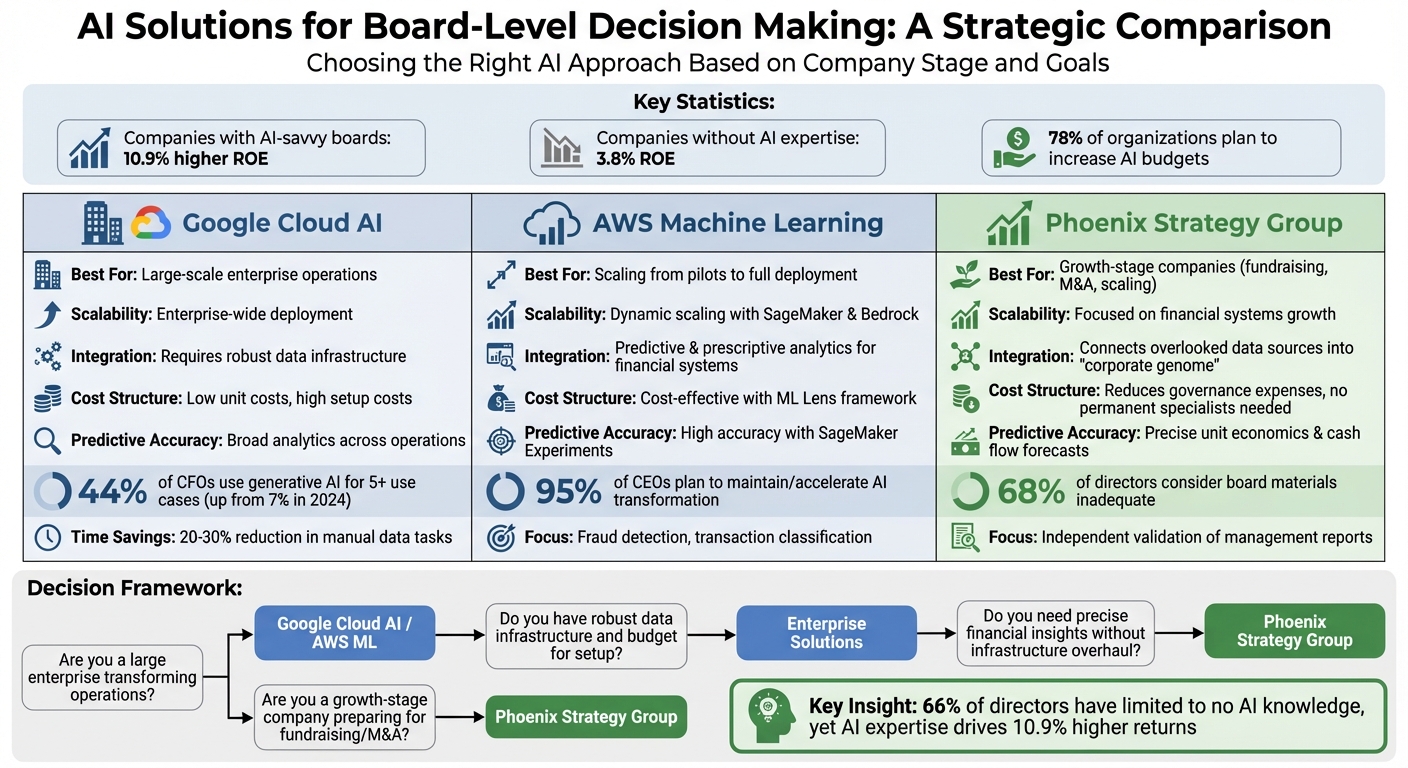
AI Solutions Comparison: Enterprise vs Growth-Stage Companies
Google Cloud AI is built to handle enormous amounts of data, ensuring smooth operations even during high-demand periods. By keeping a close watch on system metrics, it can anticipate and address potential technical issues before they escalate [7]. This capability has become increasingly important as over 60% of organizations now report having generative AI applications in production - a dramatic jump from previous years [7]. For example, virtual AI agents efficiently manage spikes in service requests, such as a sudden surge in contact center calls, without requiring a proportional increase in staffing. Google Cloud also advocates for a "top-down and bottom-up" strategy, aligning broad corporate goals with specific AI projects. This approach ensures that scaling efforts stay in sync with leadership priorities [7], creating a strong foundation for financial integration.
Google Cloud AI simplifies financial operations by consolidating data from multiple sources into a unified view of assets, customers, and operations [8]. Its Document AI feature extracts both structured and unstructured data from critical financial documents - like loan records, invoices, and investment reports - and seamlessly integrates this information into existing financial systems. Additionally, the Gemini for Workspace integration extends these AI capabilities to tools like Google Sheets and Docs. This allows finance teams to automate tasks such as complex financial modeling, creating pivot tables, and summarizing lengthy reports into concise executive summaries for board presentations [10]. By 2025, 44% of CFOs reported using generative AI for five or more use cases, a sharp increase from just 7% in 2024. Finance teams leveraging these tools have saved 20% to 30% of their time previously spent on manual data tasks [9]. Such integration not only streamlines workflows but also supports smarter cost management.
Managing costs is a critical focus for organizations adopting AI, and Google Cloud identifies six key areas to optimize: model serving, training and tuning, cloud hosting, data storage, application setup, and operational support [11]. For high-volume tasks, the platform offers Gemini 1.5 Flash, designed to balance performance with cost-effectiveness [11]. Features like context caching further help businesses maintain predictable AI budgets. A practical example comes from CME Group, which implemented Google Cloud’s cost anomaly detection in October 2024. This enabled the creation of a FinOps function that quickly identified unexpected cloud expenses during their digital transformation [11]. The results speak for themselves - 78% of organizations with formal AI strategies are already seeing returns on their investments, with the median ROI for AI in finance functions at 10%, and top performers reaching 20% or more [7][12].
Google Cloud AI excels in using customer, risk, and transaction data to deliver precise forecasts, making it a powerful tool for fraud detection and risk management [8]. Its AI agents combine external, financial, and operational data to perform root-cause analyses and scenario modeling - critical capabilities for boards making strategic decisions [9]. Predictive modeling enhances scenario planning and forecasting, while real-time anomaly detection identifies fraud and cybersecurity threats as they happen. These tools provide boards with the insights they need to make informed, strategic choices [8]. For organizations scaling rapidly, leveraging fractional CFO services can further enhance these strategic insights.
"The most significant impact typically comes from multiple use cases that can work together to reimagine the entire chain of value."
– Amy Liu, Head of AI Solutions, Value Creation, Google Cloud [7]
AWS Machine Learning stands out for its ability to handle dynamic scaling and deliver precise predictive analytics. Unlike Google Cloud AI, which focuses on aligning with broader business strategies, AWS Machine Learning zeroes in on enabling organizations to scale from small pilot projects to full-scale deployments seamlessly. Tools like Amazon SageMaker Pipelines and Model Registry streamline the machine learning lifecycle, making it easier to manage hundreds of production-ready models instead of just a handful of pilots [13]. For companies venturing into generative AI, Amazon Bedrock offers a game-changing approach: it allows businesses to customize pre-trained foundation models instead of building them from scratch. This significantly cuts down both deployment time and resource use [13][14].
The need for such scalability is clear - 95% of CEOs plan to maintain or even accelerate their transformation efforts in 2024, with 37% specifically reallocating budgets toward AI initiatives [4]. AWS’s focus on scaling aligns with the broader strategic integration trends seen in platforms like Google Cloud AI.
One of AWS Machine Learning's key strengths lies in its ability to enhance financial operations. By leveraging predictive and prescriptive analytics, CFOs can gain insights into market trends and operational performance [14]. AWS employs advanced architectures like data mesh and data lakes, supported by tools such as AWS DataZone, AWS Redshift, and AWS Clean Rooms, to enable secure and efficient data sharing across organizational units [14].
In the financial sector, AWS ML automates critical tasks like fraud detection, transaction classification, and personalized recommendations for the next-best offer [14][15]. With 62% of CEOs emphasizing the urgency of adopting generative AI to stay competitive [4], these capabilities provide a strong foundation for businesses looking to integrate AI into their financial systems.
For companies embarking on large-scale AI projects, managing costs effectively is a top priority. AWS Machine Learning helps organizations navigate the critical "buy-versus-build" dilemma [14][1]. Its solutions, such as fraud detection and transaction categorization, not only mitigate risks but also deliver measurable financial benefits [14].
The numbers back this up: 78% of organizations plan to increase their AI budgets in the coming fiscal year [5]. AWS’s Machine Learning Lens, part of its Well-Architected Framework, ensures that scaling efforts remain cost-effective while maintaining high standards for reliability and security [16]. These cost-conscious strategies are essential for sustaining AI growth without compromising performance.
Maintaining high predictive accuracy is another pillar of AWS Machine Learning. Tools like SageMaker Experiments allow teams to track key parameters and metrics, ensuring models perform reliably as they scale [13]. By utilizing feature stores and reusable code assets, data science teams can share critical properties efficiently, reducing redundancy and improving productivity [13].
"Generative AI serves as a catalyst for reimagining how technology can augment human abilities and extend our reach, doing so with an unprecedented blend of scalability, customization, and intelligence."
– Andy Jassy, CEO of Amazon [16]
This commitment to accuracy and efficiency supports leaders in making informed decisions, especially during periods of rapid growth. With 76% of executives predicting that AI will drive major transformations in the next three years [5], AWS Machine Learning equips organizations to stay ahead of the curve.

Phoenix Strategy Group takes advanced AI capabilities and transforms them into strategic tools that deliver real value at the boardroom level.
By embedding AI into core financial systems, Phoenix Strategy Group ensures businesses can scale effectively. With 51% of technology budgets directed toward cloud and AI infrastructure [6], the firm lays the groundwork for growth-stage companies to handle rapid expansion. Their Integrated Financial Model and Monday Morning Metrics offer real-time insights into critical metrics, helping leadership teams stay agile during scaling phases.
Growth often demands bold decision-making, and Phoenix Strategy Group supports this by redesigning workflows to align with AI-driven data synchronization. This approach not only enhances operational efficiency but also strengthens boards' ability to make informed strategic decisions as the company grows [6].
The firm’s fractional CFO services and FP&A systems use AI to connect data from sources that traditional systems often overlook. This creates what some refer to as the "corporate genome" - a detailed map of how people, assets, customers, and suppliers interact [4]. These tools empower boards to engage in predictive scenario planning, enabling them to test strategies and anticipate outcomes before committing resources [17][2].
This level of integration proves especially valuable during fundraising or M&A activities. The Weekly Accounting System delivers accrual-based financials and tracks key performance indicators (KPIs), moving boards away from outdated, backward-looking reports to forward-focused strategic insights. By simplifying complex financial relationships, these systems reduce oversight costs and streamline decision-making.
Phoenix Strategy Group addresses the "agency problem", where boards rely heavily on management for oversight information [2]. By leveraging AI-enhanced systems, the firm provides independent data and insights that validate management reports and uncover blind spots. This reduces the time and effort required for governance, cutting down on labor hours [3].
With 34% of global CEOs reporting increased profits from generative AI [18], the firm’s focus on automating routine tasks and improving forecasting accuracy allows companies to reallocate resources toward growth rather than administrative burdens.
Phoenix Strategy Group’s AI tools excel at delivering precise unit economics analysis and cash flow forecasts, identifying gaps in reporting and overlooked stakeholder impacts that could lead to costly mistakes [3]. For boards navigating high-stakes situations like M&A or fundraising, this level of accuracy can be the difference between a successful outcome and a missed opportunity.
Boards face a critical decision when choosing between broad, enterprise-wide AI solutions and more focused platforms tailored to financial insights. Each option comes with its own set of trade-offs, shaped by scalability, integration, and cost considerations.
Google Cloud AI and AWS Machine Learning stand out for enterprise-wide AI deployment. Their use of shared GPU pools and resource pooling helps lower unit costs and minimizes idle time [20]. These platforms support an "Internal Transformer" model, enabling AI to drive core operations [1]. However, they demand significant upfront investment in clean data and infrastructure. Additionally, inference costs - now surpassing training costs for many enterprises - pose a growing challenge [4][20]. Boards must also navigate potential vendor lock-in and the complexities of overhauling operating models at scale [1].
On the other hand, Phoenix Strategy Group caters to growth-stage companies dealing with fundraising, mergers and acquisitions, or rapid expansion. Its AI-powered financial systems independently validate management reports, addressing the common agency problem where boards often rely heavily on executives for oversight. This approach reduces labor hours and cuts governance costs [19]. However, the narrower focus means Phoenix Strategy Group prioritizes optimizing financial workflows and strategic growth over enterprise-wide AI integration.
| Feature | Google Cloud AI / AWS Machine Learning | Phoenix Strategy Group |
|---|---|---|
| Scalability | AI deployment across the enterprise [1] | Focus on financial systems and strategic growth |
| Integration | Requires substantial investment in data infrastructure [4] | Connects overlooked data sources into a "corporate genome" |
| Cost Efficiency | Low unit costs via shared resources; high inference costs [20] | Reduces oversight costs and avoids hiring permanent specialists [19] |
| Predictive Accuracy | Broad analytics with potential for "hallucinations" [3] | Delivers precise unit economics and cash flow forecasts |
| Best For | Organizations adopting AI across operations | Growth-stage companies scaling or preparing for exits |
This comparison helps boards align their technology investments with their overall strategic objectives, ensuring the chosen platform supports their unique priorities and challenges.
When a company is experiencing rapid growth, boards often face a pivotal decision: invest in enterprise-wide AI infrastructure or opt for specialized financial intelligence tools. The right choice hinges on factors like the company’s strategic goals, the state of its data readiness, and its governance framework.
For organizations looking to transform operations across multiple departments, platforms like Google Cloud AI and AWS Machine Learning can be game-changers. However, they come with a catch - significant upfront costs related to data remediation and infrastructure setup. It's worth noting that most boards are not yet fully equipped to navigate this AI-driven landscape. In fact, 66% of directors admit to having "limited to no knowledge or experience" with AI, yet companies with AI-savvy boards outperform their peers by 10.9 percentage points in return on equity[1].
On the other hand, Phoenix Strategy Group caters specifically to growth-stage companies, particularly those preparing for fundraising, mergers and acquisitions, or scaling rapidly. These are scenarios where financial precision becomes non-negotiable. Their AI-powered approach validates management reports independently, addressing what’s often referred to as the "agency problem" in boardrooms. This is especially relevant given that 68% of directors consider their board materials inadequate[18]. By integrating financial data into a cohesive and predictive framework, Phoenix Strategy Group equips boards with the clarity needed for high-stakes decisions - without requiring hefty investments in infrastructure.
This contrast between broad AI solutions and targeted financial intelligence highlights the importance of setting clear operational guidelines. As Dan Diasio, Global AI Consulting Leader at EY, aptly puts it:
"AI should drive major shifts in revenue and business model transformation, help a firm enter a new market, or fend off a major threat"[4].
Boards must establish defined scaling rules, including specific ROI targets and performance metrics, before advancing beyond pilot stages. With 78% of organizations planning to increase AI spending this fiscal year[5], the stakes are high. The selected AI strategy must align with the board’s overarching priorities, ensuring that the transformative power of AI translates into sound, impactful decision-making during critical growth phases.
Phoenix Strategy Group offers an AI-driven approach tailored for growth-stage companies, with a strong emphasis on risk management during scaling. Their system uses predictive analytics, real-time monitoring, compliance automation, and anomaly detection to spot and address potential risks - whether they’re technical, regulatory, ethical, or performance-related - before they can derail a company’s growth. This customized method ensures the insights provided are not only actionable but also aligned with the strategic priorities of the boardroom.
What sets Phoenix apart from generic enterprise AI solutions is their focus on detailed, scaling-specific insights. While traditional systems often rely on broad governance frameworks or standard compliance checklists, Phoenix’s tools are fine-tuned to reflect a company’s unique financial and operational data. This makes their solutions particularly effective for businesses experiencing rapid expansion, providing precise, board-level intelligence that supports smart, data-driven decisions.
Integrating AI to provide financial insights at the board level comes with a variety of costs. These include upfront investments in technology, data infrastructure, and hiring skilled professionals, alongside recurring expenses for governance, compliance, and maintaining the systems. To ensure smooth implementation, boards often dedicate specific portions of their budgets to these areas.
Failing to allocate sufficient resources can lead to reduced returns and heightened risks, such as inaccurate data or compliance failures. By carefully planning and prioritizing these investments, boards can harness AI to enhance their decision-making, especially during times of growth and expansion.
AI is reshaping how decisions are made in mergers and acquisitions (M&A), offering quicker and more precise insights than ever before. With the ability to process massive amounts of data - like contracts, financial statements, and market trends - AI uncovers risks that might otherwise slip through the cracks. These could include hidden liabilities, potential regulatory issues, or even mismatched organizational cultures. This level of analysis equips boards with the information they need to make confident, well-rounded decisions.
When it comes to due diligence, AI takes efficiency to a new level. By automating tasks like data extraction and applying predictive valuation models, it provides sharper deal pricing and enables scenario planning. AI-powered dashboards further simplify the process by presenting real-time metrics, such as cash flow projections, synergy expectations, and potential integration challenges. These tools make it easier for directors to assess outcomes and focus on opportunities that drive value. By speeding up deal closures and improving transparency, AI helps boards align their decisions with both their strategic priorities and financial objectives.