Published on
May 27, 2026


Predictive analytics is changing how mergers and acquisitions (M&A) are planned and executed. By leveraging AI, machine learning, and statistical models, companies can make better decisions at every stage of the M&A lifecycle. Here's what you need to know:
These tools are especially useful for growth-stage companies facing tight resources and deadlines. Predictive analytics delivers faster insights, uncovers hidden opportunities, and improves M&A outcomes with measurable results like 20% higher deal value and 10–15% better synergy realization.
Want to stay ahead in M&A? Start building predictive models that align with your goals, ensuring data quality and cross-functional collaboration along the way.
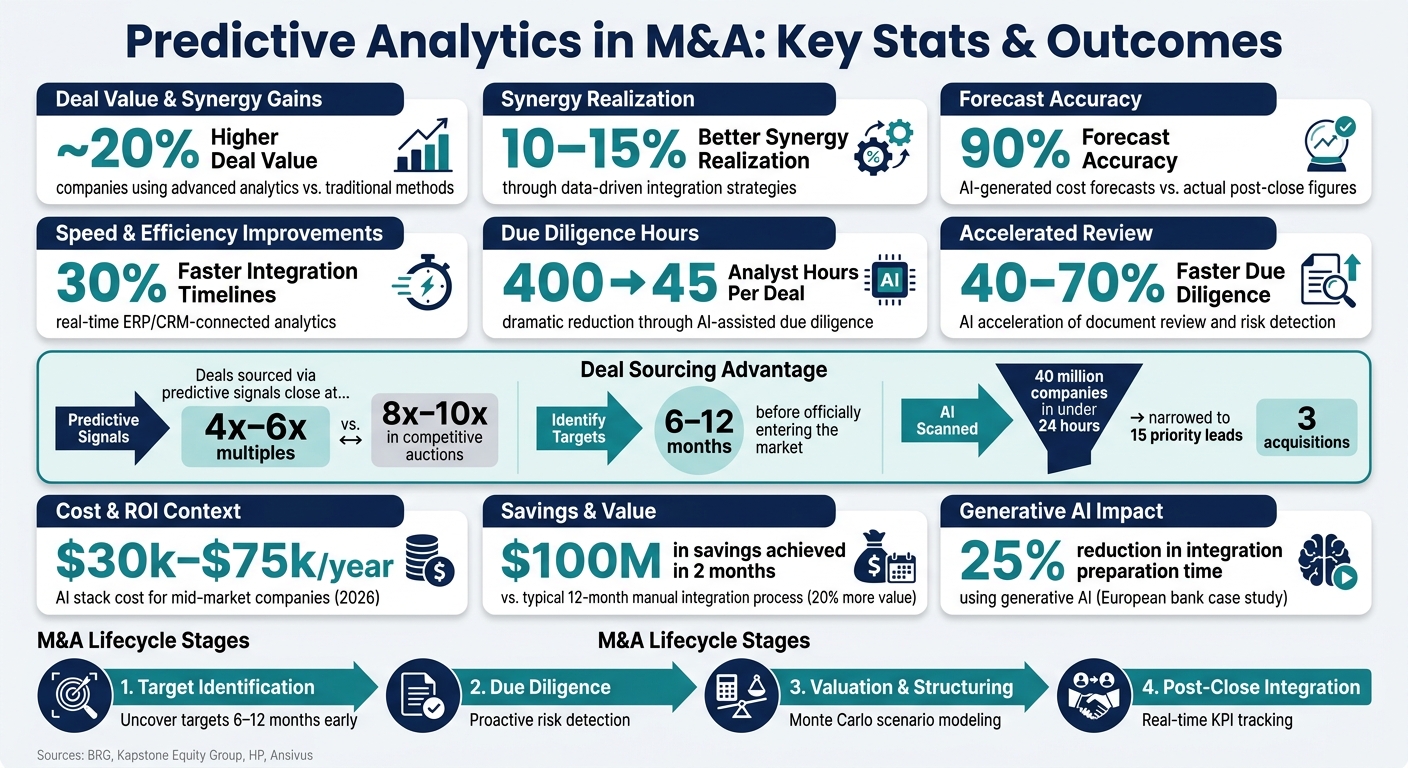
Predictive Analytics in M&A: Key Stats & Outcomes
Traditionally, finding the right acquisition target has been a slow, reactive process, often dependent on broker networks and outdated information. Predictive analytics flips this approach on its head. With AI-enabled software, companies can maintain a constantly updated pipeline of potential targets. These tools scan an expansive range of companies and refresh priority lists in real time, eliminating the reliance on static shortlists that often become outdated between review cycles [5].
One standout advantage is the ability to uncover off-market opportunities. Predictive tools monitor digital "intent signals", such as a company hiring a CFO with exit experience, a surge in patent filings, or an ERP system upgrade - indicators that suggest a business might be preparing for due diligence. These signals can reveal potential sellers 6 to 12 months before they officially enter the market [6], giving acquirers a critical edge over competitors who only engage once a deal is publicly listed.
"The ability to see around the corner and identify the next great company before the rest of the market does is the ultimate competitive edge." - Ken Pomella, Kapstone Equity Group [6]
For example, an India-based global healthcare company replaced its manual screening process with AI-enabled software to meet aggressive growth goals. The system continuously scanned a broader pool of targets and dynamically refreshed its priority list before formal bidding began. This approach significantly improved the company’s ability to secure high-priority assets [5]. Once targets are identified, predictive tools also play a key role in reducing risks during the due diligence phase.
Due diligence is often where mergers and acquisitions encounter the most challenges. Predictive analytics transforms this stage from a reactive document review process into proactive risk detection. AI tools can quickly analyze contracts for change-of-control clauses, highlight customer concentration risks in financial data, and evaluate cybersecurity vulnerabilities - areas where overlooked details can have a significant impact on deal value [7].
| Risk Area | AI Application |
|---|---|
| Legal/Contract | Extracts change-of-control clauses, exclusivity terms, and unusual obligations |
| Financial | Detects revenue inconsistencies and customer concentration risks |
| Cybersecurity | Evaluates attack surfaces and third-party vendor vulnerabilities |
| Operational | Maps dependencies between suppliers and internal processes |
Even before formal due diligence begins, AI-driven "outside-in" intelligence can assess a target’s cost structure using publicly available data. For instance, a media company used AI to scrape public sources like LinkedIn and map out a target’s workforce structure ahead of submitting a formal bid. Remarkably, the AI-generated cost forecast was within 90% of the actual figures after the deal closed. This level of precision directly influenced the initial valuation [5]. By addressing potential risks with AI, deal teams can shift their focus to refining valuations and structuring agreements.
Predictive analytics takes deal valuation to the next level by moving beyond static models. Dynamic DCF models use time-series and regression analyses to project revenue, margins, and capital expenditures, replacing guesswork with data-driven insights [2].
Monte Carlo simulations enhance this further, running thousands of valuation scenarios against variables like a 2% GDP contraction or a competitor’s new product launch. These simulations produce a probability distribution of outcomes, giving deal teams a clearer understanding of a deal’s value under various conditions [2].
"In a world awash with granular data, relying solely on these traditional techniques is akin to navigating with a compass in the age of GPS." - Ansivus [2]
Quantifying risks like customer churn or integration challenges allows teams to structure smarter agreements. For example, performance-based earn-outs become more defensible when tied to data-backed projections rather than optimistic assumptions. A European bank leveraged generative AI to refine €600 million in potential synergies during an acquisition. The bank also created 13 team charters, reducing standard integration preparation time by 25% [5].
The foundation of reliable M&A models lies in detailed financial data. Metrics like EBITDA margins, revenue broken down by product and region, capital expenditure trends, and transaction-level profit cubes provide a realistic view of business performance [1].
Operational data from systems like CRM and ERP also plays a key role. Metrics such as customer acquisition costs, churn rates, and inventory turnover help refine synergy estimates. Additionally, human capital data - like hiring trends, executive turnover, and employee ratings - offers insights into integration risks and organizational stability [1].
Take, for example, a $1 billion condiment manufacturer in May 2026. By consolidating multiple acquisitions into a unified revenue and profit cube, they transformed due diligence from a numbers-checking exercise into a strategic bid evaluation process [1].
Once internal data is in place, external market signals can add further depth to the analysis.
Internal metrics are essential, but they only tell part of the story. To complete the picture, predictive models incorporate external data like macroeconomic trends, total addressable market (TAM/SAM/SOM) insights, and competitor pricing. Alternative indicators, such as patent activity and technographic data, can also reveal valuable patterns. For instance, tracking when a target stops renewing enterprise software licenses - a phenomenon called technographic decay - can signal financial trouble or preparation for a sale [8]. Similarly, analyzing patent filings alongside IPC codes can help quantify technological overlap and assess how well an acquirer might integrate the target’s R&D.
"Predictive AI doesn't just show you who exists; it tells you who is ready." - Soren Halberg, Risk Analyst [8]
In March 2026, a private equity firm applied this approach by using AI to analyze licensing data from 45 state boards. They identified master plumbers with over 20 years of experience and cross-referenced property records with behavioral signals, like inactive Google My Business profiles. This strategy uncovered 12 off-market businesses, leading to 4 acquisitions within six months at a 4.5x EBITDA multiple - well below the 7x market average for similar deals [8].
The reliability of any predictive model depends heavily on the quality of its data. Fragmented or inconsistent data from disconnected systems - like ERP, CRM, web analytics, and HR platforms - can derail even the most sophisticated models [2]. A robust governance framework is essential to standardize and reconcile these inputs, ensuring that the model's conclusions are both credible and defensible during negotiations.
A good practice is to keep inputs, calculations, and outputs clearly separated, making every assumption easy to trace and audit. Hardcoded values hidden within formulas are a major red flag - assumptions should always be visible and easily adjustable [9]. Additionally, models must be updated after technical and HR due diligence, as early-stage assumptions often change when actual data room documents come into play.
"Analytics are the connective tissue of modern M&A, enabling stakeholders to make better decisions from the same underlying data earlier in the deal when it matters most." - BRG [1]
Clean, well-managed data is more than a technical necessity - it’s a competitive edge. For growth-stage companies, reliable data inputs enable faster, more precise analytics in M&A. Studies show that leveraging advanced analytics built on quality data can increase realized deal value by about 20% and shorten integration timelines by roughly 30% [1]. By prioritizing high-quality inputs, predictive analytics becomes a strategic tool for achieving M&A success.
Predictive analytics has transformed how companies identify and screen potential acquisition targets. By analyzing intent signals - such as key executive hires or spikes in patent activity - deal sourcing has shifted from being reactive to proactive. Ken Pomella, CEO of Kapstone Equity Group, highlights the importance of this shift:
"If you aren't using data to source your deals, you are likely bidding on someone else's leftovers." [6]
For example, an AI-powered scouting platform recently scanned a database of 40 million companies in less than 24 hours. Using criteria like CAGR, customer segments, and geographic region, the system narrowed the pool to 15 priority leads. This process resulted in three finalized acquisitions within just a few months [4].
After identifying potential targets, predictive analytics plays a critical role in refining risk assessments during due diligence.
When a target is shortlisted, predictive analytics enhances due diligence by focusing on proactive risk management. AI tools can automatically scan contract libraries to flag high-risk clauses, such as change-of-control provisions. At the same time, machine learning models analyze customer data to predict post-close risks like churn, offering a clearer picture of earnings quality compared to traditional methods.
This approach allows deal teams to detect financial and contractual risks early, shaping valuations before formal negotiations even begin. Valuation models are also evolving, incorporating Monte Carlo simulations to test assumptions across thousands of scenarios. This replaces static, single-point estimates with probability-weighted ranges, providing a more realistic view of potential uncertainties.
Even after a deal is closed, predictive analytics continues to add value by streamlining integration and monitoring performance. By connecting directly to ERP and CRM systems, analytics tools track critical metrics - like bookings, revenue pipeline, and asset utilization - against deal targets in real time [10].
The impact can be substantial. In 2025, two major commodity companies used an AI model to integrate procurement, hedging, and mixing data. This allowed them to create an optimized purchasing and recipe model in just two months, compared to the typical 12-month manual process. The result? An anticipated $100 million in savings - 20% more value than a traditional integration approach [3]. Similarly, HP utilized AI-powered tools, including a GenAI budgeting model trained on over 650 historical transactions, to achieve significant efficiency gains and real-time KPI tracking through connected ERP systems [10].
"This analytics platform has transformed our M&A integration. We have powerful new budgeting and scenario-modeling tools, and we're able to track ongoing integrations with very detailed KPIs in real time." - Julie Lathrop, Head of IT Risk Management, HP [10]
Beyond financial metrics, analytics also monitors other critical factors like talent retention and system migration challenges. These issues, if overlooked, can lead to hidden costs and erode the value of the deal over time. By keeping an eye on productivity dips or the expenses of replacing key roles, companies can address potential integration hurdles before they escalate.
Building on earlier insights, aligning predictive models with specific M&A objectives requires targeted best practices.
Predictive analytics can enhance M&A processes, but the real challenge lies in designing models that directly support strategic goals. Too often, M&A models fail by addressing the wrong questions. The solution? Start by translating deal objectives into precise model inputs.
For instance, if the aim is market expansion, include inputs like "cross-sell propensity" scores, which can be derived from overlapping customer datasets. In growth-stage tech deals, focus on talent and intellectual property risks. Inputs such as critical-role retention rates, backfill costs, and productivity loss during system migrations can provide the clarity needed for decision-making.
It's also essential to distinguish between deal assumptions (e.g., financing, purchase price) and operating assumptions (e.g., growth rates, integration friction, talent retention). Keeping these separate helps avoid overestimating synergies [9].
"A reliable model doesn't just produce an answer. It shows which assumptions drive that answer and where the deal can break." - Nexus IT Group [9]
Scenarios should also be built around key variables like engineering attrition or migration timing. This approach uncovers how these factors influence net present value (NPV) [9].
Predictive models often fall short when developed in isolation. Success requires input from multiple disciplines - finance, data science, corporate development, and operations. Each brings unique insights, and excluding any one of them can lead to critical blind spots.
"A predictive model cannot be developed in an IT silo. It requires a fusion of expertise." - Ansivus [2]
Here’s how different roles contribute:
| Role | Contribution to Predictive Modeling |
|---|---|
| Finance | Defines key valuation questions and economic hurdles |
| Data Science | Builds, validates, and cleans data for predictive models |
| Corp Dev | Translates model outputs into negotiation and bidding strategy |
| CTO/Engineering | Validates technical debt, platform compatibility, and release velocity |
| HR/Talent | Assesses retention risk, backfill costs, and cultural alignment |
Documenting judgment calls and operational dependencies (e.g., "synergy assumes platform migration within 90 days") is crucial for auditability and effective cross-functional reviews [9].
For many growth-stage companies, the biggest hurdle to adopting predictive analytics is poor data quality. Disparate systems like CRM, ERP, and web analytics often produce inconsistent data, which can undermine the reliability of models built on them.
Phoenix Strategy Group addresses this by cleaning and standardizing data into structured, transaction-level fact bases. In 2026, for example, they developed automated models for over 3,000 companies for Assembled Brands, improving risk assessments and speeding up due diligence [11].
Their expertise goes beyond data engineering. PSG helps companies move from static discounted cash flow (DCF) models to dynamic valuation frameworks. These frameworks incorporate predictive sub-models, such as time-series forecasts, machine learning–based churn predictions, and Monte Carlo simulations. These tools replace single-point estimates with probability-weighted ranges, offering a more nuanced view of potential outcomes [2].
Led by partners David Metzler, John Zdanowski, and Ethan Lu, PSG also uses explainability tools to make model outputs easier to understand. This step is essential for building trust and ensuring advanced analytics are adopted at the board level.
"Analytics are the connective tissue of modern M&A, enabling stakeholders to make better decisions from the same underlying data earlier in the deal when it matters most." - BRG [1]
These practices create a strong foundation for reducing risks and improving integration throughout the M&A process.
Even the best predictive models come with risks in M&A that need careful management.
A key issue is data quality. Early due diligence often relies on incomplete or inconsistent financial data, which can lead to models that misjudge a business's value.
Another challenge is the "black box" problem. Complex machine learning models sometimes fail to explain how they arrive at specific outputs. This lack of clarity can create doubts among board members, especially if a model advises against a deal without offering a clear explanation.
AI can speed up due diligence by as much as 40–70% [12]. While this efficiency is valuable, it also shortens the time for deal teams to catch errors or reassess assumptions.
"AI doesn't change what can go wrong, but it does make it happen faster. The central risk, therefore, is not automation of judgment, but compression of the time available to exercise it." - Killian McCarthy, Professor of Strategy, Radboud University [13]
These risks highlight the importance of maintaining strong human oversight throughout the process.
Predictive analytics should support, not replace, human judgment. While AI improves efficiency, it shifts the responsibility for critical decisions to senior leaders. To address this, the M&A process should include structured checkpoints where senior team members review outputs, challenge assumptions, and ensure the pace of analysis doesn’t surpass their ability to act effectively. These reviews should be well-documented, noting the key assessments and decisions made.
Tools like SHAP can help make AI outputs more understandable by showing which variables had the most influence on predictions and by how much [2].
Governance is about more than just accuracy - it’s about being able to justify your decisions if they come under scrutiny. This requires a clear audit trail documenting the data used, how models were validated, and instances where human judgment overruled automated results.
AI in M&A also introduces legal risks, such as those related to data privacy, intellectual property, and antitrust laws [14]. These risks need proactive management.
"AI is not a substitute for judgment, but rather a force multiplier for it. Effective deployment requires a governance framework built on transparency, accountability, and human oversight." - Morgan Lewis [14]
A defensible process includes rigorous model validation, such as splitting data into training and testing sets, backtesting predictions against historical outcomes, and calculating error margins [2]. It’s also critical to acknowledge a model’s limitations. If predictions differ significantly from actual market trends, these discrepancies should trigger further investigation, not be dismissed as irrelevant.
When predictive analytics is aligned with specific M&A goals, growth-stage companies can gain both strategic and financial advantages. This approach shifts M&A from being reactive to proactive. Instead of competing for deals already in auction, companies can identify promising targets earlier, model valuations more accurately, and enter the integration phase armed with data-driven strategies.
Companies leveraging advanced analytics report impressive results: around 20% higher deal value, 30% faster integration timelines, and a 10–15% increase in synergy capture. AI-driven forecasts have achieved up to 90% accuracy, while analyst hours per deal have dropped dramatically - from over 400 to just 45 [1][3][8].
"Analytics are the connective tissue of modern M&A, enabling stakeholders to make better decisions from the same underlying data earlier in the deal when it matters most." - BRG [1]
Deals sourced through predictive signals typically close at multiples of 4x–6x, compared to 8x–10x in competitive auctions [8]. This difference can be the deciding factor in whether a deal adds or erodes value. These advantages set the stage for swift and strategic decision-making.
To begin incorporating predictive analytics into your M&A workflow, consider a 30-day action plan. Start by auditing past deal flows to identify signals that were present in successful acquisitions. Next, select a data and CRM stack, develop a propensity model tailored to your Ideal Target Profile, and initiate automated outreach campaigns. Throughout this process, track "signal to meeting" conversion rates to refine your strategy [8].
For mid-market companies, an AI stack - including data providers, CRM tools, and an AI layer - typically costs between $30,000 and $75,000 annually as of 2026 [8].
If you’re looking for expert advice, Phoenix Strategy Group offers tailored M&A advisory services. They combine real-time data integrations with human oversight to ensure decisions are both well-informed and ready for boardroom discussions.
Forecasting key performance indicators (KPIs) is essential for predicting deal success. Focus on metrics like revenue growth, margin improvements, and customer retention. It's also crucial to pinpoint synergies such as cost reductions or cross-selling opportunities, while keeping a close eye on integration challenges like cash flow volatility.
Phoenix Strategy Group specializes in helping growth-stage companies create these predictive models. Their approach ensures businesses can make informed, data-backed decisions throughout the M&A process.
To build reliable M&A predictions, a well-rounded data strategy is essential. This strategy should combine detailed operational metrics with insights from external markets. Here are the key data categories to focus on:
Phoenix Strategy Group takes it a step further by ensuring all this data is thoroughly cleaned and organized, enabling accurate valuation and synergy modeling.
To make AI outputs understandable and useful for board-level decisions, it's essential to blend human expertise with AI-driven insights. Always validate AI-generated data by conducting a detailed review, ensuring it is free from bias and maintains transparency. Professional judgment plays a key role in deciphering complex models and translating them into actionable strategies.
Instead of depending solely on probabilistic forecasts from AI, rely on clear, measurable indicators - such as compliance requirements or contractual obligations - to define boundaries and guide decision-making. This approach ensures that AI remains a tool for informed, responsible choices rather than an unchecked predictor.