Published on
July 5, 2026


If your finance tools don’t talk to each other in a controlled way, your close gets slower, your forecast gets weaker, and diligence gets harder. For companies in the $500,000 to $10 million revenue range, API management is how I keep data moving between ERP, banking, billing, CRM, payroll, and FP&A systems without duplicate entries, stale feeds, or missing audit logs.
Here’s the short version:
What matters is not the tech itself. It’s what the controls do for finance:
I’d start with the highest-risk feeds first: bank imports, CRM-to-ERP revenue syncs, billing data, and KPI dashboard refreshes. Then I’d require OAuth 2.0, short-lived tokens, mTLS for bank or ledger links, versioned endpoints, rate limits, and instant failure alerts.
In plain English: API management is part of fractional CFO finance control, not just an IT setup.
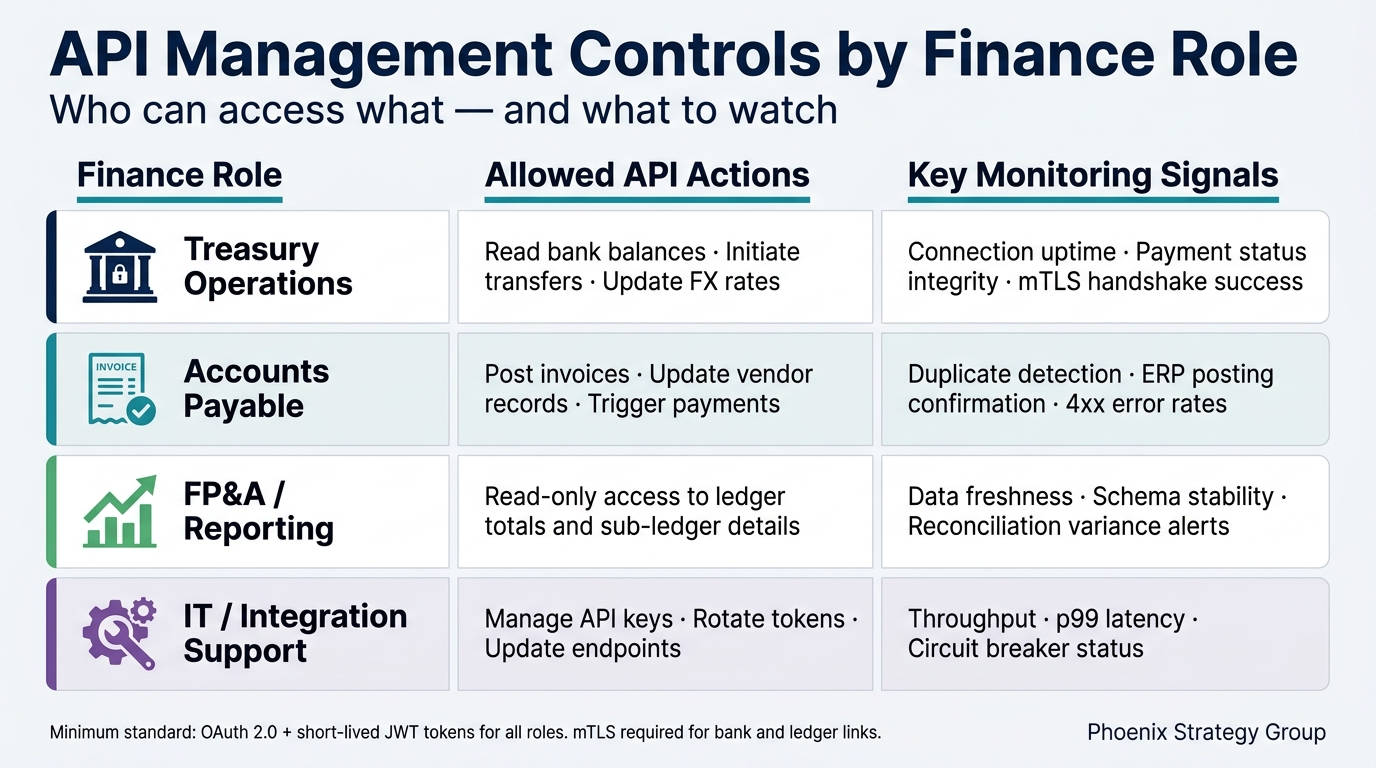
API Management Controls by Finance Role: Access & Monitoring Guide
An API gateway is the main control point for finance API traffic. It sits between finance apps and the systems behind them, checking each request before it reaches the backend. In CFO systems, this isn’t about tidy architecture for its own sake. It’s about keeping finance data clean, traceable, and ready for audit.
The gateway gives finance teams one place to control the stack, including:
The gateway can also enforce idempotency, which means a retry won’t post the same transaction twice [1].
Once traffic gets through the gateway, the next set of controls helps make sure that traffic doesn’t disrupt close or reporting.
During close, transaction volume jumps. Rate limits stop one integration from overwhelming reporting systems [6]. That becomes even more important when close traffic and reporting jobs hit at the same time. Well-run integrations fail less often than point-to-point connections [6].
API versioning gives teams a buffer when a provider makes changes. Instead of one update breaking connected finance systems overnight, teams get time to test and migrate [6]. That matters because a single schema change can break forecast refreshes and push bad data forward. Deprecation should give finance teams at least 6 months to migrate [6].
Stability alone doesn’t do the job. Finance APIs also need tight permission controls and alerts that catch problems early.
After routing and stability controls are in place, finance teams still need strong permission checks and clear failure detection.
Access control in a finance API stack should be layered. OAuth 2.0 with short-lived JWT tokens works for standard access across most integrations. For high-security machine-to-machine links, like a direct bank feed, mutual TLS (mTLS) adds verification on both sides. Role-Based Access Control (RBAC) then limits what each integration can do, with scope tied to legal entities, transaction types, or chart-of-accounts segments.
Monitoring should track p99 latency, 4xx and 5xx error rates, and stale-data alerts when a forecast feed stops refreshing. If a posting fails - for example, because of an invalid cost center - the integration should send that transaction to an exception queue and alert the right team, instead of dropping it silently and leaving a reconciliation gap for later [1]. Monitoring also helps during diligence by surfacing stale feeds and missing records before they make their way into a data room.
| Finance Role | Allowed API Actions | Key Monitoring Signals |
|---|---|---|
| Treasury Operations | Read bank balances, initiate transfers, update FX rates | Connection uptime, payment status integrity, mTLS handshake success |
| Accounts Payable | Post invoices, update vendor records, trigger payments | Duplicate detection, ERP posting confirmation, 4xx error rates |
| FP&A / Reporting | Read-only access to ledger totals and sub-ledger details | Data freshness, schema stability, reconciliation variance alerts |
| IT / Integration Support | Manage API keys, rotate tokens, update endpoints | Throughput, p99 latency, circuit breaker status |
These controls matter because they protect close speed, forecast quality, and diligence readiness. In practice, you see the impact first in close timing, trust in the forecast, and M&A diligence work.
Those controls stand out most in three fractional CFO services and finance workflows: close, forecast, and diligence.
When integrations are managed well, validated data moves from bank feeds, billing, payroll, and ERP systems straight into the close process. Middleware checks account codes, legal entity IDs, and currency precision before anything hits the general ledger [1]. That cuts down on bad entries, cleanup work, and the usual spreadsheet patch jobs at month-end.
Near-real-time API flows also shrink close lag compared with overnight batch files. Payment settlements and invoice events come in through webhooks instead of sitting around until the next overnight run [4]. And if a posting fails, it should go to an exception queue with a clear error code, not vanish into thin air [1][2]. That gives finance teams a chance to fix the issue during the month instead of finding it during close.
The same control layer helps FP&A too, because better inputs usually lead to better planning.
FP&A models are only as good as the data going into them. When actuals from the ERP, pipeline data from the CRM, headcount data from HR systems, and expense data from procurement tools move through controlled, validated APIs, timing mismatches are far less likely. Open AR and cleared payments line up the way they should instead of drifting apart because manual reconciliation took too long [4].
If a forecast feed stops refreshing, the model starts running on old numbers, and cash forecasts can drift fast. Alerts for sync failures and last successful sync times help teams spot stale feeds early [1][2]. A standard internal data model for journals and payments also shields the reporting layer from upstream vendor schema changes [1][2]. So if a SaaS provider updates its API, it doesn't quietly skew next quarter's scenario plan.
That same traceability helps when diligence starts.
Due diligence teams tend to ask the same tough questions: Where did this data come from? Who touched it? Do the numbers in the data room match the source systems? Audit logs with correlation IDs answer those questions by showing where data came from, who touched it, and how it made its way into the ERP [1]. Each log entry connects a source event, like a bank statement ingestion, to the middleware processing step and the final ERP posting. That creates a chain of evidence a buyer can verify.
Centralized identity and access management at the API gateway also removes a common diligence headache: credential sprawl. When every system-to-service interaction is authenticated, authorized, and logged in one place, buyers are less likely to find untracked admin access or undocumented access paths [3].
For growth-stage companies getting ready for a transaction, this setup also makes post-deal integration planning less painful. Middleware that exposes standardized finance APIs can abstract differences between separate ERPs, cutting the technical rework that usually follows a deal close [1].
Once the core controls are clear, apply them to the small set of feeds that move cash and shape close data. Start with the connections that can slow your close, throw off forecasts, or make diligence harder if they fail.
List every API connection, then rank each system and workflow by its impact on cash and reporting.
Start with the systems tied most closely to money and reporting: your accounting or ERP system, such as QuickBooks or NetSuite; banking feeds; your billing platform, such as Stripe; and your CRM. These are the systems your close process and cash forecast lean on every month.
Inside those systems, a few workflows carry more risk than the rest:
If one of these syncs fails or a feed goes stale, the damage adds up fast. You can end up with reporting mistakes, a cash forecast that drifts off course, or a reconciliation problem that takes hours to untangle.
Once you’ve mapped the highest-risk feeds, set a baseline control standard for each one.
Use one API gateway for authentication, rate limiting, and logging for each integration.
From there, the minimum standard is pretty simple. Require OAuth 2.0 with short-lived JWT tokens for standard integrations, and use mutual TLS (mTLS) for anything that touches your bank or core ledger [5][8]. Use versioned endpoints so vendor changes don’t break production syncs [7]. Put batch-job rate limits in place to protect the ERP during close [7]. Then set real-time alerts for auth failures, error spikes, and stale feeds [8].
API management sits inside the finance control environment. It’s not just an IT job. When an integration posts journals or moves cash, it touches control.
That’s why unmanaged integrations can cause real finance problems: timing mismatches, duplicate postings, and slower closes.
These controls support three CFO outcomes:
Shorter close cycles happen when teams replace manual CSV exports and rekeying with automated syncs. Forecasts get better when source data is timely and consistent. M&A prep gets easier when standardized interfaces help new entities connect without rebuilding controls.
Start with your highest-risk feeds. Then require immediate failure alerts.
For teams that want help putting this control layer in place, Phoenix Strategy Group helps growth-stage companies do that through bookkeeping, fractional CFO, FP&A, data engineering, and M&A support.
Prioritize finance API feeds based on how much they affect day-to-day financial operations and reporting stability. Start with the feeds tied to money movement, bank statement reconciliation, and high-frequency reporting. Those are your main control points, so they need attention first.
From there, review each feed based on its integration method, data volume, and refresh cadence. Use managed connectors for standard ERP or CRM systems. Save CDC for high-volume transaction flows. And when priorities clash, put intraday banking feeds ahead of daily close reporting so your team has better cash visibility during the day.
An API failure during month-end close can turn into a financial control problem fast, not just an IT headache. It can lead to payment mistakes, duplicate transactions, missing records, or stale ledger data that throws off financial reporting.
The tricky part is that these issues don’t always show up right away. Sometimes they surface only when reports are pulled, which leaves teams scrambling through manual reconciliations under tight deadlines. Phoenix Strategy Group stresses clear error handling, retry logic, and close monitoring to help stop these problems before they delay the close.
Yes. As small companies grow, API management stops being a nice-to-have and starts becoming part of the day-to-day work.
Ad hoc setups can get by when you have fewer than 10 integrations. But a lot of teams hit a wall around five to eight integrations. That’s usually the point where manual upkeep starts piling up technical debt.
If your business relies on APIs for payments, billing, or reporting, weak management can lead to messy problems fast:
Putting standards in place early helps with security, compliance, and reliability as your company grows.