Published on
February 27, 2026

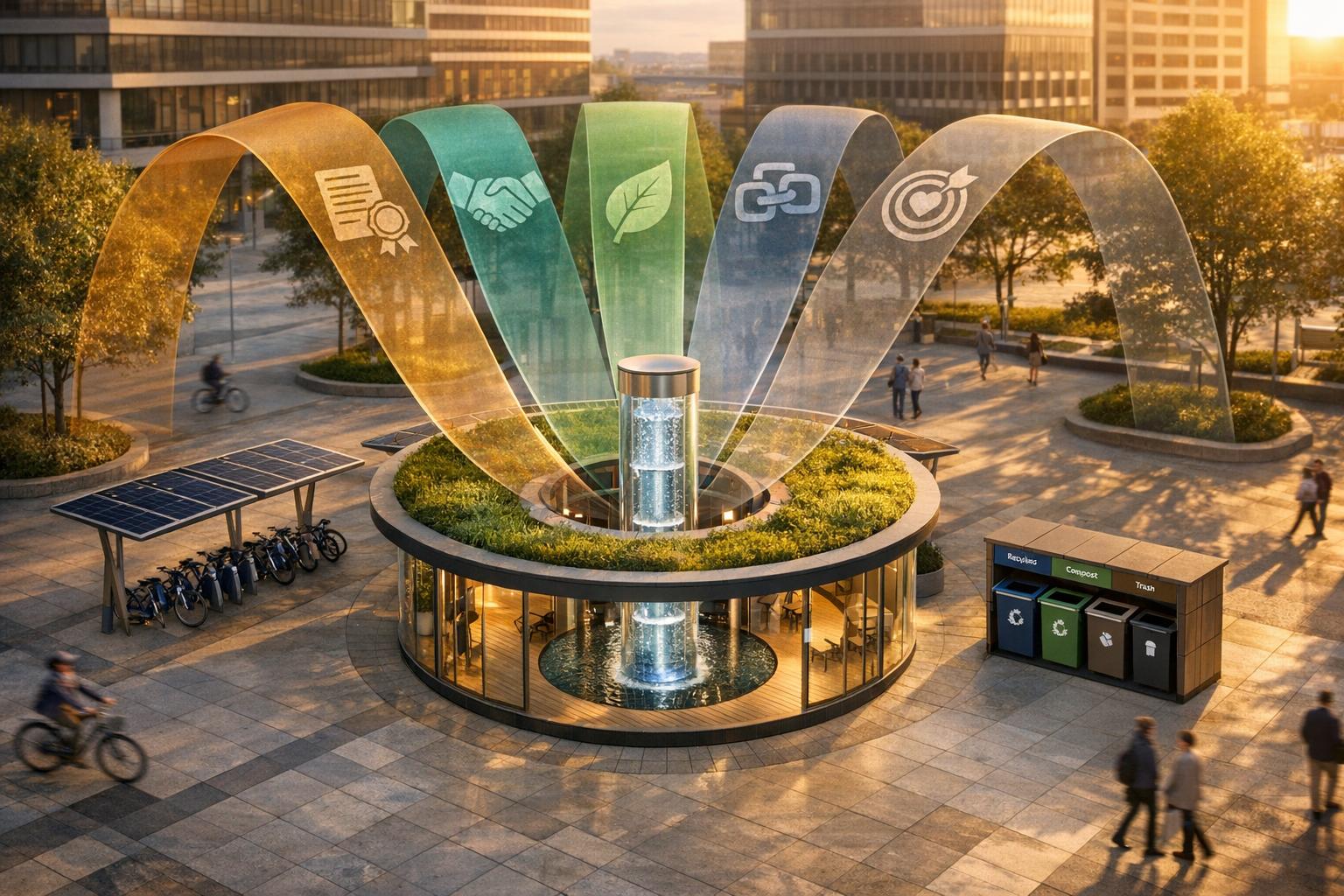
Circular urban infrastructure focuses on reusing resources and reducing waste in systems like water, transit, and energy grids. This approach helps cities cut greenhouse gas emissions, address resource shortages, and meet climate goals. But funding these projects can be challenging due to high upfront costs and technology risks. Here's a breakdown of the main funding strategies:
Each strategy plays a role in transforming urban systems while balancing financial and climate objectives. Combining these approaches is key to bridging funding gaps and achieving net-zero goals.
Federal Funding Programs for Circular Urban Infrastructure
Government grants provide non-repayable funding, making them an attractive option for municipalities looking to invest in circular infrastructure projects and scale their operations. Unlike loans, grants don’t need to be paid back, which is a big advantage for cities and counties operating on tight budgets. These funds can be used for projects like upgrading recycling systems, acquiring zero-emission buses, or building composting facilities - all without adding to municipal debt.
That said, grants often come with strings attached. Federal grants require detailed project plans, environmental assessments, and strict compliance with regulations like the Build America, Buy America Act and the Davis-Bacon Act labor standards. The application process can also involve lengthy reviews and a significant amount of paperwork. To help navigate these challenges, the EPA offers technical support through webinars and regional representatives, guiding applicants through the complex criteria involved in securing funding [5][6]. Despite the hurdles, federal grants remain a crucial source of funding for circular urban initiatives.
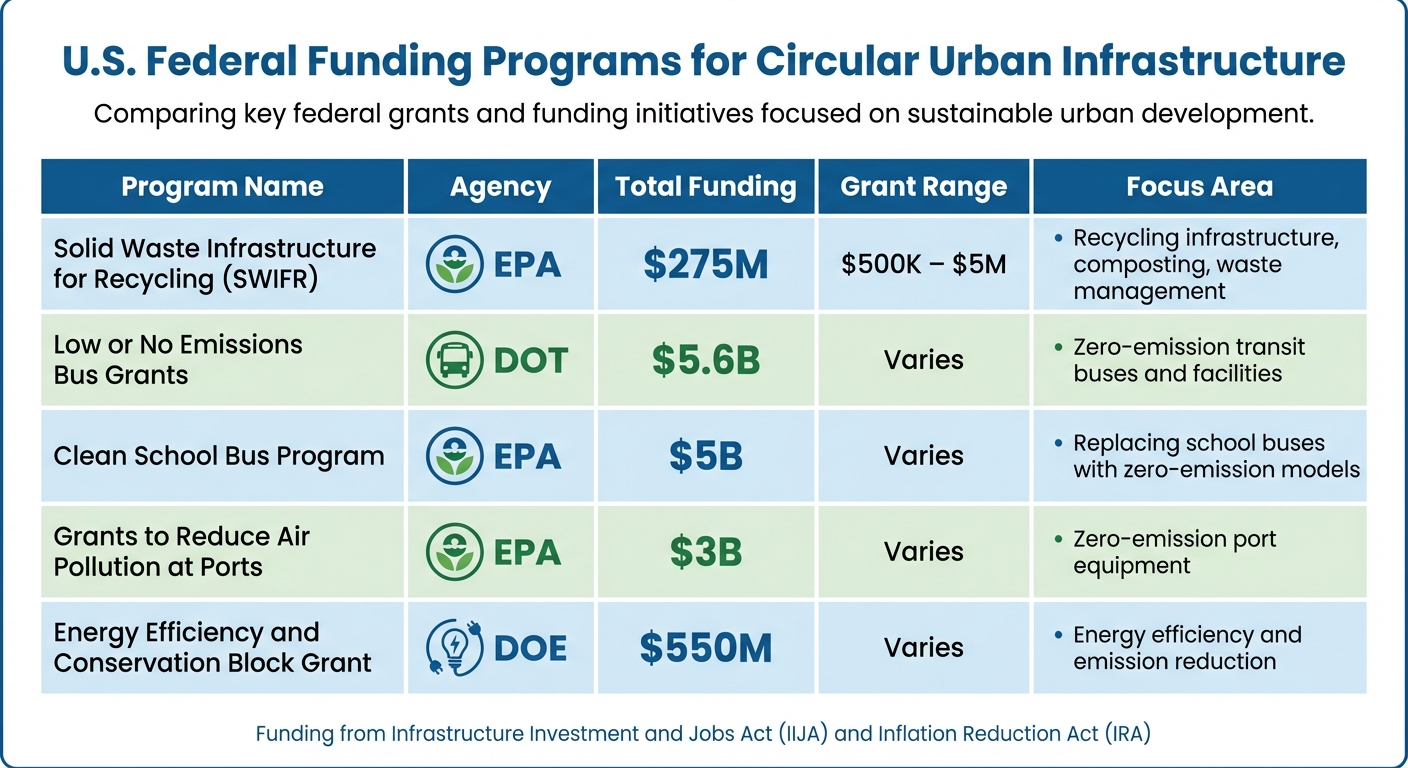
Several federal programs are specifically designed to support circular urban projects. The Infrastructure Investment and Jobs Act (IIJA) and the Inflation Reduction Act (IRA) have introduced billions of dollars in funding for these initiatives [4]. For example, the Solid Waste Infrastructure for Recycling (SWIFR) program has a total of $275 million allocated from Fiscal Year 2022 through 2026. Grants under this program range from $500,000 to $5,000,000 and can be used for projects like upgrading Material Recovery Facilities, developing composting systems, installing anaerobic digesters, or adopting advanced sorting technologies [5].
Federal funding also extends to zero-emission transit. The Low or No Emissions Bus Grant program provides $5.6 billion, while the Clean School Bus Program allocates $5 billion to replace older buses with zero-emission models [4]. Additionally, the Energy Efficiency and Conservation Block Grant (EECBG) Program offers $550 million to help local governments reduce fossil fuel emissions through initiatives like vehicle electrification and alternative transportation fuels [4].
| Program Name | Agency | Total Funding | Grant Range | Focus Area |
|---|---|---|---|---|
| Solid Waste Infrastructure for Recycling (SWIFR) | EPA | $275M | $500K – $5M | Recycling infrastructure, composting, waste management [5] |
| Low or No Emissions Bus Grants | DOT | $5.6B | Varies | Zero-emission transit buses and facilities [4] |
| Clean School Bus Program | EPA | $5B | Varies | Replacing school buses with zero-emission models [4] |
| Grants to Reduce Air Pollution at Ports | EPA | $3B | Varies | Zero-emission port equipment [4] |
| Energy Efficiency and Conservation Block Grant | DOE | $550M | Varies | Energy efficiency and emission reduction [4] |
Private investments and public-private partnerships (PPPs) play a crucial role in advancing circular urban projects. They bring in not just capital but also specialized expertise and the ability to implement projects more efficiently. These funding models are particularly suited for complex initiatives like zero-emission transit systems and cutting-edge recycling technologies, where innovation is key.
One of the standout benefits of PPPs is how they align incentives between public and private entities. As Taylor from Oxmaint explains:
"The fundamental advantage of public‑private partnerships isn't private financing - it's incentive alignment. When a private partner designs, builds, and maintains an asset for 30 years, they design for durability and maintainability because they bear the lifecycle cost" [9].
This alignment often results in 10–15% cost savings and 15–20% faster project completion [9]. Additionally, these partnerships shift significant risks - like design, construction, and long-term maintenance - from taxpayers to private entities that are better equipped to manage them. This approach complements public funding efforts by speeding up project timelines and fostering innovation.
However, private investment comes with its own set of expectations. Private partners typically seek returns through long-term concession agreements, often spanning 20–50 years, during which they operate and maintain the asset [9]. Ensuring that financial benefits, such as savings from energy efficiency or reduced waste, are captured by the funder is essential to demonstrate a return on investment [1]. Governments must also put in place strong monitoring systems to ensure the quality and longevity of assets over these extended periods.
The water, energy, and transportation sectors are leading the way in adopting circular PPP models, as these industries manage high-volume, high-frequency resources where circular approaches can make a significant difference [1]. In transportation, private funding is increasingly directed toward zero-emission bus fleets and electric vehicle (EV) charging infrastructure. Government-backed demand guarantees help reduce investment risks, making these projects more attractive to private investors.
Waste management is another area where PPPs are gaining traction. Cities are collaborating with private companies to develop and operate advanced systems for recovery, composting, and anaerobic digestion. These partnerships allow municipalities to access state-of-the-art waste processing technologies without needing substantial upfront investment. Meanwhile, private operators benefit from long-term service contracts that ensure consistent revenue streams.
A growing trend within these collaborations is the emergence of "Green PPPs" or "Resilience Partnerships", which emphasize ecological sustainability and climate adaptation alongside traditional goals like cost efficiency [7]. These innovative partnerships are helping to build the financial and operational foundation needed to push forward circular urban infrastructure projects.
Green bonds and sustainable debt financing are becoming important tools for funding long-term projects, offering municipalities and investors a way to support environmentally focused initiatives. These bonds are specifically designed to fund projects like renewable energy, water recycling, and sustainable waste management - all of which have clear environmental benefits [11].
For cities aiming to develop circular urban systems, green bonds offer long-term, stable funding at competitive rates. They also align with the growing interest from investors who want their money to contribute to meaningful environmental changes. Unlike traditional municipal bonds, green bonds come with added transparency, as issuers disclose the environmental outcomes of their projects [11]. Many green bonds are also tax-exempt, which reduces borrowing costs for cities while giving investors competitive after-tax returns [11]. The market for these bonds has expanded rapidly, with U.S. issuances reaching $90 billion in 2021 and cumulative totals surpassing $334 billion by mid-2022 [10].
However, attracting institutional investors like pension funds requires third-party certification to ensure that projects meet high environmental standards. Organizations like the Climate Bonds Initiative (CBI) provide this certification, helping to prevent "greenwashing", where projects are falsely advertised as environmentally friendly [11]. Despite the growth of sustainable bonds, only about 5% of them specifically target circular economy initiatives, even though 80% indirectly support circular practices [10].
Smaller municipalities often face challenges when issuing green bonds. The process requires setting key performance indicators (KPIs), monitoring progress, and reporting environmental impacts - all of which can be administratively demanding, often requiring specialized financial management [10]. To overcome these hurdles, cities often bundle smaller projects into a single bond issuance, making them more appealing to large investors [11]. By structuring financing in this way, municipalities can pave the way for impactful projects.
Several examples highlight how green bonds are being used to fund transformative infrastructure projects. The San Francisco Public Utilities Commission, for instance, has issued $3 billion in certified climate bonds, supporting projects like water treatment upgrades and renewable energy systems that align with circular economy goals [12].
On the East Coast, DC Water made history in 2014 with a $350 million certified green bond for its Clean Rivers Project, which reduced sewer overflows by 96%. The utility later issued a $25 million Environmental Impact Bond that helped create 20 acres of green infrastructure and cut stormwater runoff by nearly 20% by 2021 [13][15][16].
In New York, the New York State Energy Research and Development Authority (NYSERDA) issued several green bonds between 2018 and 2020, each ranging from $15 million to $18 million, to fund residential solar and energy efficiency programs [11]. Meanwhile, the Vermont Municipal Bond Bank issued $38 million in bonds to fund 19 loans, including a $3 million loan to replace a broken oil boiler with a biomass-powered system at the St. Johnsbury School District [11].
These projects show how green bonds can finance critical infrastructure like district heating networks, water recycling facilities, and renewable energy systems. Some utilities have even turned to 100-year "century bonds" to match the financing term with the lifespan of the assets, ensuring that future generations who benefit from these systems also contribute to their cost [14][15]. These examples illustrate how green bonds not only support sustainable urban development but also advance the principles of a circular economy.
Blended financing merges public grants or concessional loans with private capital to make circular infrastructure projects more attractive to commercial investors. Why is this necessary? Many circular economy projects rely on untested technologies or lack a proven commercial history, making them too risky for private lenders to back independently [17][8].
Here’s how it works: public funds are strategically used to adjust the risk-return balance of these projects. For instance, public money can take a "first-loss" position using guarantees or subordinated debt, meaning it absorbs initial losses if the project underperforms. This safety net reduces the perceived risk for private investors, encouraging their participation. And the results speak for themselves. Between 2013 and 2014, the Global Environment Facility used $175 million in public funds to attract about $1.1 billion in private capital - a leverage ratio of 6.3 to 1 [17].
"Blended finance is an approach that blends scarce public concessional funds with private sector commercial capital to realize innovative, high-impact infrastructure projects that do not yet have a commercial track record." - Plastic Smart Cities [17]
Beyond risk-sharing, blended financing lowers the overall cost of capital, making circular projects more financially feasible [17][8]. This is particularly crucial for circular infrastructure, which often faces higher upfront costs compared to traditional, linear systems. The following examples highlight how this model effectively shares risks and drives success.
Real-world cases show how combining public funds with private capital can reshape financial risks and unlock project potential.
Take the DC Water Environmental Impact Bond as an example. In 2016, DC Water issued a $25 million "Pay For Success" bond to fund green stormwater infrastructure. Private investments from Goldman Sachs and Calvert Social Investment Foundation, structured by Quantified Ventures, introduced a risk-sharing mechanism. Investor returns were tied directly to project outcomes: higher payouts for exceeding runoff reduction targets or compensation for underperformance. This setup allowed the city to experiment with circular water solutions while minimizing financial risk [18][15].
Another example is the CPIC Conservation Finance Initiative, led by the International Union for Conservation of Nature. This initiative blended $8 million in non-grant funding from the Global Environment Facility with $2 million in grant funding from the Rockefeller Foundation. This $10 million base attracted up to $100 million in private investment for biodiversity and natural resource management projects [17].
The Closed Loop Infrastructure Fund, launched in 2014, is another standout. Supported by corporations like 3M, Coca-Cola, and Walmart, the fund offers below-market rate loans to U.S. municipalities for circular economy infrastructure. Projects in cities like Baltimore and Memphis have used these funds to modernize recycling collection and processing systems. Acting as a bridge between limited public budgets and the full cost of upgrading waste systems, this fund highlights how innovative financing can advance circular urban systems [19].
Impact investment funds channel resources into projects that deliver measurable environmental and social benefits alongside financial returns. For circular urban infrastructure projects, this means aligning closely with ESG (Environmental, Social, and Governance) goals and the UN Sustainable Development Goals. Impact investors are particularly drawn to initiatives that can demonstrate clear sustainability outcomes, such as reducing waste, boosting resource efficiency, and cutting carbon emissions [20].
Traditional infrastructure has a significant environmental footprint, making circular infrastructure an appealing alternative. By 2030, shifting to a circular economy could create an annual economic output of USD 4.5 trillion while safeguarding ecosystems and supporting sustainable recovery [20].
"The move to circular economies could generate USD 4.5 trillion in annual economic output by 2030 while helping to achieve the Sustainable Development Goals, protect the health of our ecosystems and enable sustainable recovery." – UNEP [20]
To address the high upfront costs and technology risks often associated with circular projects, impact investors frequently offer catalytic, below-market loans [19]. For projects to secure this funding, they must show that long-term savings from improved efficiency will offset initial expenses, ensuring a solid return on investment [1]. These strategies pave the way for tangible examples of success throughout the circular value chain.
Impact investment funds are driving breakthroughs across the value chain - from collection and sorting to processing and advanced manufacturing. They target industries where circular models hold the most promise, such as water and energy, buildings and construction, food and agriculture, chemicals, and electronics [20][1].
In addition, many impact investors are leveraging digital technologies to improve transparency and track sustainability outcomes within circular supply chains. By addressing resource risks like supply chain disruptions and material shortages, circular infrastructure projects can deliver both financial stability and measurable environmental gains [21].

When it comes to securing funding for circular urban infrastructure, solid financial planning is essential. Phoenix Strategy Group (PSG) steps in with fractional CFO and investment banking services tailored for growth-stage companies. They specialize in building financial models that simplify operations and make fundraising more efficient [2].
Their AI-powered FP&A tools provide real-time forecasts and scenario modeling, helping businesses tackle high upfront costs and mitigate technology risks [2]. PSG also dives deep into unit economics, analyzing metrics like contribution margins, LTV/CAC ratios, and payback periods to ensure projects can scale profitably [2].
Additionally, PSG equips companies with practical tools such as a Funding Readiness Scorecard, a Funding Milestone Planner, and DSO/DPO tracking systems. These resources are designed to improve cash flow management and pinpoint funding gaps [2].
Phoenix Strategy Group doesn’t stop at financial tools - they also focus on aligning financial data with what investors want to see. Their M&A advisory services refine buyer profiling, revenue attribution, and deal structuring, which can lead to higher valuations and better after-tax proceeds [2].
For circular economy initiatives, PSG introduces frameworks like Circular Economy Reporting for SMB Manufacturers. This helps smaller companies adopt sustainable practices while meeting the reporting standards required by eco-conscious investors [2]. They also work on optimizing ESG portfolios by integrating sustainability metrics with financial performance. This approach is crucial for attracting impact investors who prioritize measurable environmental results [2].
Government grants help reduce technology-related risks, while public-private partnerships and blended financing ease the burden of upfront costs. Meanwhile, green bonds and impact investment funds offer a way to balance measurable environmental goals with competitive financial returns.
Currently, infrastructure accounts for 70% of global greenhouse gas emissions, yet funding for green and circular initiatives remains insufficient due to concerns over technology risks [1]. As the World Bank explains:
"The cost of mitigating and adapting to climate change increasingly outweighs the amount of public funds available, thus there is a global need to increase and capitalize funds from the private sector" [8].
This funding gap highlights why no single strategy can tackle the scale of investment needed. Successful examples from around the world demonstrate the importance of combining multiple funding approaches [3]. These successes depend on aligning incentives between public and private sectors.
Navigating these funding challenges requires financial expertise. From creating bankable financial models to developing circular economy reporting frameworks, expert guidance ensures projects are ready for investment. Phoenix Strategy Group supports these efforts with fractional CFO services, AI-driven forecasting tools, and funding readiness assessments. These tools help circular infrastructure projects secure capital, maintain cash flow, and grow sustainably [2]. Beyond securing funding, expert advice plays a critical role in advancing the circular economy.
Achieving net-zero urban infrastructure is possible with the right combination of funding strategies and skilled execution.
The right funding choice hinges on your project's scope, potential to generate revenue, and long-term objectives. For climate-focused initiatives, green bonds might be a suitable option. Public infrastructure projects could benefit from revenue capture strategies, while blended finance models, such as public-private partnerships, can be effective for combining resources from different sectors. To identify the best approach for your circular urban infrastructure project, consider consulting financial advisory experts like Phoenix Strategy Group, who specialize in crafting tailored funding strategies.
Cities can make urban infrastructure projects less risky for private investors by employing strategies that spread and manage potential risks. One approach is financial aggregation, which combines resources from multiple projects to minimize the risks tied to any single one. Establishing clear and predictable policy frameworks also helps by reducing uncertainties that might deter investors. Public funding plays a role too, offering a safety net that can stabilize projects.
Additionally, tools like guarantees, insurance, and blended finance solutions - which mix public and private funding - help create a more secure investment environment. These measures make it easier for the private sector to confidently invest in urban infrastructure that supports sustainable and resilient development.
To issue a green bond, a city needs to adhere to the Green Bond Principles, which emphasize transparency and clear communication. The funds raised must be directed toward projects that provide measurable environmental or climate benefits. Additionally, the allocation of proceeds should align with these objectives, ensuring the funding supports initiatives that promote sustainability. These principles act as a framework to keep the process accountable and focused on achieving meaningful outcomes.