Published on
February 19, 2026

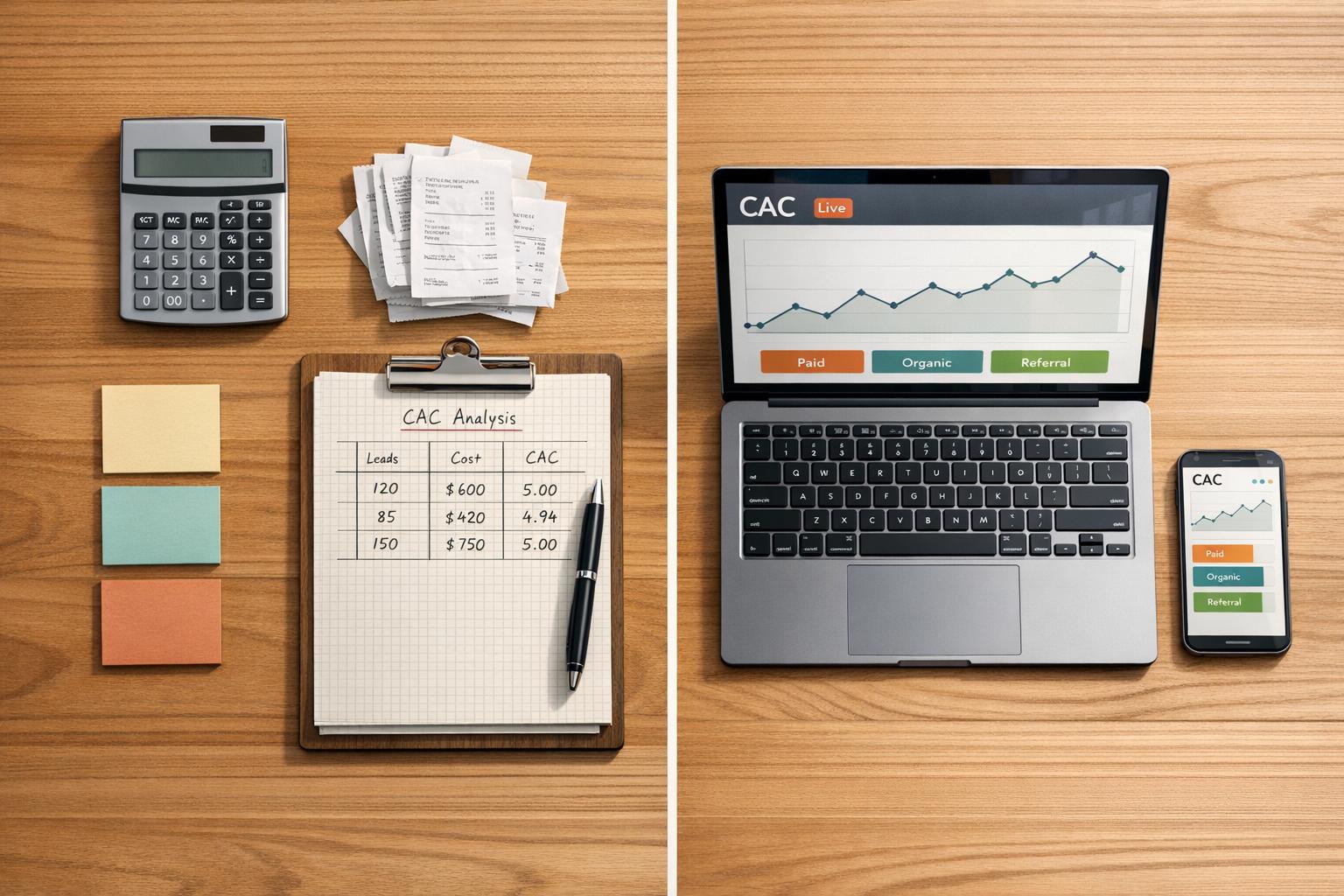
Tracking Customer Acquisition Cost (CAC) effectively is critical to managing growth and profitability. Here's the bottom line: manual tracking may work for small, simple setups, but as your business scales, automated tools save time, improve accuracy, and provide deeper insights.
| Metric | Manual Tracking | Automated Tools |
|---|---|---|
| Time Required | Hours per cycle | Real-time syncing |
| Accuracy | Prone to errors | High reliability |
| Scalability | Limited | Handles complex data |
| Insight Depth | Basic averages | Multi-channel insights |
For startups, manual tracking may suffice. But for businesses scaling or managing complex campaigns, automation is the smarter choice. Transitioning to automated systems can transform CAC tracking into a tool for smarter decisions and growth.
Manual vs Automated CAC Tracking: Complete Comparison Guide
Manual CAC tracking involves using tools like Google Sheets or Excel to pull together data from various sources. The process starts by selecting a specific timeframe - whether it's a month, quarter, or year - and compiling all marketing and sales expenses for that period. These expenses include direct costs like ad spend and indirect ones such as salaries, commissions, software fees, and overhead.
Data typically comes from platforms such as Snowflake, HubSpot, Salesforce, and ad networks. Once collected, you input the numbers into a spreadsheet, tally up the new customers acquired during the timeframe, and calculate CAC by dividing the total expenses by the customer count. As Brian Balfour, CEO of Reforge, points out:
"If you don't take these time periods [sales cycles] into account, you could be overestimating or underestimating CAC and as a result making some terrible operating decisions."
For businesses with an average sales cycle of 60 days, it's crucial to align expenses from two months ago with current customer conversions for accurate tracking.
One common pitfall is underestimating CAC by focusing only on advertising spend. A more thorough calculation - factoring in salaries, tools, and overhead - often reveals a much higher "Full CAC." For instance, a CAC initially thought to be $200 could actually be closer to $900 [1]. In fact, excluding indirect costs can understate true expenses by 30–50%. While manual tracking allows for detailed oversight, it can become cumbersome as datasets grow larger.
Manual tracking has its strengths and weaknesses. It can work well for startups with straightforward operations but may falter as complexity increases. This approach is often ideal for early-stage startups (pre-$1M ARR) still working to establish product-market fit or for businesses with simple marketing funnels and limited resources. It provides full control over how costs are calculated without needing advanced engineering. However, as Julian Alvarado from Coefficient.io explains:
"Accurately calculating CAC can be complex, especially when... manual spreadsheet refreshes are embedded into your workflow." [3]
| Feature | Advantages | Disadvantages |
|---|---|---|
| Cost | Low initial investment using familiar spreadsheet tools. | Labor-intensive as the process scales. |
| Control | Full control over logic and allocation of overhead. | Susceptible to human error and data entry mistakes. |
| Flexibility | Easy to adapt for custom business models or unique cases. | Struggles to handle high lead volumes or complex datasets. |
| Speed | Quick to set up with existing tools. | Time-consuming data reconciliation may result in outdated insights. |
One major hurdle with manual tracking is the issue of data silos - when critical information is scattered across disconnected systems. This often requires frequent manual exports and updates, which can slow down decision-making and increase the workload needed to hit revenue goals.
Automated CAC tracking tools connect seamlessly with CRMs like HubSpot and Salesforce, ad platforms such as Google, Meta, and LinkedIn, and data warehouses like Snowflake or BigQuery. This integration eliminates the need for manual data exports by syncing spend and revenue information in real-time or on a set schedule. Using secure OAuth connections and pre-built integrations, these tools ensure your CAC metrics stay up-to-date without extra effort [6][7].
What makes automation stand out is its ability to link anonymous visitors to known leads through identity resolution. By using device IDs and cookies, these tools provide a complete picture of the customer journey, which manual tracking often misses. Instead of relying on basic last-touch attribution, automated systems offer multi-touch attribution models - like linear, time-decay, and position-based - that distribute credit across every interaction along the buyer's path [6][7][10].
These platforms also simplify cost allocation by automatically distributing shared expenses, such as salaries, software costs, and overhead, across channels based on spend or customer volume. Some advanced systems even include conversational analytics, allowing users to query data with natural language. For example, you could ask, "Which channel had the lowest CAC last month?" and get an instant answer [9]. These features set the groundwork for the efficiency and accuracy benefits discussed next.
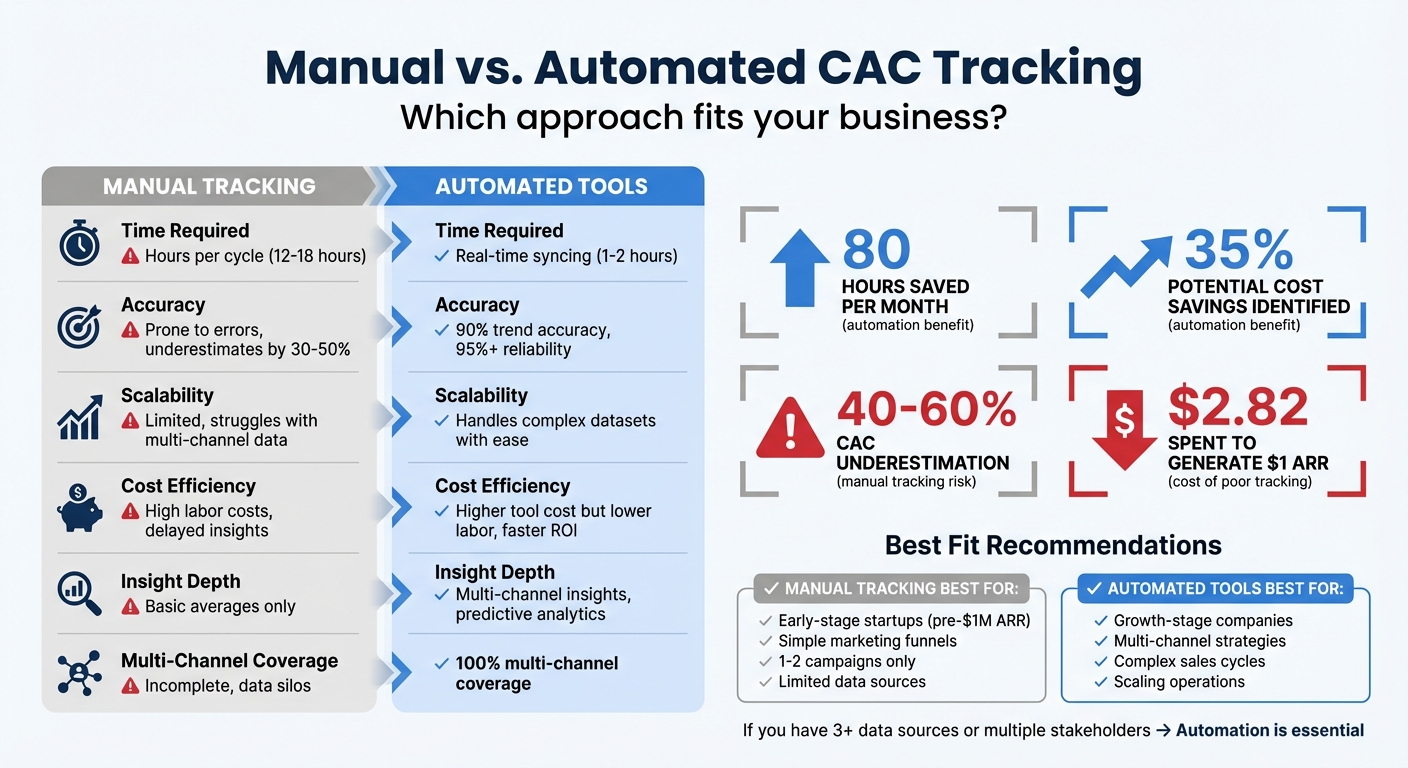
The time savings alone are a game-changer. Manual CAC analysis can take 12–18 hours per cycle, while AI-driven automated tools cut this down to just 1–2 hours [8]. With less time spent on repetitive tasks, your finance and marketing teams can focus on strategic initiatives instead.
Automation also boosts accuracy. Automated systems achieve 90% trend accuracy and provide 100% multi-channel coverage, far surpassing manual tracking, which is prone to errors and outdated data [8]. Companies using these tools report over 95% reliability in their reporting [9]. Additionally, automated systems often uncover cost-saving opportunities that manual methods overlook - businesses can identify up to 35% in potential savings [8].
For companies in growth mode, scalability is another critical advantage. As marketing channels expand and sales cycles grow more complex, automated tools handle the increased data effortlessly. They even offer predictive capabilities, using AI-driven alerts to monitor trends and flag any deviations from target costs, enabling proactive management [8][1].
As Derek Martin, Partner, puts it:
"It truly helps you sleep better at night. Knowing that if you've got 12 or 25 different campaigns, that each of those campaigns are net positive, and driving ROI." [11]
These benefits are further illustrated through real-world success stories.
The impact of automation is evident in real-world applications. For instance, ClickUp used AttributionApp integrated with HubSpot as it scaled from $4M to over $150M in ARR. This setup allowed them to connect paid channels and product usage directly to revenue, providing their finance team with audit-ready CAC and payback metrics that manual tracking couldn't deliver [6]. Similarly, United Way Northwest Indiana saved around 80 hours per month and $20,000 annually by adopting automated data pipelines that unified fragmented sources into real-time dashboards [9].
Phoenix Strategy Group (https://phoenixstrategy.group) exemplifies how automation can elevate CAC tracking. They specialize in building automated financial data pipelines for growth-stage companies, synchronizing marketing spend, sales activity, and revenue in real-time. By replacing reactive spreadsheet analysis with predictive financial intelligence, they enable leadership teams to make informed scaling decisions. Their Integrated Financial Model links CAC metrics directly to cash flow forecasting and unit economics, addressing the limitations of manual tracking and offering a unified, forward-looking framework.
A critical aspect of these systems is ensuring they account for "fully loaded" costs - not just ad spend, but also sales commissions, software subscriptions, and overhead. When configured correctly, automated tools transform CAC from a retrospective number into a strategic asset that drives future growth [1][12].
When it comes to tracking Customer Acquisition Cost (CAC), the differences between manual and automated methods are stark. Manual methods demand hours of tedious data entry, while automated systems handle real-time syncing, providing instant updates on dashboards [1]. Accuracy is another critical factor - manual tracking often overlooks non-advertising costs like sales compensation, content production, and overhead, leading to underestimations of CAC by as much as 40–60% [1][13].
| Metric | Manual CAC Tracking | Automated CAC Tools |
|---|---|---|
| Time Required | High; hours spent on data entry and reconciliation [1] | Low; real-time data syncing and dashboard updates [1] |
| Accuracy | Prone to human error and missing non-ad costs [13] | High; pulls direct data from CRM and financial APIs [13] |
| Scalability | Low; becomes unmanageable with multi-channel growth [1] | High; handles complex, high-volume data effortlessly [1] |
| Cost Efficiency | High labor costs and delayed insights [1] | Higher tool cost but lower labor cost and faster ROI [1] |
| Insight Depth | Basic; usually limited to "blended" averages [13] | Deep; provides channel-specific and predictive insights [13] |
Stephanie Trovato, a Content Strategist, sums it up perfectly:
"CAC gets misleading fast when teams track ad spend, then miss the costs that sit elsewhere. Sales compensation, tools, content production, overhead allocation, and manual work all shape what it costs to win a customer" [1].
These differences highlight how the choice between manual and automated methods depends on your business's scale and data complexity.
For early-stage companies with straightforward sales funnels and minimal data sources, manual tracking can work. Spreadsheets are usually sufficient for managing one or two campaigns. However, as soon as your sales process involves multiple stakeholders or data from more than three systems, automation becomes a necessity [1].
Manual processes often create bottlenecks for scaling businesses, delaying critical budget decisions. In 2024–2025, some companies in the top spending quartile found they were spending $2.82 to generate just $1 in Annual Recurring Revenue (ARR), largely because of incomplete cost attribution and slow data reconciliation [13]. Additionally, average CAC has risen by about 14% annually [13], and every new competitor increases CAC by 15–20% [1]. For growth-stage businesses, these inefficiencies can be costly.
Automated systems powered by AI have shown to improve conversion rates by 20–30%, turning CAC tracking into a strategic advantage rather than just a retrospective metric [13]. These tools allow businesses to shift from reactive to proactive decision-making, paving the way for sustainable growth.
Switching from manual to automated CAC tracking can save time and improve accuracy. The first step is to audit all acquisition-related costs, such as sales software subscriptions, travel expenses, and even a portion of office rent [4][1]. monday.com highlights the importance of this process:
"When acquisition data lives across systems, teams spend time reconciling numbers instead of acting on them" [1].
To streamline this, centralize your data by connecting ad spend platforms, CRMs, and billing systems into a single dashboard [5][1]. Your automated system should account for more than just ad spend - it should also include sales commissions, marketing salaries, technology costs, and overhead [1].
Integration is key. Use pre-built connections to ensure your marketing attribution tools sync directly with CRMs and billing platforms. This eliminates the need to manually compile data from various sources [5][4]. Additionally, automate workflows like lead scoring and email sequences. AI-powered lead scoring can help prioritize high-intent prospects, which improves conversion rates and reduces labor costs per opportunity [1].
Once your CAC tracking system is automated, ongoing monitoring is essential to maintain accuracy and efficiency. Conduct monthly reviews of your CAC payback period - calculated as Acquisition Cost ÷ (ARPA × Gross Margin %) - and investigate any deviations greater than ±10% from the trailing three-month average [4]. Top-performing SaaS companies aim for a payback period of under 12 months [5][4].
Track performance by channel, customer type, and cohort to pinpoint inefficiencies [5][4]. A healthy LTV:CAC ratio typically ranges between 3:1 and 4:1 [5][1]. If the ratio exceeds 5:1, you might be underinvesting in growth and should scale up successful channels [4]. On the flip side, if it drops below 2:1, focus on improving efficiency before increasing spending [4]. As Alex Fine from Understory Agency explains:
"Consistent, segmented tracking transforms CAC and LTV from static numbers into actionable levers for sustainable growth" [4].
For early-stage companies, using three-month averages can help smooth out volatility. Enterprise businesses, however, should rely on rolling windows that align with their longer sales cycles [4]. By following these steps, you can transition from manual tracking to a fully automated system, allowing your CAC data to guide smarter growth strategies with expert financial oversight.
Tracking Customer Acquisition Cost (CAC) accurately is key to identifying strategies that lead to sustainable growth. For early-stage businesses with smaller data volumes, manual tracking can be a practical choice. It offers flexibility and comes with minimal upfront expenses. However, it’s worth noting that manual methods can be time-intensive [14] and prone to inconsistencies caused by human factors like fatigue and cognitive overload [2].
As businesses grow, automation becomes the logical next step. Automated tools address the limitations of manual tracking by processing data much faster and ensuring consistent accuracy across all metrics [2]. In fact, automated systems often match or outperform manual processes in terms of precision [2].
The choice between manual and automated tracking depends largely on your business’s size and growth trajectory. For companies handling larger datasets or scaling rapidly, automation is no longer optional. Manual methods simply can’t keep up without incurring significant time and operational costs [14]. Automated systems also offer the added benefit of real-time data capture, which supports better risk analysis and more personalized decision-making [2][15].
If you’re ready to make the switch, start by centralizing your data. This means accounting for all acquisition costs - not just ad spend, but also expenses like sales commissions, marketing salaries, technology subscriptions, and overhead. A solid data foundation ensures your automated system delivers a complete and accurate view from the outset.
For businesses navigating this transition, Phoenix Strategy Group (https://phoenixstrategy.group) offers specialized FP&A and data engineering services tailored to growth-stage companies. Their expertise in real-time data synchronization and strategic advisory helps transform CAC tracking into a powerful growth tool. Whether you’re adopting automation for the first time or fine-tuning an existing system, their fractional CFO services provide the guidance needed to align your tracking methods with your business model and sales cycle.
In short, moving from manual to automated CAC tracking doesn’t just save time - it turns your data into a strategic advantage. With the right tools, CAC tracking evolves from a basic reporting task into a driver of smarter capital allocation and sustainable growth.
When calculating full CAC (Customer Acquisition Cost), it's important to include all expenses related to your sales and marketing efforts. This goes beyond just ad spend and should cover:
By factoring in all these components, you get a clearer picture of your actual acquisition costs, which is essential for better financial planning and decision-making.
When spreadsheets start feeling like a bottleneck - slowing you down, leading to errors, or falling short on delivering real-time insights - you know it's time to switch to automated CAC tracking. Automation brings better accuracy, saves time, and delivers real-time data that helps you manage cash flow and refine growth strategies. For businesses focused on scaling and making smarter decisions, automating CAC tracking isn't just helpful - it’s a game-changer.
Matching your marketing investments to customers with lengthy sales cycles hinges on understanding the CAC payback period. This metric reveals how long it takes for your business to recoup customer acquisition costs through gross profit. To stay on top of this, leverage a CAC payback dashboard for real-time monitoring.
To refine your strategy further, analyze customer cohorts and track performance across channels, campaigns, and segments over time. This approach helps you predict CAC trends and fine-tune your marketing spend to better align with the value each customer brings.