Published on
May 11, 2026


Compliance automation has become a major focus for venture capital (VC) funding due to its ability to address rising compliance costs, regulatory complexity, and operational inefficiencies. Businesses, especially in highly regulated industries like finance, healthcare, and technology, face mounting pressure to streamline compliance processes with fractional CFO services. Here's why this trend is gaining traction:
Compliance automation offers cost savings, risk reduction, and scalability, making it an attractive investment for VCs and a critical tool for businesses navigating today's regulatory landscape.
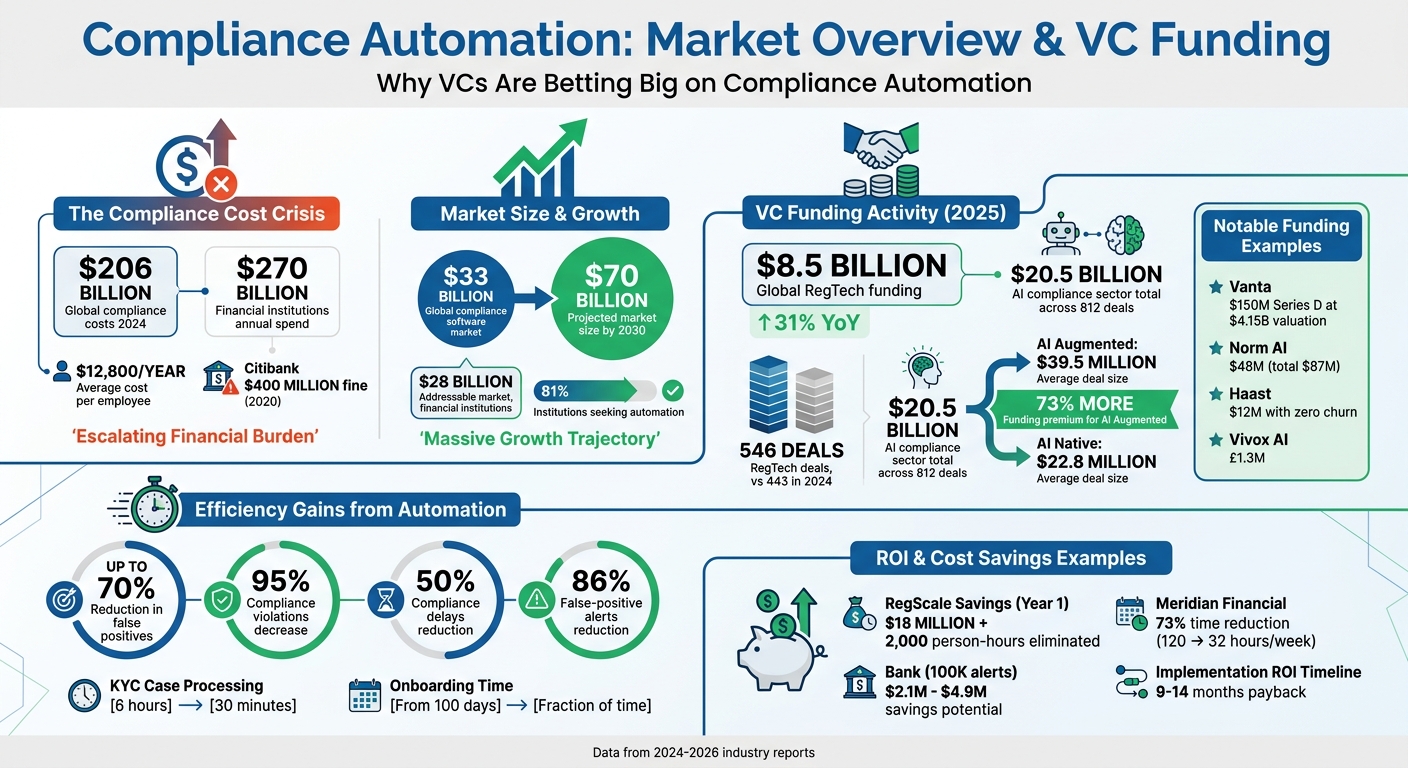
Compliance Automation Market Statistics and VC Funding Trends 2025-2026
The compliance software market is booming, with a global valuation exceeding $33 billion. Financial institutions alone spend a staggering $270 billion annually on regulatory compliance, creating a $28 billion addressable market as 81% of these institutions actively seek cost-effective compliance technologies [5][6]. The transition from manual processes to automated systems is no longer optional - it's a necessity. Compliance and legal teams currently spend 70% of their time on repetitive, manual tasks. Adding to the challenge, the explosion of AI-generated content has increased enterprise content volume by 8x to 10x, making manual review unfeasible. Automation offers a scalable solution, enabling efficiency gains without proportional cost increases [6]. This combination of market growth and operational inefficiencies has drawn significant venture capital interest toward scaling compliance automation solutions.
As regulatory demands grow, the potential for compliance automation continues to attract innovation and investor confidence. In 2025, venture capital investment in compliance automation soared, with global RegTech funding increasing 31% year-over-year, reaching $8.5 billion across 546 deals - a notable rise from 443 deals in 2024. Meanwhile, the broader AI compliance sector pulled in $20.5 billion across 812 deals [1][8].
Investors are particularly drawn to established solutions that integrate AI. Companies enhancing existing products with AI - often labeled as "AI Augmented" or "retrofitters" - secured 73% more funding per deal in 2025, with an average of $39.5 million per deal, compared to $22.8 million for AI-native startups [1]. This trend reflects buyer preferences for trusted workflows in highly regulated environments. A standout example is Vanta, which raised $150 million in a Series D round at a valuation of $4.15 billion. This round was led by Wellington Management, with participation from Goldman Sachs and Sequoia [8].
While financial services remain the largest driver of demand, other industries are quickly following suit. Healthcare and pharmaceutical companies are focusing on automation to manage the overwhelming volume of regulatory documentation required by HIPAA, the FDA, and the EU Medical Device Regulation (MDR) [6]. Similarly, technology companies - especially those in AI - are racing to adopt compliance tools to address emerging regulations like the EU AI Act and state-level AI bias laws [6].
The push for automation is urgent. AI-powered solutions are transforming traditionally slow processes. For instance, AI-driven transaction monitoring can reduce false positive alerts by up to 70%, significantly improving operational efficiency [5].
As Rohit Agarwal, Managing Director at Peak XV, put it: "We are seeing a major shift across large enterprises: a content explosion driven by LLMs alongside an increasingly complex regulatory landscape" [6].
Building on the momentum of market expansion and increased investment, compliance automation directly tackles the hurdles posed by intricate regulatory landscapes.
Traditional compliance methods rely on periodic reviews - checking customer records every few years. Automation flips this model on its head, enabling continuous Know Your Customer (KYC) processes. By leveraging real-time data feeds, behavioral analytics, and external updates like sanctions lists or ownership changes, automated systems keep customer profiles up to date without manual intervention. Regulatory requirements are transformed into engineered routines that integrate seamlessly into daily operations. These systems sync with core business applications, issuing immediate alerts for high-risk activities.
The results are striking. Companies utilizing automated regulatory tracking have seen violations drop by as much as 95% and compliance delays cut in half [4]. Automated systems flag high-risk patterns and approaching deadlines, notifying compliance teams instantly and reducing the likelihood of missed filings - a common risk with manual processes. This proactive approach minimizes operational risks, bolsters investor confidence, and enhances return on investment (ROI).
Manual compliance processes often lead to disorganization, with institutions relying on scattered spreadsheets and email threads. This creates inefficiencies and increases the risk of errors [4]. Automation eliminates this chaos by maintaining detailed, time-stamped digital audit trails for every compliance-related action. These logs include user IDs and contextual information, creating a level of transparency that manual methods simply can't replicate.
Take Meridian Financial Group, for example. In 2026, the firm, which manages $2 billion in assets, faced a five-day scramble during an SEC exam, resulting in a deficiency letter for poor record-keeping. After adopting a centralized CRM-based system with automated audit trails, they slashed compliance processing time by 73% - from 120 hours to just 32 hours per week - and reduced documentation gaps by 95%. Their next SEC exam was completed in two days, with no deficiencies noted [4].
"Regulators are no longer satisfied with best efforts. They require proof of robust, scalable, and traceable oversight. Ensuring regulatory compliance through manual logs is risky."
- Liam Shanahan, Senior Client Partner, Dualboot Partners [9]
By streamlining record-keeping, companies position themselves for growth without the burden of escalating compliance costs.
In traditional setups, scaling operations often means adding more compliance staff. Automation breaks this cycle. In the U.S., organizations spend an average of $12,800 per employee annually on compliance, with large financial institutions shelling out over $200 million per year [11]. By automating repetitive tasks like AML/KYC reviews and transaction monitoring, businesses can grow without skyrocketing compliance expenses.
The cost savings are impressive. In 2025, RegScale, a compliance automation platform, helped a global organization integrate automated controls into its DevSecOps pipelines, saving $18 million and eliminating 2,000 person-hours in the first year [12]. Similarly, Artemis Health cut its manual compliance workload by 50% [10]. These systems also streamline compliance across multiple frameworks - SOC 2, ISO 27001, GDPR - allowing firms to "collect once, apply many" and avoid redundant work when expanding into new markets. For mid-sized companies (100–300 employees), implementation costs typically range between $150,000 and $300,000, with most recovering their investment within 9 to 14 months [4].
Through enhanced monitoring, efficient record-keeping, and cost-effective scaling, compliance automation not only simplifies regulatory challenges but also strengthens the financial appeal that draws venture capital interest.
Venture capitalists are increasingly investing in compliance automation startups, driven by the need for scalable solutions to tackle regulatory challenges. In 2025 alone, $20.5 billion was funneled into AI compliance startups across 812 deals [1]. This trend reflects a strategic focus on platforms capable of addressing recurring compliance needs efficiently.
Compliance automation platforms are making waves across various industries. While FinTech led the way with $8.4 billion in funding during 2025 [1], the same AI-driven infrastructure - designed for tasks like turning regulations into executable code, real-time monitoring, and automated audit trails - has found applications in cybersecurity, healthcare data protection, and supply chain security [1][3]. This adaptability allows these platforms to expand into new regulated markets without starting from scratch.
Their modular design is key to scalability. For instance, Vivox AI creates "atomic" AI agents, each specializing in tasks such as sanctions screening or transaction monitoring. By February 2026, Vivox had raised £1.3 million after proving its platform could cut compliance case processing times from six hours to just 30 minutes, while reducing false-positive alerts by 86% for enterprises operating in over 100 countries [13].
Another factor drawing investors is how seamlessly these solutions integrate with existing enterprise systems. In 2025, companies that built AI tools to work within established workflows raised an average of $39.5 million per deal - 73% more than "AI Native" startups, which averaged $22.8 million per deal [1].
"The syndicate isn't paying for growth potential. It's paying for proven compliance infrastructure that enterprises already procure."
- Chintan Zalani, Bot Memo [1]
This scalability is further propelled by evolving global regulations, which are tightening at a rapid pace.
Stricter regulations worldwide are fueling demand for compliance automation. This creates a feedback loop: tougher rules drive adoption of automation, which enables regulators to impose even higher standards. For example, the EU AI Act, with an August 2026 deadline, is pushing financial institutions to implement systems with automated logging and human oversight [13]. Non-compliance with high-risk systems under this act could result in fines of up to €35 million or 7% of global annual turnover [13]. These requirements aren't optional - they're critical investments for staying compliant.
In the U.S., RegTech investments surged to $5.9 billion across 294 deals in 2025, marking a 17% increase in funding and a 29% rise in deal volume compared to the previous year [2]. Globally, the market for AI in RegTech is projected to reach $3.3 billion by 2026, with a compound annual growth rate of 36.1% [2]. By April 2026, RegTech firms accounted for over one-third of all global FinTech transactions [2].
"The combination of regulatory tailwinds, institutional capital, and genuinely transformative AI capabilities creates the kind of market conditions that produce category-defining companies."
- FinanceX Magazine [2]
Countries like the UK, Singapore, and EU member states are moving toward requiring "provable governance", making auditable AI a global standard [13]. This trend allows companies to expand internationally with minimal adjustments, reducing risks for investors. Tightening regulations also create cost predictability, which strengthens the return on investment (ROI) for backers.
Compliance spending is a non-negotiable expense - companies must meet regulatory requirements regardless of the economic climate. Globally, financial institutions spend over $275 billion annually on compliance [7], with companies averaging $10,000 per employee per year on compliance-related activities, a figure that has doubled in the past decade [14]. This creates steady, recurring revenue streams that appeal to venture capital and debt investors alike.
The efficiency gains from automation directly enhance ROI. For example, a bank processing 100,000 alerts annually could save between $2.1 million and $4.9 million using AI automation [5]. Additionally, AI-powered transaction monitoring can reduce false-positive alerts by up to 70%, enabling compliance teams to focus on real risks [5].
Automation also speeds up revenue generation. Traditional onboarding processes can take up to 100 days, delaying revenue recognition. Norm AI, which raised $48 million in April 2026 (bringing its total funding to $87 million), uses AI agents to convert regulations into decision trees and executable programs. This approach streamlines analyses that once required large legal teams, significantly reducing onboarding times [2].
Other success stories highlight the model's effectiveness. Vanta, for instance, raised $150 million in Series C funding at a $2.45 billion valuation in July 2024. By 2026, it had launched an autonomous AI agent capable of managing security and compliance workflows end-to-end without human intervention [3].
The takeaway is clear: compliance automation not only cuts costs but also helps companies avoid penalties that could amount to billions of dollars. For investors, this combination of cost savings and risk mitigation is hard to ignore.
Compliance automation is addressing a pressing need, particularly in sectors like finance, where regulatory compliance costs hit an estimated $270 billion annually [6]. This technology is proving its worth by cutting down false-positive alerts and slashing onboarding timelines from 100 days to just a fraction of that [5]. As a result, businesses can scale operations and content production without needing to proportionally expand their compliance teams.
Compliance is non-negotiable, making automation platforms a dependable source of recurring revenue. In 2025, the sector secured $20.5 billion across 812 deals [1]. Notably, companies that integrated AI into established workflows raised 73% more per deal than startups focused solely on AI [1]. With applications spanning industries like FinTech, healthcare, and supply chain management, these platforms are well-positioned to break into other regulated markets. Regulatory developments, such as the EU AI Act and mandates for continuous monitoring, are further fueling growth, with projections estimating the market will reach $70 billion by 2030 [3].
For growth-stage businesses, compliance automation offers a clear strategic edge. The sector’s rapid expansion has drawn significant interest from venture capitalists, validating its role in helping companies scale operations efficiently.
Mid-market firms benefit not just by avoiding fines but by unlocking revenue opportunities. Take Haast, for example. After raising $12 million in April 2026, the company achieved zero customer churn by embedding compliance features directly into tools like Google Workspace and Salesforce. This allowed clients to manage growing content demands without adding legal staff [6]. By turning compliance into a driver of efficiency rather than a bottleneck, companies gain a competitive edge.
For businesses aiming to scale, choosing platforms that integrate seamlessly into existing workflows is crucial. Solutions that provide court-ready audit trails and enable continuous risk assessments are particularly appealing to enterprise buyers and investors alike.
"Enterprises shouldn't have to choose between moving fast and staying compliant, and that tradeoff is exactly what manual review processes currently force on teams."
- Kunal Vankadara, CEO of Haast [6]
Embedding automation early allows companies to meet rigorous regulatory standards while scaling efficiently. This approach also attracts larger acquirers and institutional investors, who see automated compliance as a key factor in reducing risk.
For those collaborating with Phoenix Strategy Group on fundraising or M&A efforts, showcasing a strong, automated compliance infrastructure can significantly enhance appeal to institutional investors. Regulatory readiness is increasingly seen as a critical factor in de-risking investment opportunities.
Start with automating those repetitive and time-consuming tasks that often lead to human errors - like regulatory reporting. Automation can simplify workflows, minimize mistakes, and save valuable time. Focus on areas such as compliance monitoring, risk assessment, and document collection. Processes like AML (Anti-Money Laundering), KYC (Know Your Customer), and generating audit trails are also perfect candidates for automation. These not only cut down delays and violations but also boost overall efficiency. By prioritizing regulatory reporting first, you create a solid starting point for expanding automation efforts.
Evaluating the return on investment (ROI) of compliance automation means looking at how it improves efficiency, reduces errors, and minimizes risks. Here are some key factors to consider:
Beyond these measurable benefits, automation also supports scalability. It allows businesses to handle growth without a matching increase in costs. On top of that, automated tools enable quicker risk responses and better decision-making, giving companies a strategic edge.
An audit-ready compliance platform needs to cover three key aspects to make the process seamless and efficient:
These features work together to simplify compliance management and make audits far less daunting.