Published on
January 12, 2026


Market risks like currency fluctuations, commodity price swings, and interest rate changes can disrupt financial plans, especially for growth-stage companies with tight margins. Hedging helps stabilize cash flow, earnings, and balance sheets by reducing uncertainty in financial forecasts.
Key takeaways:
Hedging isn’t about predicting markets - it’s about building resilience into financial planning. By incorporating hedging into monthly workflows, FP&A teams can reduce volatility and support growth goals.
Start by determining what needs protection. For most growth-stage companies, the big three market risks are foreign exchange (FX) volatility, interest rate fluctuations, and commodity price swings. FX risk comes from factors like timing mismatches, revaluations, and adjustments to competitive pricing, which can lead to transaction, translation, and competitive exposures. Interest rate risk impacts both funding costs and the pricing of forward contracts, while specific cost components - such as raw materials or labor - may rise at rates that don’t align with the overall Consumer Price Index.
Organize exposures into four key categories: contracted payables, contracted receivables, forecast cash flows, and balance sheet items. Each category typically falls under different teams. For example, procurement and treasury usually manage contracted payables, while FP&A oversees forecast cash flows. The challenge lies in quantifying transaction exposure over a 1- to 3-year horizon, factoring in current contracts and forecast renewals [7]. To address varying levels of certainty, apply tiered hedging ratios: use higher coverage for signed contracts (where certainty is high) and partial coverage for strong forecasts (with medium certainty) [2]. Once exposures are mapped out, refine your approach further with scenario analysis and sensitivity testing.
Develop a range of scenarios - best-case, worst-case, and most likely outcomes - to test and improve your assumptions [6]. Start by identifying external drivers, like GDP growth or regulatory changes, and internal factors, such as strategic initiatives. Then, quantify key uncertainties like interest rates or currency fluctuations using measurable metrics. Apply these scenarios to your financial models to gauge their potential impact on revenue, costs, and cash flow.
"Utilizing sensitivity and scenario analysis in the planning process can be a game changer... [it can] reveal questionable or faulty assumptions in financial models." - Sean Coakley, CFA, Market Strategist, Corpay [4]
For FX exposure, simulate both upside and downside currency swings - typically in the range of ±5% to 20% - to measure how volatility affects the home-currency value of your free cash flow [7]. Instead of relying on standard Value at Risk (VaR), use Cash Flow at Risk (CFaR). CFaR ties hedging decisions directly to operating cash flow and budget stability, translating uncertainty into potential deviations from your financial plan. This makes it easier to justify hedging costs to leadership [2]. To enhance clarity, apply 95% confidence intervals to monthly income statements to visualize spot rate variances [4]. This type of analysis often highlights flawed assumptions or overlooked factors that could otherwise compromise the accuracy of your forecasts.
Once you've mapped out exposures and run scenarios, the next step is choosing tools to minimize forecast uncertainty. Most FP&A teams rely on three main strategies: forward contracts for stability, options for flexibility, and safe haven assets to cushion against broader market shocks.
Forward contracts let you lock in a fixed exchange rate, interest rate, or commodity price for a future date. By agreeing on a set price today, you eliminate the guesswork of forecasting. For instance, if you owe €500,000 to a supplier in 90 days, a forward contract ensures you know the exact USD amount, no matter how the EUR/USD rate fluctuates.
However, this approach has a downside: if the market moves in your favor, you won’t benefit. For example, if the euro weakens, you’re still bound to pay the agreed-upon forward rate. To balance this risk, many businesses use layered hedging, which involves spreading forward contracts across different timeframes. A Canadian energy exporter managed USD/CAD fluctuations (ranging from 1.3100 to 1.3800) by layering contracts: 80% coverage for months 1-3, 60% for months 4-6, 40% for months 7-9, and 20% for months 10-12. This strategy smoothed their overall exchange rate and reduced volatility [1]. Research suggests that a 12-month layering approach can cut cost volatility by 70%, while a 6-month strategy reduces it by 36% [5].
Forward contracts are best suited for obligations with clear amounts and deadlines. Steven Moffat, Vice President of Finance at North American Produce Buyers, uses them to stabilize crop prices affected by unpredictable weather, ensuring the company isn’t "taken advantage of if the market dips" [1].
For exposures that are less predictable, it’s better to opt for tools that offer more flexibility.
Options provide the right - but not the obligation - to execute a transaction at a predetermined price. Think of options as insurance: you pay a premium upfront, and they protect you if the market moves against you, while still allowing you to benefit if the market moves in your favor. A put option safeguards against falling prices, while a call option protects against rising costs.
Options are ideal for hedging uncertain transactions. For example, if you're protecting revenue that hasn’t been booked yet, an option ensures your margins are safe without forcing you to trade if the deal doesn’t go through [3]. The main drawback is cost - option premiums can be pricey, especially during volatile periods. To manage this, many FP&A teams adjust by choosing a strike price slightly offset from the current rate, effectively creating a deductible [11].
"Options are quite literally the equivalent of investment insurance." - Ryann Marotta, CFA, CFP, Senior Portfolio Manager, Austin Asset Management [11]
Roughly 80% of independent registered investment advisers use protective puts to guard against losses [11]. Since options require upfront payment rather than credit, they’re a good choice for companies with limited credit availability [9]. A study of U.S. firms revealed that FX hedging, including options, boosted market valuations by an average of 4.87% [3].
In addition to derivatives, non-derivative assets can provide a safety net. FP&A teams often turn to liquid assets - like gold, U.S. Treasuries, and high-quality bonds - that tend to hold their value during market turmoil. These assets typically have little correlation with equities during volatile periods [10], offering a buffer against systemic risks like recessions, geopolitical events, or credit crises that can’t be addressed with forwards or options alone.
Long-term asset allocation is considered one of the most effective ways to hedge against market risk [10]. Gold, for example, is often recommended as a small part of a portfolio - usually around 5% - to protect against major market disruptions [10]. For companies focused on liquidity, holding enough cash or short-term investments to cover up to five years of expected withdrawals can help avoid selling assets during downturns [10]. While safe haven assets won’t eliminate risks tied to FX or commodities, they add stability during broader market shocks.
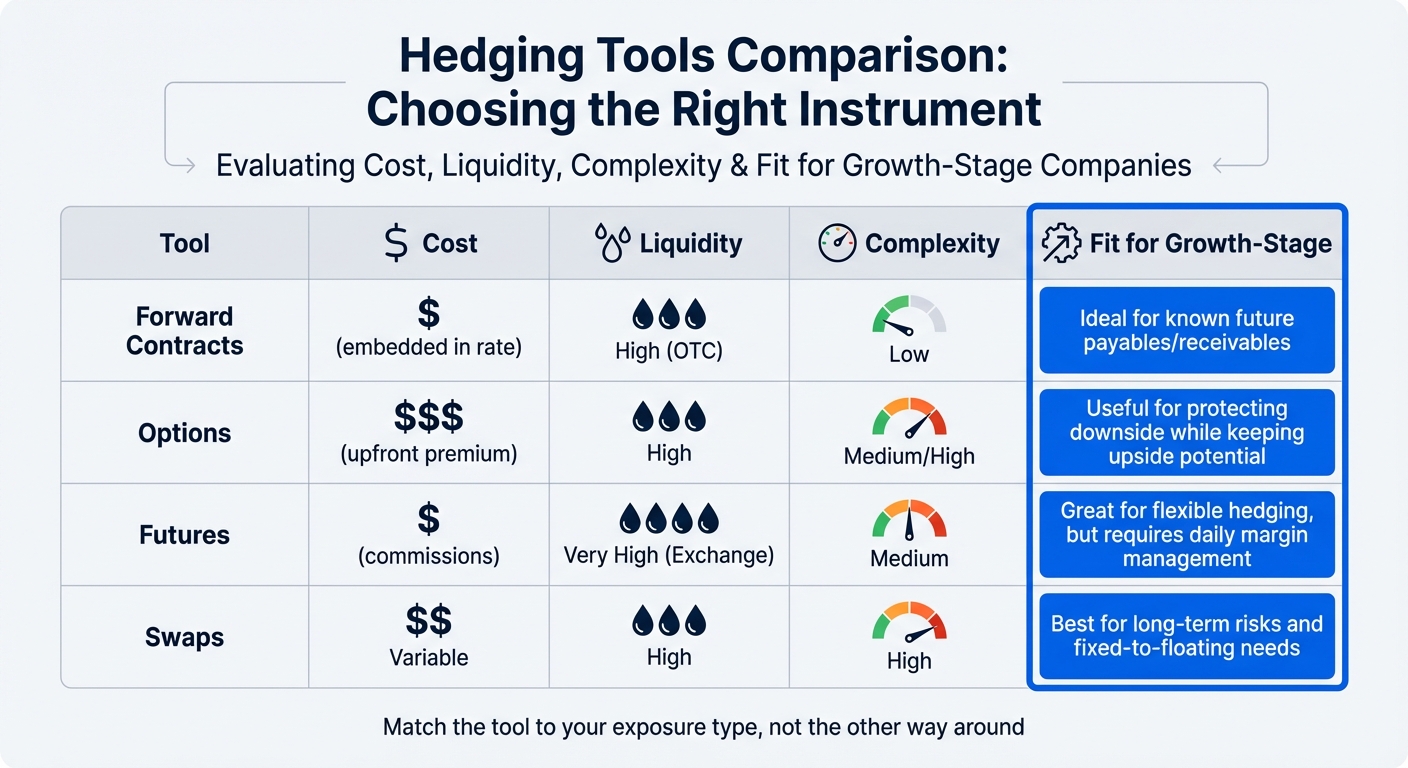
Comparison of Hedging Tools for FP&A Market Risk Management
To effectively incorporate hedging into your financial planning and analysis (FP&A) workflows, align it with your monthly planning cycle. Here's an example of a practical cadence: Week 1: update your exposure map; Week 2: review risk metrics like Value at Risk (VaR) and Cash Flow at Risk (CFaR); Week 3: execute your hedging strategies; and Week 4: report the outcomes to leadership [2]. This process keeps your hedging efforts in sync with your most current forecasts and business goals.
Before executing any hedging strategies, start by updating your exposure map. Categorize risks based on their source and ownership - for example, Procurement might handle contracted payables, while FP&A oversees forecasted cash flows [2]. It's also important to differentiate between two main types of hedging: cash flow hedging, which focuses on protecting future transactions to minimize budget variances, and balance sheet hedging, which addresses revaluation risks on existing assets to reduce earnings volatility [2].
Hedging costs need to be factored into your financial model to ensure transparency. For example, forward contracts embed their costs in the rate through forward points, which are based on interest rate differences between currencies rather than explicit fees [2]. Options, on the other hand, require an upfront premium. You can account for this premium using one of two methods:
The choice of method should align with how leadership evaluates performance, ensuring consistency in reporting.
When preparing your budget, it's a good idea to stress-test it using scenario grids. These grids help you map out best-case, base-case, and worst-case foreign exchange (FX) outcomes. This way, you can see how hedging costs, along with potential gains or losses, might affect your cash flow and margins [2]. This exercise not only clarifies your risk tolerance but also helps justify hedging expenses to stakeholders.
Finally, integrate these hedging costs into your financial model to maintain a clear understanding of how they impact the overall budget.
The right hedging instrument depends on your specific needs. Here's a comparison of the most common tools:
| Tool | Cost | Liquidity | Complexity | Fit for Growth-Stage |
|---|---|---|---|---|
| Forward Contracts | Low (embedded in rate) | High (OTC) | Low | Ideal for known future payables/receivables |
| Options | High (upfront premium) | High | Medium/High | Useful for protecting downside while keeping upside potential |
| Futures | Low (commissions) | Very High (Exchange) | Medium | Great for flexible hedging, but requires daily margin management |
| Swaps | Variable | High | High | Best for long-term risks and fixed-to-floating needs |
Forward contracts are a solid choice when you have clear, high-certainty exposures, such as signed contracts with defined amounts and deadlines. Options provide flexibility, making them a good fit for hedging revenue that hasn't been finalized yet. Futures offer high liquidity but demand active monitoring for margin calls, while swaps are better suited for complex, long-term risk management. Always match the tool to the type of exposure you're managing, not the other way around.
Once you've selected the appropriate instruments, the next step is to define your risk tolerance levels to guide your hedge ratios.
Risk tolerance isn't subjective - it’s a measurable threshold tied directly to your business goals. Start by determining acceptable levels of budget variance and earnings volatility. Then, allocate hedge ratios based on the type of exposure:
This tiered approach ensures you avoid over-hedging, which wastes resources, and under-hedging, which leaves you vulnerable to risk.
Document your strategy in a straightforward FX policy. This policy should outline the scope, objectives, approved instruments, and decision-making rules [2]. It serves as a playbook to maintain consistency across quarters and simplifies onboarding for new team members. Use Cash Flow at Risk (CFaR) if your priority is budget stability, and Value at Risk (VaR) for managing exposure across multiple currencies [2].
Consistently monitoring and tweaking your hedging program is essential. Set up a regular review process and use clear metrics to measure its effectiveness.
When evaluating hedge performance, it’s important to differentiate between accounting effectiveness and economic effectiveness. Accounting effectiveness ensures compliance with regulatory standards like ASC 815, qualifying your program for hedge accounting treatment. Economic effectiveness, on the other hand, focuses on achieving your company’s goals - such as protecting profit margins or meeting budgeted exchange rates [12][13].
For balance sheet hedging, keep an eye on how much of the FX gains or losses during a period your hedges offset. The typical target is 75% to 100%, excluding forward points [13]. For cash flow hedging, focus on budget rate delivery, aiming for 60% to 90% of foreign currency revenues or expenses to align with pre-defined budget rates [13]. Tools like Value at Risk (VaR) can help you estimate potential losses across your portfolio with 95% confidence, while Cash Flow at Risk (CFaR) translates FX uncertainty into potential deviations from planned cash flows [2].
If your hedge doesn’t fully offset FX risks, break down the residual gains and losses into categories like over/under-hedging, forward point effects, unhedged currencies, or timing mismatches between accounting and hedge rates [13]. This analysis can help pinpoint the cause of any shortfall and guide adjustments to future hedge ratios or instruments. For balance sheet hedges, even a modest gain - reducing re-measurement losses by as little as 5% or as much as 150% - is often considered a success [13].
With these metrics in place, you’ll be better equipped to adapt your strategies as market conditions change.
Regularly monitoring hedge performance ensures you can adjust strategies to stay aligned with changing market dynamics. During your monthly reviews, revisit exposure maps and risk metrics to assess how well your program is working [2]. When markets shift, use scenario grids to stress-test your financial models, mapping best-case, base-case, and worst-case FX scenarios to understand potential impacts on margins and cash flow.
As exposure certainty grows, adjust hedge ratios accordingly [2]. Market volatility can also shift correlations - one of the main drivers of basis risk. If this happens, you may need to modify or add positions to maintain hedge efficiency. Stick to your pre-established rules during uncertain times. As Xe Corporate wisely reminds us:
"Hedging is meant to reduce uncertainty, not to guess where markets will go" [2].
Clear communication across teams is critical when making adjustments. Treasury, FP&A, accounting, and tax departments must stay aligned to avoid costly missteps. A cautionary tale: Ford’s miscommunication over palladium hedging led to a $1 billion write-off when prices dropped sharply (Source: Chicago Fed, "Understanding Derivatives", 2013/2026). This highlights how poor internal coordination can neutralize natural hedges or lead to financial mismanagement.
Phoenix Strategy Group enhances FP&A capabilities by embedding hedging strategies into financial workflows, especially for growth-stage companies that may not have the resources to establish sophisticated programs. Their fractional CFO and FP&A services help protect margins without requiring a full treasury team, making hedging more accessible and effective.
Every company faces unique risks, and Phoenix Strategy Group recognizes this by crafting hedging strategies that match each business's specific risk profile and growth goals. Instead of relying on one-size-fits-all solutions, they analyze exposures from foreign exchange (FX), commodities, and interest rate fluctuations. These strategies are customized to align with a company’s risk tolerance and budget constraints.
For businesses preparing for fundraising or mergers and acquisitions, Phoenix Strategy Group conducts tailored stress tests to reveal how market changes could impact valuation and cash flow. Their expertise in unit economics ensures hedging costs are carefully balanced against their effect on contribution margins. This tailored approach equips FP&A teams to manage market risks more effectively.
Phoenix Strategy Group integrates hedging strategies into detailed financial models, providing deeper insights into risk management. Their 3-statement models and 13-week cash flow forecasts demonstrate how tools like forward contracts and options influence cash flows and balance sheets, ensuring liquidity is managed effectively and decisions are executed on time [14].
Using delta-normal analysis, they estimate potential FX losses with a 95% confidence level, offering a forward-looking view of risk probabilities [4]. Sean Coakley, CFA, emphasizes the value of this approach:
"Sensitivity and scenario analysis in the financial planning process can help businesses assess potential impacts of foreign exchange movement on financial performance."
Their scenario planning tools further refine decision-making, allowing businesses to evaluate financial risks under diverse market conditions [14][4]. This transparent modeling approach clearly separates input assumptions from calculations, making it easier to adapt strategies as market dynamics change [14]. With these tools, FP&A professionals are empowered to fine-tune hedging tactics as needed, ensuring strategies remain aligned with evolving market realities.
Hedging isn’t about predicting market trends or profiting from currency fluctuations. Instead, it’s focused on minimizing uncertainty, ensuring that your pricing, margins, and cash flow planning remain steady even when exchange rates, commodity prices, or interest rates shift unexpectedly [2]. For growth-stage companies with tighter margins and smaller cash reserves, this stability is essential to protect against volatility that could threaten your runway or disrupt strategic plans.
The best strategies rely on a combination of clear exposure mapping, tiered hedging based on certainty levels, and a repeatable monthly process that ties real risks to straightforward decision-making rules [2]. For example, you can apply higher hedge ratios to signed contracts where risks are locked in, while maintaining lower coverage for early-stage forecasts, allowing for more flexibility as conditions evolve.
When integrated into your existing FP&A workflows, these practices strengthen your overall financial framework. Hedging is most effective when it becomes a regular part of your FP&A rhythm rather than a one-off task. In fact, structured hedging policies have been shown to reduce earnings volatility by 23% and improve budget accuracy by 60% within just 18 months [15].
Phoenix Strategy Group brings FP&A expertise to the table, helping companies implement disciplined hedging practices that build financial resilience. Even without large treasury teams, growth-stage businesses can manage material risks effectively by leveraging simple tools like forward contracts and incorporating hedging costs into their budgets from the outset. This approach safeguards your ability to execute growth plans, no matter the market conditions. With Phoenix Strategy Group’s fractional CFO and FP&A services, these strategies become accessible, empowering your team to manage risks confidently and focus on scaling with stability. By adopting these methods, FP&A teams can strengthen their risk management efforts and set the stage for sustainable growth.
To zero in on the most pressing market risks for your company, start by examining areas where your financial exposure is most vulnerable. Take a close look at key revenue and cost drivers that are influenced by external forces like commodity prices, foreign exchange rates, interest rates, or supply chain challenges. Link these variables to your profit-and-loss statement and balance sheet, and assess how a ±10% shift in each factor could affect your financial performance.
Scenario planning can help you map out base, best-case, and worst-case outcomes, making it easier to identify factors that might have a big impact on cash flow or earnings. For instance, foreign exchange risks can be evaluated using tools like cash flow at risk (CFaR) or value at risk (VaR), while commodity price risks might call for price sensitivity analysis or forward curve simulations. After ranking these risks by their potential financial impact, you can focus on hedging strategies that align with your company’s risk appetite and financial objectives.
A well-structured hedging policy is key to maintaining consistency and discipline. This involves clearly defining exposures, choosing the right instruments - such as forward contracts or options - and regularly revisiting your strategy to ensure it stays relevant. Phoenix Strategy Group can provide support by building a data-driven framework, running scenario analyses, and crafting tailored hedging programs that not only promote growth but also ensure compliance with U.S. financial reporting standards.
When it comes to managing market risks, forward contracts and options are two popular tools, each with its own approach.
Forward contracts are straightforward: they lock in a specific price for a future transaction. Both parties are obligated to follow through at the agreed price, and there's no upfront cost involved. This makes them a solid choice for those seeking price certainty, though they don’t offer any flexibility.
Options, in contrast, provide more leeway. They give the holder the right - but not the obligation - to buy or sell at a set price. However, this flexibility comes at a cost, as options require an upfront premium. The upside? They allow you to benefit from favorable market changes while capping potential losses, making them a versatile, albeit slightly more expensive, hedging option.
To properly account for hedging costs in your financial planning, make sure to list them as separate line items in your rolling forecasts and scenario analyses. These costs can include things like forward points, trading fees, and operational expenses. It's important to regularly update your cash flow projections to account for any changes in these costs, keeping your forecasts precise and useful.
Use FP&A tools to stress-test how hedging might affect your company’s liquidity and earnings under various market conditions. This method allows you to stay financially stable while effectively managing market risks.