Published on
January 4, 2026


Real-time FP&A tools are transforming finance teams by automating data updates, reducing manual tasks, and delivering faster insights. These platforms integrate with systems like ERP, CRM, and HRIS, replacing outdated spreadsheet workflows. Companies using these tools report improved efficiency, reduced errors, and ROI as high as 300%. Yet, many finance teams still rely on manual methods, missing opportunities for growth and accuracy.
Here’s a quick overview of four leading FP&A tools:
Quick Comparison:
| Tool | Key Features | Best For | Setup Time | Starting Cost |
|---|---|---|---|---|
| Abacum | Unlimited dimensions, 50+ integrations | Mid-market companies | ~4 months | $20,000+ annually |
| Cube | Excel integration, scenario modeling | Small businesses using Excel | ~5 months | $20,000+ annually |
| DataRails | 200+ integrations, Excel-based | Teams needing consolidation | 6–12 weeks | $20,000+ annually |
| LiveFlow | QuickBooks sync, fast reporting | QuickBooks users | ~1 hour | Lower cost (~$10,000) |
Real-time FP&A tools save time, improve accuracy, and enable faster decision-making. Whether you’re focused on reporting, budgeting, or forecasting, choosing the right platform depends on your business size and needs.
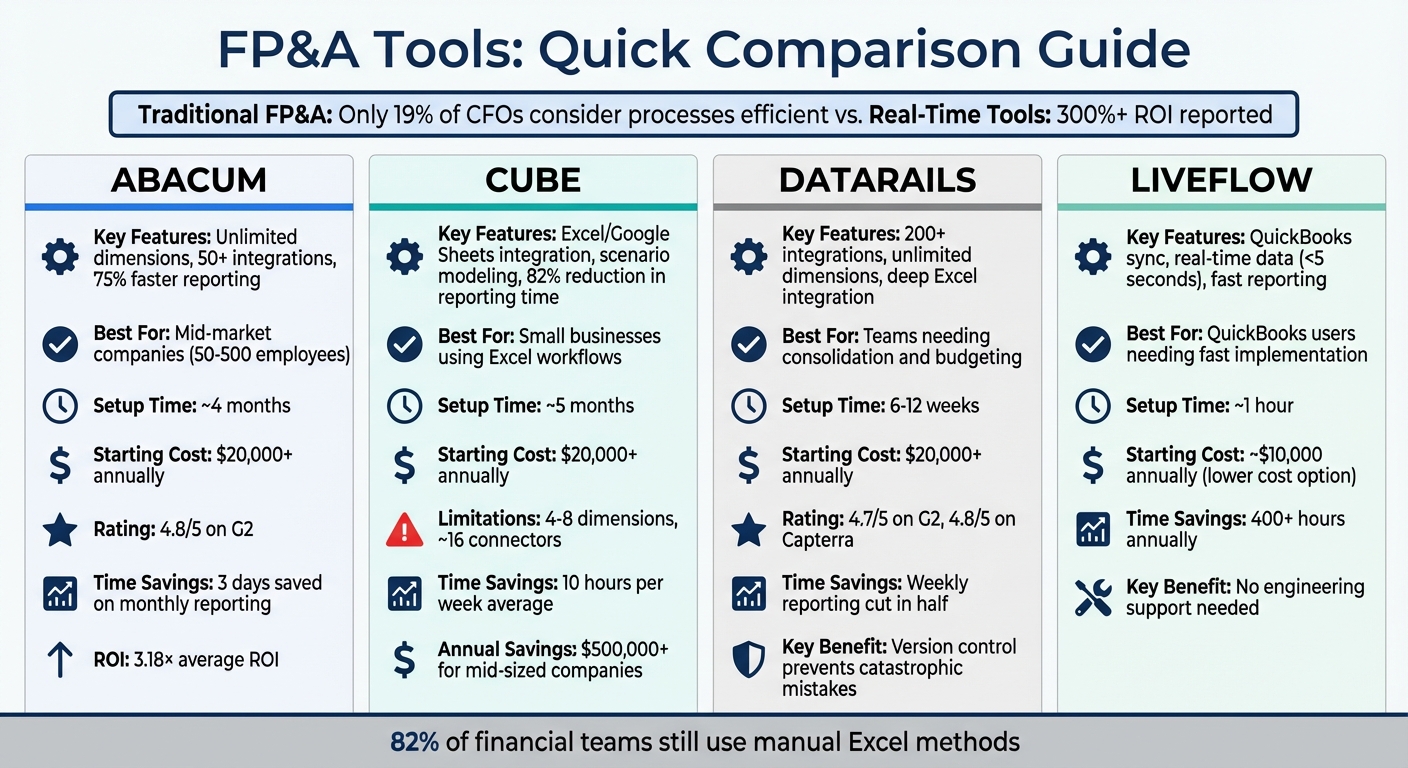
FP&A Tools Comparison: Features, Costs, and Implementation Time
Traditional FP&A methods are falling short for many finance teams. In fact, only 19% of CFOs consider these processes efficient, and just 25% believe they lead to effective decision-making [2]. The reliance on manual spreadsheet-based workflows is a major culprit behind this inefficiency.
Finance professionals using these outdated methods spend a staggering amount of time on low-value tasks. Only 35% of their time is dedicated to high-value activities like generating insights [3]. The rest is consumed by manual data tasks - exporting files, reconciling numbers, and fixing formulas. For nearly 29% of organizations, finalizing a forecast takes over 10 days [3]. Compare that with one company that automated over 1,000 data sources and slashed its forecast input time from 45 days to just 3 [2].
Real-time FP&A tools eliminate these bottlenecks by directly syncing with systems like ERPs, CRMs, and payroll through automated APIs. Take Quality Bearings Online, for instance. By adopting real-time software, the leadership team could validate financial data during live meetings in just 10 seconds, a massive improvement over their previous manual checks [4]. Sam Moss, Chief Operating Officer at Quality Bearings Online, highlighted this transformation:
With Phocas, we verify data in live meetings in just 10 seconds, allowing us to move on immediately. [4]
Another key advantage of real-time tools is their ability to reduce errors. Sixty-nine percent of organizations cite human error as their top concern when it comes to data integrity in manual processes [4]. Real-time tools address this by automating reconciliation and using AI to flag anomalies instantly. Despite these advantages, 82% of financial teams still rely on manual tools like Excel [4], leaving them vulnerable to version control issues and formula-related disruptions.
Here’s a quick comparison of traditional FP&A methods versus real-time tools:
| Feature | Traditional FP&A (Spreadsheets) | Real-Time FP&A Tools |
|---|---|---|
| Speed to Insights | Weeks or days (often tied to month-end close) | Instant or real-time dashboards |
| Data Refresh | Manual exports and batch uploads | Automated sync via APIs/connectors |
| Error Rates | High (69% cite human error as primary concern) [4] | Low (automated reconciliation and AI alerts) |
| Scalability | Limited; prone to version control issues | High; centralized single source of truth |
| Scenario Planning | Slow; 21% of teams can't run it at all [3] | Fast; what-if analysis in minutes |
| Time on High-Value Tasks | 35% of professional time [3] | Increased focus on analysis due to a 45% reduction in manual work [5] |
The data makes it clear: real-time tools not only save time but also improve accuracy, scalability, and decision-making speed. Traditional methods, while familiar, are no match for the efficiency and reliability of modern solutions.
Abacum speeds up financial planning and analysis (FP&A) processes by automating financial and operational reporting. This automation cuts process time by an impressive 75% [8]. Instead of waiting days for month-end consolidations, finance teams gain instant access to live dashboards that integrate data from over 50 sources, including ERPs, HRIS systems, and CRMs [8].
At Yoco, FP&A Manager Pieter Hugo noticed immediate improvements. His team now saves three days on monthly reporting, and budgeting and planning are 60% faster due to enhanced revenue analysis [7]. Similarly, FirstVet streamlined its reconciliations and reporting, shaving five days off their monthly reporting cycle [8].
Scenario planning, which used to take days, now happens in seconds [7][8]. Kenjo’s Head of Finance, Geoffroy de Bouvier, shared how Abacum transformed their forecasting process:
The forecasting period was reduced from 2 months to 3 weeks thanks to Abacum. Helping us save time but also reduce our OPEX spend. [7]
Abacum doesn’t just save time - it helps finance teams uncover cost efficiencies. For example, DCI’s Head of FP&A, Alexander Moll, used the platform to identify departmental cost savings of up to 25% [8]:
Abacum's streamlined workflows enabled us to identify cost savings of up to 25% in key departments, driving tangible business value. [8]
By automating data cleaning and aggregation across 50+ integrations, Abacum eliminates the need for manual CSV downloads and reduces errors, all while saving money [8]. Cortex reported 50% faster budget cycles after using Abacum [8], and Aspiritech’s CEO, Tara May, shared that leadership team members save 10–15 hours per month on tasks like updating forecasts or analyzing performance [7].
These efficiencies free up resources and pave the way for more accurate forecasting.
Abacum’s AI-powered forecasting tools use historical data to deliver precise predictions while removing human biases [14]. With access to 700+ native integrations, the platform ensures that forecasts are based on up-to-date information rather than outdated figures [9][13].
Real-time anomaly detection flags inconsistencies immediately, preventing errors from undermining forecast accuracy [10]. Users have reported an 80% reduction in time spent on Budget vs. Actual (BvA) reporting [9][10]. Antavo’s FP&A Manager, Márton Bódis, highlighted the strategic value of Abacum’s tools:
The ability to manage multiple scenarios simultaneously is a game-changer. We can save historical versions, analyze assumptions, and learn from them to make better decisions. [8]
This level of precision supports Abacum’s ability to scale alongside growing businesses.
For growth-stage companies, Abacum offers the flexibility to expand financial models without overhauling existing systems. Its multi-dimensional modeling allows finance teams to add new elements - like products, subsidiaries, or vendors - as the business grows [8][13]. This capability ensures that budgets can be managed at a granular level, giving teams precise control over spending [11].
Abacum’s built-in AI ETL features automatically reconcile and classify data, eliminating the need for manual data management [13]. Organizations using advanced FP&A tools like Abacum report an average ROI of 3.18×, driven by increased revenue and lower operational costs [12]. AI implementation through Abacum can save finance professionals between 50 and 200 hours annually [12][14]. The platform also maintains high user satisfaction, with a 4.8/5.0 rating across major review platforms [7][9].
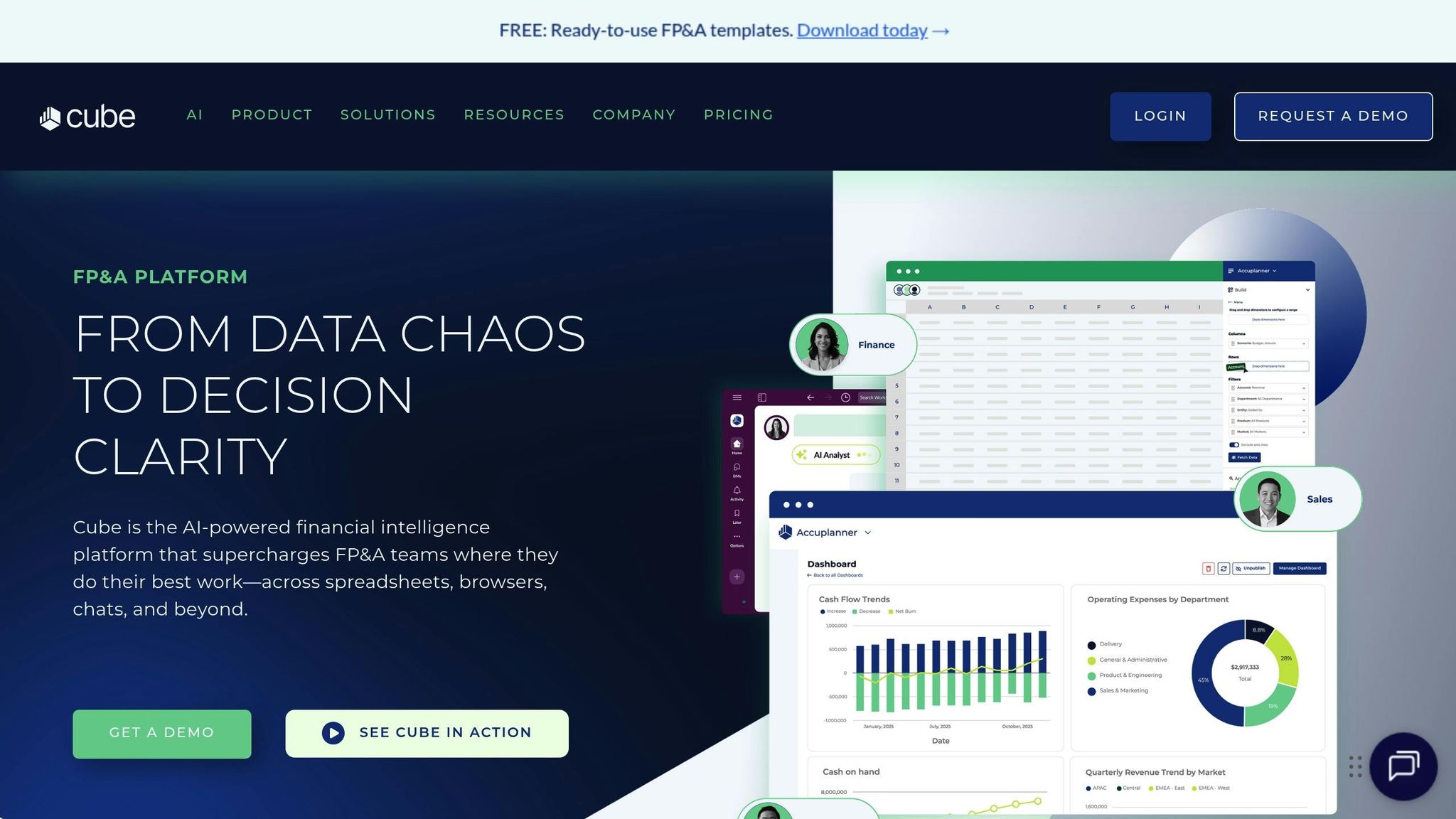
Cube tackles the common bottlenecks in traditional FP&A processes, making data handling much faster and more efficient. Instead of relying on manual exports and tedious VLOOKUPs, Cube automatically pulls data from ERP, CRM, HRIS, and spreadsheet systems. This automation has led to finance teams reporting an 82% reduction in reporting time [15]. Tasks that once took hours now happen with just one click.
Sean Moore, VP of Strategy, shared his experience:
Updating reports across our 80+ stores used to take hours; now with Cube, it can be done in a click [15].
Cube’s AI-powered variance analysis also speeds up the process of identifying changes and understanding their causes, turning hours of work into mere seconds. This shift allows teams to move from simply reacting to data to proactively shaping strategies. By leveraging Cube's AI Suite, users report a 95% reduction in workflow time and gain 10x more insights into their financial data compared to manual methods [15]. These improvements don’t just save time - they also drive tangible cost savings.
The faster insights delivered by Cube translate into significant financial benefits. Mid-sized companies using the platform save over $500,000 annually [15], and Cube boasts a 34% faster payback period compared to competing tools [15]. Ethan Kutner, Director of FP&A, detailed his team’s efficiency gains:
We've saved 10 hours per week and more than $300,000 annually with Cube [17].
Much of these savings come from eliminating manual data management. Finance professionals save an average of 31,267 minutes per year by cutting out repetitive tasks [15]. James Mann, CFO, explained how this shift has changed their focus:
We are now able to spend more than half our time on strategic work - partnering with the business instead of cleaning up the numbers [15].
By integrating directly with Excel and Google Sheets, Cube minimizes the need for extensive training and ensures compliance with cloud governance standards.
Thanks to its seamless data integration, Cube creates a single source of truth, solving version control issues that often plague traditional FP&A workflows. By combining historical data with real-time updates from connected systems, Cube eliminates errors caused by outdated information or broken formulas. Its AI-powered tools automatically detect anomalies and validate data integrity, ensuring forecasts are based on reliable numbers.
Cube also allows finance teams to run unlimited "what-if" scenarios without duplicating files or worrying about version control. Whether it's testing pricing changes, hiring plans, or market shifts, the platform makes it quick and easy. Lauren O'Connor, Director of FP&A, emphasized this flexibility:
As [Cube] is based in Excel, it is easy to look at things in different ways to quickly analyze data or change the drivers of your forecast [16].
Cube is built to grow with your business, offering unlimited dimensions and flexible hierarchies. Finance teams can model data by department, region, product line, or custom metrics - all without needing IT support. The platform also simplifies multi-entity and multi-currency consolidation, rolling up data from various business units while maintaining detailed granularity [18].
This scalability ensures Cube can adapt to evolving business needs. Dustin Walsted, VP of Finance, Technology, and HR, summed it up perfectly:
Cube will help organize your existing chaos and scale as you grow [20].
In addition, Cube ensures enterprise-grade governance with SOC 2 Type II certification and GDPR compliance [19], making it a reliable choice for companies preparing for major milestones like funding rounds or IPOs.
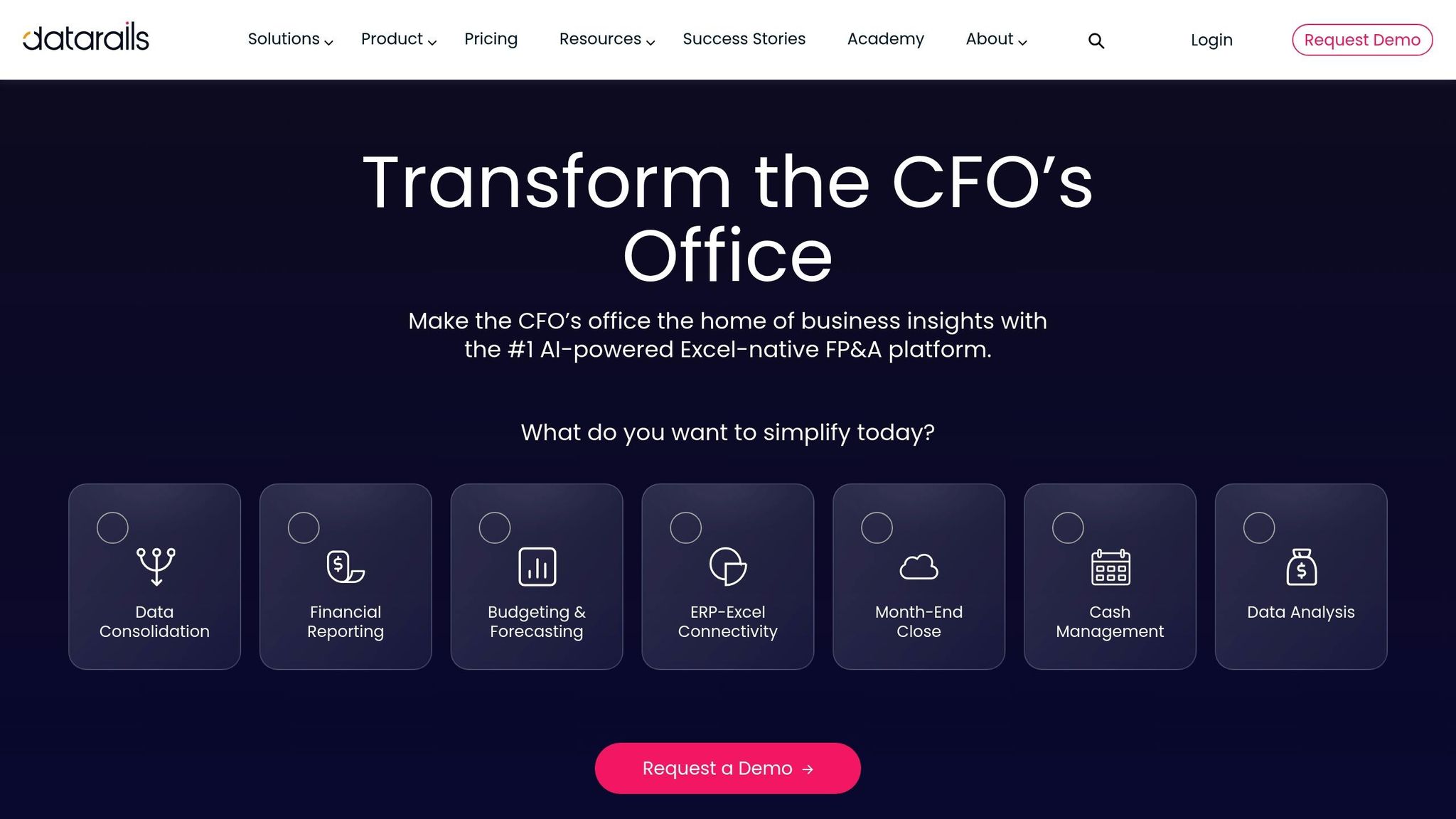
DataRails transforms the way finance teams consolidate data, reducing the process from days to mere minutes. By automatically pulling information from over 200 sources - like ERP, CRM, HRIS, and banking systems - directly into Excel, teams can continue working in the familiar Excel environment with all its functionality intact [21][22].
Megan Hedderson, Controller at Spencer & Butcher, shared her experience with this shift:
It works effectively. At the click of a button, my financial statements are ready. From over a week to minutes to produce our financial statements [21].
The platform goes even further with its "Genius" AI assistant, which provides real-time answers and insights, enabling teams to move from reactive reporting to proactive analysis [21]. Charlotte Kelly, Head of FP&A at Butternut Box, highlighted the immediate impact:
Thank goodness we went ahead with Datarails... We've cut our weekly reporting time in half [21].
These time savings don’t just improve workflows - they also lead to substantial cost reductions.
The time efficiencies achieved with DataRails have a direct impact on reducing costs. Steven Carkey, VP Finance Operations at 100%, explained the difference it made for his team:
Without Datarails, I would've needed to double my current team of three just to produce what we're delivering today [21].
The platform helps companies save hundreds of thousands of dollars annually through streamlined cost analysis [24]. For example, Tereza Sahakian, Director of FP&A at Alasko, shortened the budgeting process from weeks of manual work to just one day [24]. Similarly, Carrollton Development Group’s two-person finance team cut report generation time from three or four days to about two hours [25].
Beyond saving time and money, DataRails helps prevent costly errors. Samantha Cassidy, FP&A Lead at Empower Healthcare Solutions, emphasized this benefit:
It saves me so much time and having that version control allows us to stop having potentially catastrophic mistakes ever happening again [21].
These efficiencies not only lower expenses but also lead to more precise and timely forecasting.
DataRails ensures accuracy by creating a unified platform for live financial data. This eliminates version control issues and reduces manual errors commonly found in traditional spreadsheets. The platform’s AI algorithms scan financial data to identify discrepancies, outliers, and trends that might otherwise go unnoticed [26].
Reports and forecasts refresh instantly - either on demand or on a set schedule - so decisions are always based on up-to-date information [23]. Visualization tools make it easier to spot variances and anomalies compared to static spreadsheets [21]. This real-time visibility is especially useful for managing cash positions across multiple entities, removing the need for manual reconciliations [21].
DataRails is designed to grow with your business, accommodating multi-entity and intercompany operations as complexity increases [21]. It integrates data from over 200 sources and scales alongside your tech stack without requiring IT involvement [24]. Implementation typically takes just 4–6 weeks [26].
Andrew Austin, CFO at Carrollton Development Group, summed up the scalability advantage:
You don't need more people – you just need smart people using Datarails [26].
This scalability was crucial for Butternut Box, which doubled its production capacity after adopting DataRails, all while keeping its finance team lean [24]. The platform supports growing businesses by managing increasingly complex models, all within the familiar Excel interface [21][22][24].

LiveFlow stands out for its speed and ease of implementation. While traditional FP&A platforms often require months to get up and running, most teams can start using LiveFlow in under 60 minutes [27]. The platform syncs data from QuickBooks Online to Google Sheets or Excel in less than 5 seconds, cutting out the hassle of manual data exports [27]. Since it integrates directly into existing workflows in Excel and Google Sheets, finance teams can avoid the disruption of learning new tools or proprietary modeling languages [29]. Plus, it provides real-time, detailed insights down to individual transactions, saving finance teams over 400 hours annually through automated data updates [27]. This combination of speed and efficiency not only saves time but also reduces costs.
LiveFlow simplifies FP&A processes, helping companies save on both staffing and setup costs [31][29]. There’s no need for engineering support or external consultants, which means avoiding hefty "Statement of Work" fees common with other enterprise tools [31][29]. At about half the cost of traditional platforms, LiveFlow offers an affordable alternative that also shortens launch times [31]. For example, Lupus Research Alliance cut their monthly reporting time by five days after adopting LiveFlow, while ETS Performance gained the equivalent of an extra full-time employee’s capacity [29]. These efficiencies make forecasting more reliable and cost-effective.
By automating processes and eliminating manual data entry errors, LiveFlow significantly improves forecast accuracy [28][6]. Its rolling forecast feature seamlessly integrates real-time data into models, allowing teams to update projections instantly [28][30]. A CFO at a private equity firm shared their experience:
LiveFlow has transformed our month-end close process. We now deliver consolidated reports to investors in hours, not days [28].
With 68% of CFOs identifying real-time financial visibility as their top priority for improving business performance, LiveFlow’s automated variance analysis and drill-down tools ensure decisions are based on the latest data [28].
LiveFlow is built to grow with businesses, consolidating data from unlimited QuickBooks entities while automatically managing multi-currency conversions and diverse charts of accounts [31]. It offers a centralized view of global operations without requiring IT involvement [28]. For instance, Rize Education used LiveFlow to create an "investor-ready" finance system, automating reporting to maintain strategic value during growth [29]. Additionally, the platform meets SOC 2 Type I and Type II compliance standards, ensuring secure and reliable performance in complex, multi-entity environments [29].
Here’s a breakdown of the main strengths and limitations of each tool, based on the analysis above:
Abacum stands out with its modern, web-based interface and the ability to handle unlimited dimensions, making it a solid choice for mid-market companies. It boasts a 4.8/5 G2 rating and a relatively short 13-month payback period [35]. However, the hybrid SQL/Excel syntax can present a learning curve for some users, and its implementation takes around four months [32].
Cube integrates seamlessly with Excel and Google Sheets, offering live data synchronization and scenario modeling. This can cut manual work by up to 75% [33]. However, it is limited to 4–8 dimensions and approximately 16 native connectors [33] [35], which may limit scalability. Implementation averages five months, with pricing typically starting at $20,000+ per year [33].
DataRails excels in its deep Excel integration, offering over 200 native connectors and unlimited dimensions. It has earned high ratings, including 4.7/5 on G2 and 4.8/5 on Capterra [32]. Implementation is faster, taking 6–12 weeks, but performance may drop when handling extremely large datasets [33] [36].
LiveFlow is designed for QuickBooks users who need fast and efficient reporting with rapid data refresh capabilities. However, it is more focused on reporting rather than serving as a full FP&A suite.
Here’s a side-by-side comparison of the tools to make it easier to evaluate their strengths and limitations:
| Tool | Key Strengths | Main Limitations | Best For |
|---|---|---|---|
| Abacum | Unlimited dimensions, 50+ integrations, fast reporting [8] [32] | 4-month setup; requires moving away from Excel [35] | Mid-market companies (50–500 employees) [32] |
| Cube | Familiar Excel interface; up to 75% less manual work [33] | Limited to 4–8 dimensions; ~16 connectors [33] [35] | Small businesses reliant on Excel workflows [33] |
| DataRails | 200+ integrations, unlimited dimensions, significant time savings [32] [34] | 6–12 week implementation; potential Excel performance constraints [33] [36] | Teams focused on consolidation and budgeting [32] |
| LiveFlow | Efficient reporting and rapid data refresh | More reporting-focused than a full FP&A suite | QuickBooks users needing fast implementation |
Each tool offers a unique balance of speed, integration capabilities, and scalability, catering to various needs. Whether your priority is rapid deployment, deep Excel integration, or support for complex, multi-entity planning, the right choice will depend on your specific requirements and business size.
Real-time FP&A tools are revolutionizing the way finance teams operate, replacing outdated, manual spreadsheets with automated, strategic solutions. High-performing teams using these tools report ROI exceeding 300%, with some recouping their investment in less than six months [1]. Despite this, 86% of finance professionals still rely on Excel [36], highlighting the massive opportunity for improvement. Traditional teams spend up to 75% of their time on data-related tasks, but automation shifts that focus, enabling analysts to dedicate their efforts to strategic initiatives. Companies adopting these tools have reported forecast accuracy improvements of 20–25%, scenario turnaround times reduced by 70%, and individual analysts saving around 130 hours annually [1].
"The 3rd generation of FP&A tools is set to tie the whole finance stack together, provide unparalleled visibility into real-time data, eliminate manual work, and usher in the generation of strategic finance." – Activant Capital [36]
These results demonstrate the tangible advantages of adopting real-time FP&A tools. For growth-stage companies, this is a pivotal moment. Establishing strong foundations early and targeting high-impact areas like budgeting and forecasting can yield significant improvements [1]. Opting for tools that integrate seamlessly with Excel can also speed up adoption [36]. Modern mid-market solutions now offer faster implementation - measured in weeks rather than months - with annual costs ranging from $20,000 to $40,000, a fraction of the $100,000+ price tag of older legacy systems [36].
Phoenix Strategy Group specializes in helping growth-stage companies implement and optimize real-time FP&A systems. Through their fractional CFO services and FP&A expertise, they empower businesses to harness real-time data synchronization, build integrated financial models, and develop strategic KPIs. This transformation elevates finance from a back-office function to a strategic asset, enabling smarter decisions and delivering measurable results.
Real-time FP&A tools bring a host of benefits compared to traditional approaches. One standout advantage is their ability to provide immediate cash flow visibility, which helps businesses create faster and more precise forecasts. By automating reporting tasks, these tools cut down on manual work and reduce the chance of errors, all while boosting overall efficiency.
Another key benefit is how these tools improve cross-department collaboration. Teams can access real-time data, enabling them to make quicker, well-informed decisions. With constantly updated insights, businesses can adapt to changes more effectively, staying nimble in today’s fast-paced financial landscape.
Real-time FP&A tools take forecasting to a new level by delivering up-to-the-minute financial data straight from source systems as transactions happen. This eliminates the need to rely on outdated, end-of-month data and minimizes errors caused by manually consolidating spreadsheets. With automated updates and a steady flow of data, these tools can quickly highlight anomalies and trends, allowing teams to make adjustments before small issues grow into major forecasting problems.
Features like live dashboards and instant reporting give decision-makers the ability to act swiftly, whether it's addressing cash flow risks or testing different scenarios on the spot. These tools also incorporate external benchmarks and predictive models, transforming raw numbers into actionable insights. For companies in growth phases, this translates to faster, more precise decisions and a sharper competitive edge.
When selecting an FP&A tool, businesses should prioritize a few critical aspects to ensure the solution aligns with their needs and supports their growth objectives.
First up is real-time data integration. A tool that delivers instant updates empowers finance teams to keep a close eye on cash flow, identify potential risks, and tweak forecasts as needed. This capability enables quicker, more informed decisions. Additionally, the tool should easily integrate with existing systems like ERP, CRM, and payroll software, simplifying workflows and cutting down on manual tasks.
Another key feature to prioritize is flexibility in modeling and scenario planning. Tools that offer functionalities like drag-and-drop budgeting, AI-powered forecasting, and “what-if” analysis make it much easier to adapt to shifting conditions while minimizing errors. These features are especially helpful during unpredictable times when agility is crucial.
Lastly, don’t overlook cost, scalability, and security. While upfront costs might seem steep, the right tool should pay off by saving time, boosting accuracy, and improving decision-making. Make sure the platform meets compliance standards such as SOC 2 or ISO 27001 and provides strong support for onboarding and ongoing use. By keeping these factors in mind, businesses can choose an FP&A tool that not only streamlines operations but also enhances strategic decision-making.