Published on
July 13, 2026


If I want faster payback, I’d usually pick a free trial. If I want more signups at the top of the funnel, I’d look at freemium.
Here’s the short version:
What I’d measure before choosing:
Bottom line: more signups do not mean more revenue. The better model is the one that gets me to paid conversion, margin, and payback with less drag on cash flow.
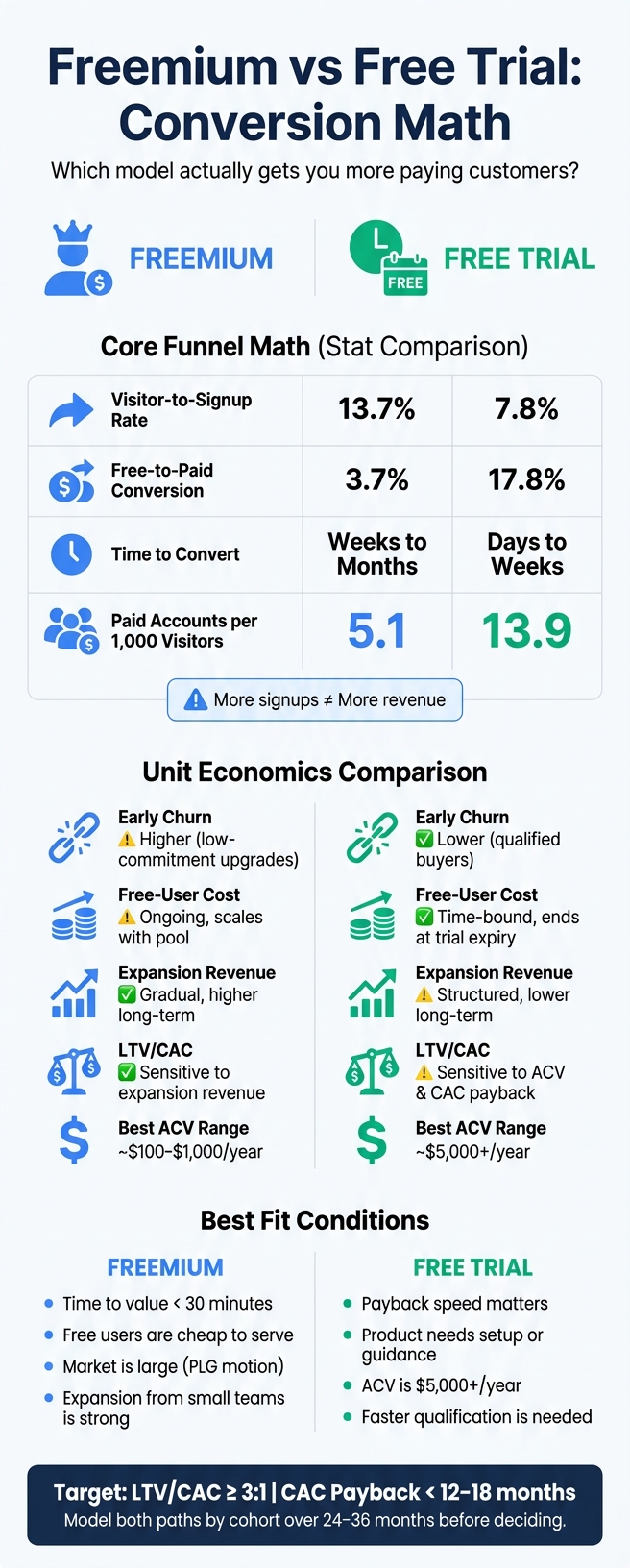
Freemium vs Free Trial: Conversion Math & Key Metrics
| Criteria | Freemium | Free Trial |
|---|---|---|
| Signup volume | Higher | Lower |
| Paid conversion rate | Lower | Higher |
| Time to convert | Longer | Shorter |
| Free-user cost | Can stack up over time | Limited to trial period |
| Early retention | Often weaker | Often stronger |
| Expansion upside | Often higher later | Often lower later |
| Best fit | Low-price, self-serve SaaS | Higher-price or more complex SaaS |
If I were running a growth-stage SaaS company, I would not judge this choice by signup rate alone. I’d model conversion, churn, support cost, expansion, and payback side by side over 24 to 36 months and choose the path that holds up when the numbers get tighter.
Freemium usually brings in more signups because the ask is small. Low friction does that. Free trials ask users to commit a bit more upfront, so fewer people enter the funnel. But the people who do are often closer to buying.
Here’s the benchmark view:
| Metric | Freemium | Free Trial (Opt-In) |
|---|---|---|
| Visitor-to-signup rate | 13.7% | 7.8% |
| Free-to-paid / Trial-to-paid conversion | 3.7% | 17.8% |
| Time to conversion | Weeks to months | Days to weeks |
| Paid accounts per 1,000 visitors | 5.1 | 13.9 |
At first glance, this can look a little odd. More signups, yet fewer paid accounts? That’s the trade-off. The averages point to one big factor: how fast users reach first value.
The math itself is straightforward: 1,000 × visitor-to-signup rate × free-to-paid (or trial-to-paid) rate = paid accounts per 1,000 visitors.
A standard freemium product converts about 13.7% of visitors into signups and around 3.7% of those signups into paid users[4]. That gap is the whole story. A lot of freemium users sign up because access is easy, not because they planned to buy soon.
That slower buying intent changes the revenue timeline. Freemium can keep feeding the top of funnel, but upgrades may take weeks or months to show up. So even with strong signup volume, paid growth can lag.
Opt-in free trials convert about 7.8% of visitors into trial signups and roughly 17.8% of those users into paid accounts[4]. So the funnel starts smaller, but it monetizes better.
Trial length also changes the outcome. 7-day trials convert at a median of 24%, while 30-day trials fall to about 14%[5]. That makes sense. A shorter window pushes people to act. A longer one gives them more time to drift, delay, or forget. When the clock runs out, the product has to sell itself on value, not ease.
Conversion depends heavily on how fast users reach the "aha" moment - the moment the product clicks and starts to make sense. That’s where both models either gain momentum or lose it.
A freemium user who doesn’t activate right away may still come back and convert later. A free trial user usually doesn’t have that luxury. If they miss that moment inside the trial window, they’re often gone for good.
OpenView reports median activation at ~20% for freemium and ~40% for free trials[3]. In plain English, trial users are more likely to hit core value early. That early pull matters because trial conversion runs on speed.
For more complex products with higher average contract values, sales-assisted onboarding can help push users toward activation and paid conversion. But for most self-serve SaaS, the product has to do the heavy lifting before the trial ends.
Conversion is only the first layer; churn, support cost, and expansion revenue decide whether that growth pays back. The next question is whether those conversions cover churn, support load, and CAC.
Once someone converts, the next issue is simple: does the model still pay back after you account for free-user cost and retention? Conversion rate tells you who gets into the funnel. Unit economics tells you if that funnel is worth running.
| Metric | Freemium | Free Trial |
|---|---|---|
| Paid churn rate | Higher early churn; many low-commitment upgrades | Lower early churn; buyers are more qualified |
| Infrastructure and support cost | Ongoing and scales with the free-user pool | Time-bound and ends when the trial expires |
| Expansion revenue potential | Gradual seat growth across many small accounts | Fewer but larger initial contracts with structured upsells |
| CAC efficiency | Lower effective CAC per payer when product-led conversion is strong, but free-user costs must be included | Higher CAC per paying customer, offset by higher ACV and better qualification |
| LTV/CAC | Highly sensitive to expansion revenue over time | More sensitive to initial ACV and CAC; payback is often faster |
These two models create different kinds of customers. That changes both retention and expansion. A ChartMogul study of 1,200 SaaS companies over 36 months found that trial-converted customers had 15% higher first-year retention but 25% lower expansion revenue compared to freemium-converted customers.[7]
That pattern makes sense on the ground. Freemium cohorts often include a big group of inactive, or "zombie", users who signed up and never returned. And the paid accounts that do come from freemium often begin as low-commitment upgrades, like a team lead adding one or two seats. That can lead to higher early churn.
Free trial cohorts look more like a pass-or-fail test. Users either convert when the trial ends or they walk away. The ones who do convert usually stay longer in year one because they made the decision after a real product evaluation.
If you track blended paid churn across both models, you miss the story. Growth-stage teams should break cohorts out by acquisition path:
Then measure 3-, 6-, and 12-month logo retention and net dollar retention (NDR) for each path on its own. That’s the only way to see which motion brings in stickier customers.
That’s why cohort-level retention is the right lens for LTV.
Free users still cost money. Infrastructure, support, onboarding, and free-tier engineering time do most of the damage. Free users can generate 30% to 40% of all support tickets despite bringing in little or no revenue.[6] At U.S. support labor rates, even one support interaction every three months can add up to $20 to $60 per free user each year.[6]
Infrastructure adds another cost line. One benchmark puts monthly cloud spend at $500,000 across 10 million free users, or $0.05 per free user per month.[8] On its own, that sounds tiny. But conversion rate changes the picture fast.
At a 0.5% conversion rate, it takes 200 free users to create one paying customer. Using the benchmark infrastructure and support inputs, that comes out to about $14 in cost per acquired paid account before you add any marketing or sales spend.[8]
A clean gut check is to compare lifetime cost per free user with expected monetization value. Put plainly, the cost side is annual cost per free user multiplied by average active years. The value side is upgrade probability multiplied by ARPA, gross margin, and average paid retention.
Those costs feed straight into CAC payback.
Freemium plants a lot of small accounts. Some of them grow over time. A small team may start on a free plan, add a few seats, and then move up tiers little by little. That bottom-up motion can drive strong net dollar retention if the product is sticky. But growth is often slow, and many of those seeded accounts never get past a small user base.
Free trial usually creates fewer accounts, but larger ones from day one. Expansion is more structured and often sales-driven, which makes it easier to plan around. The trade-off is that it takes more investment to get those accounts in the first place.
LTV/CAC turns all of this into one simple comparison. For growth-stage SaaS, a basic subscription LTV formula is:
LTV = (ARPA × Gross Margin) ÷ Monthly Churn Rate.[10]
Using a simple example, if ARPA is $100/month, gross margin is 80%, and monthly churn is 5%, then LTV = $1,600.[10]
The usual target for growth-stage SaaS is an LTV/CAC ratio of at least 3:1, with CAC payback under 12 to 18 months seen as healthy for fundraising and steady growth.[9][11]
Those economics shape which model fits the product and the go-to-market motion. For companies navigating these complex unit economics, fractional CFO services can provide the strategic oversight needed to optimize LTV/CAC.
After conversion math and unit economics, the next step is fit. The basic rule is pretty simple: pick the model that lines up with your product complexity, ACV, and payback target. In practice, that means matching your model to conversion rate, churn, support cost, expansion revenue, and LTV/CAC.
| Criteria | Freemium | Free Trial | Hybrid |
|---|---|---|---|
| Complexity and onboarding | Simple, self-serve workflows; time to value under 30 minutes | Complex, multi-step workflows; time to value measured in days with guided onboarding | Moderate complexity; self-serve for core use, guided for advanced features |
| ACV range | Low ACV (≈$100–$1,000/year) | Mid to high ACV (≈$5,000+/year) | Tiered ACV across SMB and mid-market segments |
| Sales motion | PLG, low-touch, no dedicated sales per account | Sales-assisted or sales-led with dedicated reps | PLG for small accounts; sales-led for larger deals |
| Free-user cost | Low marginal infrastructure and support cost per free user | Time-bound and ends when the trial expires | Free usage capped or scoped by tier |
Freemium fits when product-led growth can carry a lower conversion rate. It tends to work best when time to value is under 30 minutes, upgrade triggers are clear, and the market is big enough to handle a low conversion rate without breaking the business.
This is common with collaboration tools, productivity apps, and lightweight utilities. In those products, inviting a teammate is often part of the core use case, so growth can come built in. Freemium usually makes sense only at low ACV, where a large volume of free users can make up for lower conversion.
Free trial fits when qualification and faster payback matter more than top-of-funnel volume. If the product lives in finance, compliance, or multi-team workflows, users often need more structure before the ROI clicks.
For products with ACV above about $5,000–$6,000 per year, a time-boxed trial can do two jobs at once: qualify buyers and tighten payback. Instead of letting anyone stay free for as long as they want, the business gets a clearer read on intent.
Hybrid makes sense when one product serves both self-serve users and larger accounts that need sales support. That setup can work well, but only if you separate the funnels.
A simple way to think about it:
Measure retention and NDR for each group on its own. If you blend them together, the conversion data gets muddy fast. Keep each funnel separate so payback stays measurable.
Once you can see conversion rates and unit economics side by side, the choice gets a lot clearer: look at payback speed. More signups don't automatically mean better economics. In plenty of cases, a smaller trial funnel can still bring in more paying customers than freemium because the conversion rate is higher.[1][2]
But that only tells part of the story. You also need to factor in churn, support cost, expansion revenue, and LTV/CAC. Trial-converted cohorts often retain better during year one, while freemium-converted cohorts may bring in more expansion revenue later on.[7] So the better option is the one with the shorter payback period and the stronger LTV/CAC for your product.
That's the real trade-off. LTV/CAC matters more than raw signup volume. Aim for at least 3:1 LTV/CAC and a payback period that matches your cash cycle.
Before you decide, model both paths by cohort. Group users by acquisition month and by model, then track:
Do that across a 24–36 month window. Then pressure-test the numbers. If conversion drops by 20%, what changes? If churn goes up by one point, does the model still work? Those scenario checks often show which option holds up better when things get tight.
Choose the model that gets you to payback faster, with retention that's good enough to support growth.
Choose based on your product’s unit economics, customer behavior, and growth stage.
Freemium works best when marginal costs stay low and network effects matter. The catch? If too few free users convert, support costs can creep up and eat into margins.
Free trials tend to push people toward a paid decision faster. That often means higher conversion and more predictable recurring revenue.
Either way, keep a close eye on CAC payback, aim for an LTV:CAC ratio of at least 3:1, and review cohort conversion trends.
Focus on the metrics that show customer health and how well growth is working:
These numbers tell you a lot, fast. If conversion rates are weak, the product or offer may not be landing. If churn climbs in certain cohorts, that’s a sign something is off with fit, onboarding, or retention. And if acquisition costs take too long to earn back, growth can start to strain cash flow.
A 3:1 LTV:CAC ratio is generally sustainable, and recovering CAC within 12 to 18 months helps support cash flow during growth.
A hybrid model fits mature SaaS companies that want steady recurring revenue without giving up the ability to grow as customer usage climbs.
It combines a stable base subscription fee with usage-based pricing. That gives customers more flexibility, helps make revenue easier to forecast, and lets the business earn more as usage increases.