Published on
May 12, 2026


Efficient IT asset management can save businesses money, reduce risks, and ensure smoother scaling. The IT asset lifecycle - planning, procurement, deployment, maintenance, replacement, and disposal - directly affects costs, productivity, and security. Poor management leads to wasted budgets, untracked devices, and compliance issues. For example, untracked "ghost assets" and unused software licenses can drain thousands annually. On the other hand, proactive management can cut IT costs by up to 30% and reduce downtime.
Here’s why managing IT assets well matters:
Using tools like CMDBs, automated tracking, and performance data ensures IT systems align with business goals. This approach transforms IT asset management from a cost center into a growth enabler.
As businesses grow, poorly managed IT assets can quickly spiral into major issues. When scaling happens fast, even small missteps in managing these assets can lead to significant headaches.
Without a centralized system to monitor assets, IT teams can lose track of devices. This results in "ghost assets" - equipment listed in records but unused, misplaced, or obsolete. Here's an example: purchasing just five extra laptops each quarter at $1,200 apiece adds up to $24,000 wasted annually [7].
Relying on spreadsheets for tracking only makes matters worse. It can lead to shipping mistakes, delays in onboarding new hires, and unnecessary hardware purchases [7][6].
This lack of visibility doesn’t just drain budgets - it also increases maintenance costs over time, requiring more sophisticated financial management.
Unmonitored, aging assets can become a financial burden. When no one is tracking an asset's condition or lifespan, maintenance becomes a last-minute scramble. Emergency repairs, expedited shipping for parts, and premium vendor support all come with hefty price tags [7]. On top of that, unreliable technology slows employees down, with one-third of workers blaming outdated equipment for reduced productivity [7].
Switching to proactive lifecycle management can make a huge difference. Companies that plan ahead can stretch their annual IT budgets by up to 30% compared to those stuck in a reactive approach [4]. But financial strain isn’t the only risk - compliance and security issues can also emerge.
Unmanaged IT assets pose serious security threats. Devices that are unpatched, outdated, or still accessible to former employees create vulnerabilities.
"Security software can only protect what it can see. If a device is offline, unmanaged, or overlooked during offboarding, it becomes a potential entry point for threats." - JumpCloud [7]
Regulations like GDPR, SOC 2, and HIPAA require organizations to maintain accurate, auditable records of IT assets. Failing to provide these during an audit can lead to fines and legal trouble [7][6]. Charlotte Nicolaou, Technical Marketer at Starhive, explains:
"By having that overview of what you have and how old it is you can ensure timely retirement of potential security risks and avoid the cases where an asset that can no longer be supported with security patches... isn't happily sitting in a corner running a critical service." [8]
With the global average cost of a data breach at $4.9 million [7], the risks of neglecting IT asset management are too costly to overlook.
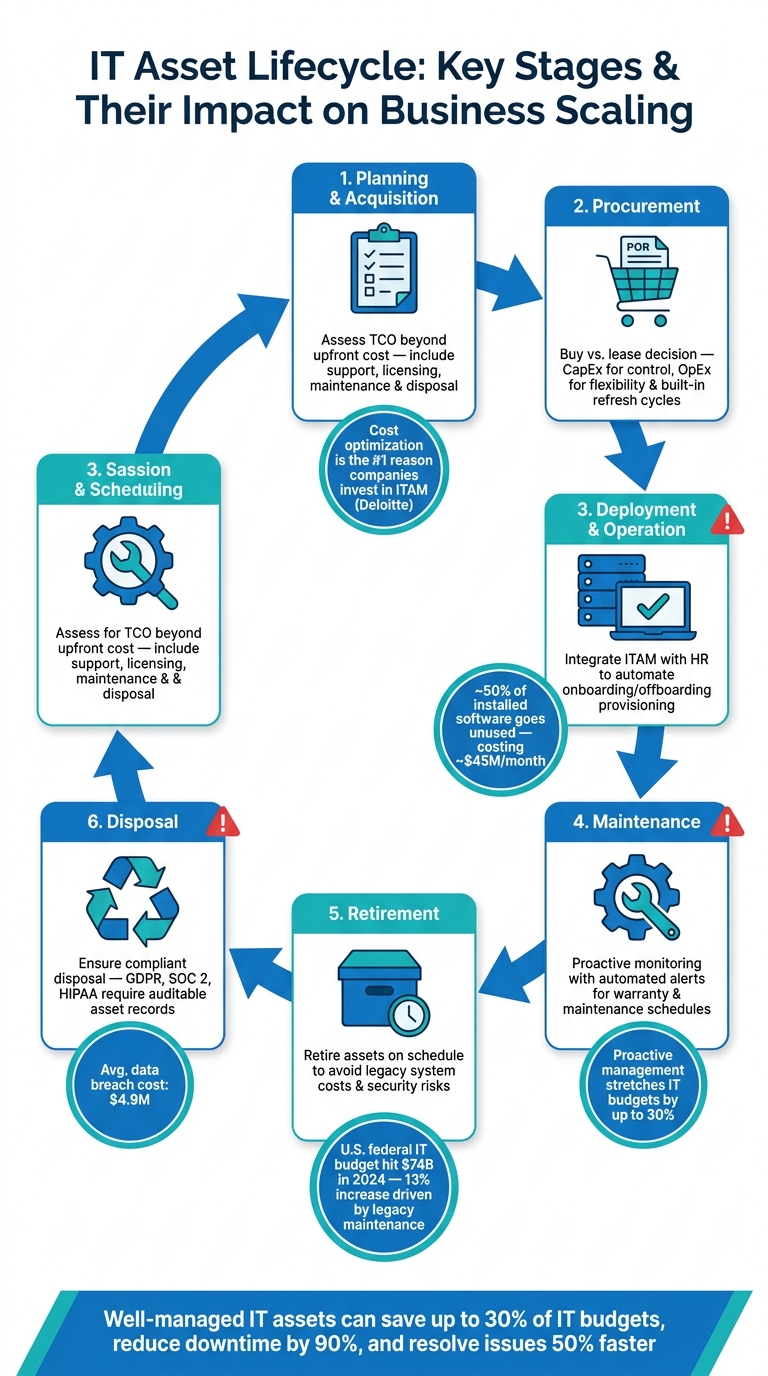
IT Asset Lifecycle: Key Stages & Their Impact on Business Scaling
Every IT asset - whether it's being purchased, deployed, or retired - plays a direct role in how well your organization can scale without running into unexpected costs or interruptions.
Laying the groundwork for IT assets starts with smart planning. Establishing a predictable refresh cycle helps avoid budget surprises when scaling up. Standardizing hardware across teams also simplifies management as your organization grows. According to Deloitte, cost optimization is the leading reason companies invest in IT asset management [2].
Another key step is assessing the Total Cost of Ownership (TCO). This means looking beyond the upfront price to include expenses like support contracts, licensing, maintenance, and disposal. By doing so, businesses can cut annual asset-related costs [9]. Deciding whether to buy (CapEx) or lease (OpEx) assets early in the process is equally important. Leasing provides lower upfront costs and often includes built-in refresh cycles, while purchasing gives you full control and potential tax benefits, such as Section 179 deductions.
"We take our top 50 customers and go through the servers that are end of life next year... Just those big ticket items - anything over a couple thousand dollars - you want to identify for them and say as a courtesy, 'just want to let you know next year you're going to have to buy a new server.'" - Justin Kelm, CEO, JK Technology Solutions [3]
These initial decisions set the stage for smoother deployments and long-term operational success.
The choices made during acquisition significantly influence how efficiently assets can be deployed - and that efficiency matters when scaling. Quick, accurate deployment ensures employees get the tools they need without delays. Without a clear deployment process, businesses risk uncoordinated asset purchases, where hardware and software are acquired through different channels and often lack centralized tracking.
Here’s a staggering fact: nearly 50% of installed software goes unused, costing companies about $45 million per month in wasted licenses [10]. To address this, integrating IT asset management tools with HR systems can automate provisioning during onboarding and recover assets during offboarding. This helps close visibility gaps that often lead to inefficiencies.
"Getting a grasp on what you're buying and who is buying it is probably one of the most major steps you can do." - Aaron Davenport, Software Asset Manager, HCA [10]
Once assets are deployed, consistent monitoring ensures they remain secure and cost-effective, while also enabling timely maintenance and eventual retirement.
Proactive maintenance is what separates companies that scale effortlessly from those caught off guard by unexpected costs or downtime. Without active monitoring, maintenance becomes reactive - leading to emergency repairs, rushed part orders, and operational disruptions.
Retirement is just as critical. Outdated equipment can slow down the adoption of new technologies, creating bottlenecks. For example, U.S. federal government data reveals that IT budget projections for civilian agencies reached $74 billion in 2024 - a 13% increase from the previous year - mainly due to the high costs of maintaining legacy systems [1]. For growing businesses, retiring assets on schedule is a smart financial practice that protects future budgets.
Automated alerts for warranty expirations and maintenance schedules can help shift IT teams from reactive problem-solving to proactive planning [5][6]. This kind of forward-thinking management supports scalability and keeps operations running smoothly.
Efficient IT asset lifecycle management does more than just cut costs - it ensures your assets perform at their best, helping to drive business growth.
If you're still relying on spreadsheets, it's time to upgrade to a centralized Configuration Management Database (CMDB). A CMDB consolidates everything - hardware details, software licenses, vendor agreements, maintenance records, and even dependencies - into a single, accessible system. This approach addresses a major issue: 43% of small businesses fail to track their assets effectively [14]. Poor tracking can lead to wasted spending and increased security vulnerabilities.
Pair your CMDB with automated discovery tools to keep tabs on your network. These tools scan for all connected devices, from laptops to IoT equipment, ensuring nothing escapes notice. This step is crucial for identifying "Shadow IT" - unauthorized software or cloud services that might slip under IT's radar [11]. For smaller businesses, tools like Spiceworks offer free automated discovery, while ManageEngine AssetExplorer provides more advanced features like software license compliance for larger organizations [13].
"vScope is revolutionary. It's hard to overstate how many problems and headaches it removes from our daily work." - A. Holmkvist, IT Team Lead, SYSAV [12]
Taking it a step further, connect your asset management system to your IT Service Management (ITSM) platform. This integration allows monitoring tools to automatically create service tickets when performance issues arise - no manual work required [11][13]. Such automation not only improves efficiency but also enables real-time performance tracking for your assets.
Tracking inventory is only part of the equation. The real game-changer lies in using performance data to guide smarter decisions. Real-time monitoring helps identify underused assets that can be reallocated to areas with higher demand, cutting down on unnecessary purchases [15].
"Striking a balance between underutilisation and not having enough availability can be difficult, but without data, it is highly unlikely to be achieved." - Charlotte Nicolaou, Starhive [8]
Set performance triggers - like high error rates or frequent repairs - that automatically flag assets for evaluation. This approach shifts your team from guessing when to replace equipment to making decisions based on actual performance and cost data [8][11]. A well-managed IT asset system aims for an asset utilization rate above 85% and keeps downtime under 1% of total operating time per asset [15].
While performance metrics optimize operations, understanding costs ensures that your financial strategy aligns with growth objectives.
Managing IT costs during periods of growth means looking beyond the upfront price of an asset. By tracking Total Cost of Ownership (TCO) alongside Return on Investment (ROI), you can account for ongoing expenses like maintenance, energy consumption, support contracts, and even disposal. For example, a low-cost laptop that fails after 18 months will ultimately cost more than a durable one that lasts four years [11].
Use centralized dashboards to monitor key metrics such as TCO, depreciation schedules, and ROI across your asset portfolio. Industry benchmarks suggest aiming for an ROI above 150% for effective IT asset programs [15]. Real-world examples show the impact of this approach: a global financial firm reduced operational costs by 15% in just one year after adopting centralized asset tracking, while a manufacturing company slashed maintenance expenses by 20% through improved lifecycle management [15]. As your asset inventory grows, these kinds of improvements can have a snowball effect, driving even greater efficiency and cost savings over time.
Taking a disciplined approach to IT asset management can cut costs and significantly improve ROI. Studies reveal that 20–30% of IT budgets are wasted on underused assets, with up to 25% lost to "ghost assets" - equipment that’s either unaccounted for or no longer in use [16]. Redirecting these savings can directly fund growth opportunities like hiring new talent or expanding into new markets.
The financial perks don’t stop there - they also translate into smoother operations. Proactive asset management helps IT teams shift from constantly putting out fires to running well-planned systems. For example, keeping tabs on warranty periods and performance data allows you to replace aging hardware before it fails, avoiding disruptions during critical times. Dependency mapping is another game-changer, reducing unplanned downtime by as much as 90% [16]. Additionally, IT teams with streamlined asset management processes resolve issues 50% faster [16].
When businesses grow, centralized asset data makes scaling far easier. By maintaining a single source of truth, IT teams can deploy standardized devices to new locations, ensuring consistency across hardware models while avoiding the chaos of decentralized purchasing. Tools like asset tagging - using barcodes, QR codes, or RFID - help track equipment across all sites, reducing the risk of lost or idle devices as your company expands.
Unused software can be a major drain on resources.
"Every dollar spent on software that nobody uses is a dollar that could have gone to innovation. The discipline that eliminates that waste is IT asset management - and it starts with knowing what you actually own." - ITAM Review community [16]
Shockingly, nearly 50% of installed software goes unused, costing businesses approximately $45 million per month across industries [10]. Proper lifecycle management helps identify underutilized licenses, cutting waste before renewal periods. Similarly, adopting standardized hardware refresh cycles - typically 3 to 4 years for laptops and 5 years for servers - replaces the outdated "run it until it breaks" mindset. This planned approach often secures better pricing and terms, ensuring IT investments align with your company’s growth strategies. Every dollar spent on technology is then actively contributing to scaling your business.

Managing IT assets isn’t just about technology - it’s a financial strategy. That’s where Phoenix Strategy Group steps in. Many growth-stage companies struggle to understand the true effectiveness of their IT spending. Phoenix Strategy Group bridges that gap by aligning IT asset decisions with financial goals, helping businesses gain clarity and control over their IT costs.
Basing IT budgets on past expenses can lead to inefficiencies. Instead, Phoenix Strategy Group helps companies plan for the future with fractional CFO and FP&A services. They organize IT budgets into three clear categories:
This structured approach helps businesses identify waste - such as the 30% of SaaS spending typically lost to unused or underutilized licenses [17]. By redirecting those funds, companies can fuel growth initiatives. Phoenix Strategy Group also incorporates a 5–10% contingency fund into IT budgets, ensuring unexpected costs (like hardware failures) don’t disrupt hiring plans or expansion efforts.
With this disciplined framework and data-driven insights, every IT dollar is optimized for growth.
Visibility is key to effective IT management. Phoenix Strategy Group builds ETL pipelines that connect over 100 apps into a single, real-time dashboard. This unified view tracks asset performance, software usage, and financial metrics side by side - eliminating the need for quarterly spreadsheet reviews [18].
Michael Mancuso, CIO of New Law Business Model, sums it up perfectly:
"Hire PSG if you want to make your life easier and have accurate data." [18]
This level of transparency allows businesses to address issues like underperforming servers or unused software licenses before they become costly problems.
Phoenix Strategy Group takes things a step further with their Integrated Financial Model, which ties IT asset planning directly to growth strategies. Instead of treating IT as a standalone expense, this model demonstrates how elements like hardware refresh cycles, software costs, and infrastructure investments impact broader goals such as revenue growth, headcount plans, and cash flow.
Effective IT asset management plays a key role in driving scalable growth. As businesses expand, every operational area faces increased pressure - and IT is no exception. Without proper oversight of asset ownership, expenses, and replacement schedules, growth can quickly become inefficient and expensive. In fact, poorly managed IT assets can waste up to 25% of IT budgets [9], diverting funds that could be used for hiring or expanding into new markets.
Taking a disciplined approach to IT asset lifecycle management can eliminate these inefficiencies. By implementing accurate tracking systems, planning refresh cycles, and aligning IT spending with business goals, companies can turn asset management into a strategic tool for growth. For instance, organizations that focus on Total Cost of Ownership tracking can cut asset-related expenses by 15% annually [9]. Additionally, having an accurate asset map in place significantly speeds up incident resolution [16].
"Organizations that treat ITAM as a strategic discipline - not just a compliance checkbox - consistently see the biggest returns." - ITAM Forum [16]
The connection between IT asset management and scaling isn’t just about operational efficiency - it’s also about financial impact. When businesses integrate automated tracking, proactive planning, and financial analysis into their IT management processes, they create a solid foundation for growth. Features like predictable refresh cycles, automated license audits, and real-time visibility lead to cleaner budgets, fewer unexpected costs, and faster decision-making. This kind of structure is crucial for growth-stage companies, whether they’re opening new locations, onboarding remote teams, or preparing for a funding round.
As Phoenix Strategy Group illustrates, linking IT asset management directly to financial planning makes growth more predictable and intentional. By connecting IT decisions to financial models, cash flow forecasts, and long-term strategies, businesses can scale systematically and with confidence.
The fastest way to spot and get rid of "ghost assets" is by setting up a well-organized IT asset lifecycle management process. This involves conducting regular audits and using real-time tracking to identify assets that are unused or have gone missing. These steps can cut down on waste and help avoid inefficiencies in operations.
Track critical IT asset metrics such as performance, utilization, costs, lifecycle stages, and total cost of ownership. Monitoring these metrics helps you make informed decisions to allocate resources effectively, manage expenses, and align IT strategies with business goals - keeping your operations running smoothly as your company grows.
Deciding between buying or leasing hardware often comes down to your business's growth plans and financial priorities.
Leasing can be a smart choice if you’re looking for flexibility, reduced upfront expenses, and the ability to upgrade equipment easily. This makes it especially appealing for businesses experiencing fast growth or frequent technological changes.
On the other hand, buying works well for companies with steady growth and sufficient capital. While it requires a larger initial investment, owning your hardware can lead to long-term savings and gives you full control over your assets.
For many businesses focused on scaling, leasing is a popular option. It helps conserve cash flow, supports operational flexibility, and ensures IT resources can keep pace with the company’s evolving needs.