Published on
May 12, 2026


Predictive analytics transforms supply chain planning by forecasting potential challenges before they occur, enabling businesses to make informed decisions. Instead of reacting to issues like stockouts or supplier delays, companies can anticipate demand, optimize inventory, and mitigate risks proactively. Here's how it works:
Even mid-sized companies can implement predictive analytics within 6–12 months using cloud-based tools. The result? Lower costs, higher efficiency, and improved customer satisfaction. Whether you're scaling operations or managing complex supply chains, predictive analytics offers a smarter way to stay ahead.
Predictive analytics isn't just about speeding up reports - it’s about making informed decisions before issues hit your bottom line, often with the guidance of fractional CFO services. Here's how it reshapes supply chain planning.
Traditional forecasting relies heavily on historical sales averages. Predictive analytics steps up by incorporating external factors like weather conditions, economic trends, and even social media sentiment to refine demand estimates [2][7]. These models don’t just provide a single forecast - they offer a range of possibilities, each with its likelihood, giving businesses clarity on demand and its uncertainties [6][4]. Techniques like neural networks and random forests excel at identifying complex, non-linear patterns that older methods might miss [2][7].
This enhanced demand accuracy allows companies to adopt more flexible and responsive inventory strategies.
Holding too much inventory ties up cash, while too little can lead to costly stockouts. Predictive analytics bridges this gap by using precise demand forecasts to replace outdated, static safety stock calculations. Instead, it introduces dynamic, AI-driven buffers that adapt in real-time as demand or lead times fluctuate [6].
The results speak for themselves. Saint-Gobain managed to cut inventory levels by 40% using dependable SKU-level forecasts, while Danone reduced raw material and packaging inventories by as much as 40% during volatile market conditions [6]. Across different industries, organizations leveraging predictive analytics often see a 15–30% drop in inventory carrying costs [8].
Predictive analytics isn’t just about optimizing demand and inventory - it’s also a powerful tool for spotting risks early. Supply chain disruptions, whether caused by port congestion, supplier issues, or regulatory shifts, rarely come without warning. Predictive models continuously monitor indicators like supplier performance or weather patterns, flagging potential risks before they escalate [9][11]. Studies indicate that disruptions lasting over a month occur roughly every 3.7 years, with major disruptions potentially wiping out 45% of a year’s EBITDA [10].
By identifying risks early, businesses can act decisively - rerouting shipments, diversifying suppliers, or tweaking procurement strategies. This proactive approach strengthens the entire supply chain framework.
| Risk Category | Predictive Indicator | Mitigation Action |
|---|---|---|
| Supplier Risk | Financial distress; late deliveries; insolvency | Diversify vendors, renegotiate terms |
| Logistics Risk | Weather patterns, port congestion, labor strikes | Reroute shipments, adjust lead times |
| Operational Risk | Equipment anomalies, quality defects | Predictive maintenance, switch suppliers |
| Regulatory Risk | Jurisdiction law changes, ESG non-compliance | Flag non-compliant vendors, update sourcing |
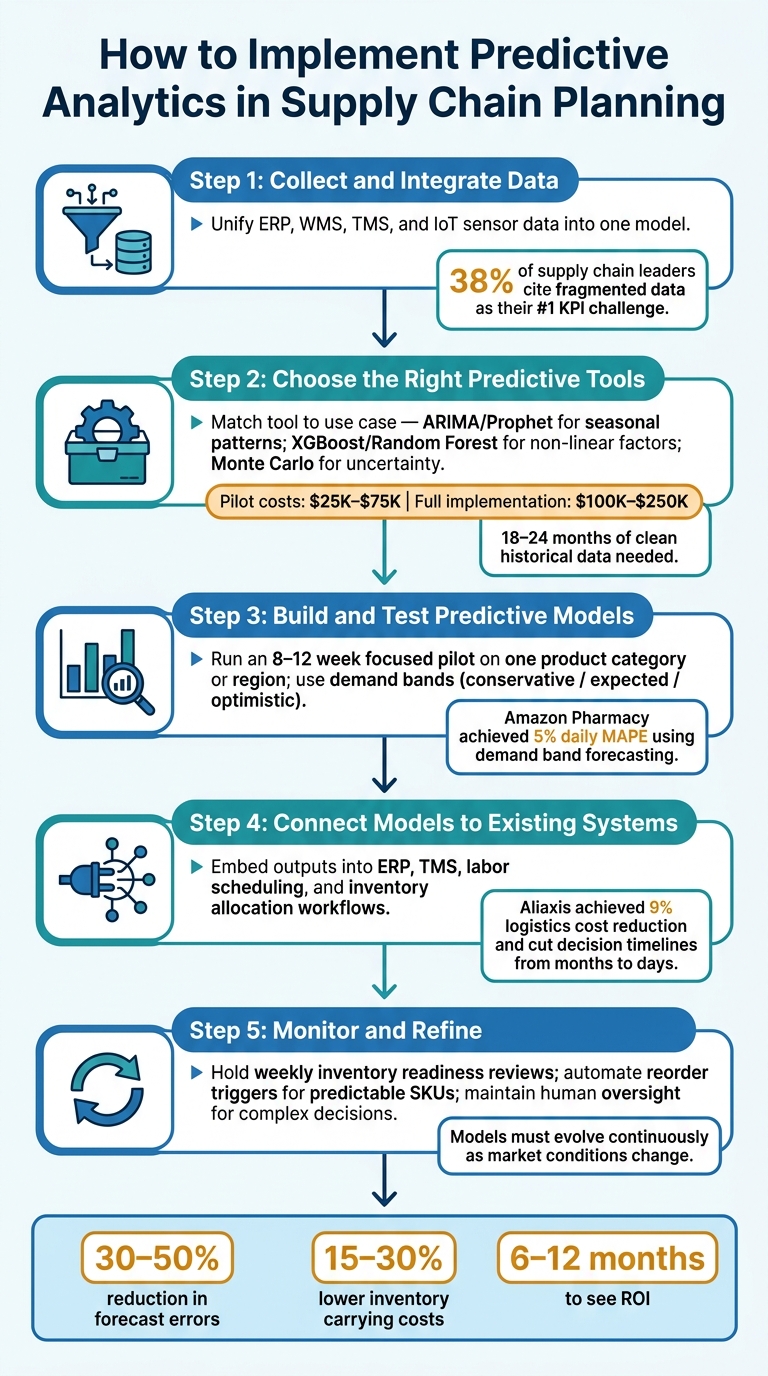
How to Implement Predictive Analytics in Supply Chain Planning: 5-Step Guide
To make predictive analytics work effectively in supply chain planning, it's best to take a phased approach. Starting small and scaling gradually allows companies to build confidence and expand as they see results. At Phoenix Strategy Group, this step-by-step strategy has proven to help businesses adopt predictive analytics smoothly.
The foundation of predictive analytics is clean, well-organized data. However, many supply chain teams face challenges because their data is scattered across different systems - like ERP platforms, spreadsheets, and warehouse management tools - that don’t communicate with each other. In fact, 38% of supply chain leaders cite fragmented data and lack of integration as their biggest challenge to tracking KPIs [14].
To address this, aim to create a unified data model that brings together information from your ERP, WMS, TMS, and IoT sensors. Start with a data audit to identify key demand signals and set up automated pipelines to keep these data feeds updated without requiring manual effort. It’s also critical to clean the data - removing errors caused by stockouts or one-time anomalies - before building any models [12].
"Predictive analytics is only as good as the data behind it." - Xenoss [3]
Different tools work best for different scenarios. For stable, seasonal patterns, time-series models like ARIMA or Prophet are reliable and easy to interpret. When dealing with non-linear factors - like weather, pricing, or promotions - machine learning models such as XGBoost or Random Forest are more effective. For decisions involving uncertainty, like safety stock, probabilistic models like Monte Carlo simulations offer a range of possible outcomes instead of a single prediction [3][8].
Pilot projects typically cost between $25,000 and $75,000, while larger implementations for mid-sized companies can range from $100,000 to $250,000 [15]. To get meaningful results, you’ll need at least 18–24 months of clean historical data [15].
Start small with a focused pilot project. For example, target a specific product category or region over an 8–12 week period. This approach keeps the scope manageable and allows you to demonstrate ROI before scaling up [15]. Segment your product portfolio by demand type - steady movers, seasonal items, or items with intermittent demand - and tailor your modeling approaches accordingly [13].
Instead of producing a single forecast, design models that output demand bands, which include a conservative estimate, an expected range, and an optimistic scenario. For example, Amazon Pharmacy used this method to achieve a daily Mean Absolute Percentage Error (MAPE) of just 5%, enabling precise staffing and inventory decisions [13]. By planning for a range of outcomes, you’re better prepared for uncertainties.
Once the models are validated, integrate them into your daily operations for immediate impact.
To maximize the impact of predictive analytics, embed the outputs directly into your workflows. This could include labor scheduling systems, inventory allocation rules, or ERP and TMS platforms [3][4].
For instance, Aliaxis, a global piping manufacturer, created a digital twin of its European supply network. By connecting it to their planning systems, they could run real-time "what-if" simulations. This led to a 9% potential reduction in logistics costs and shortened decision timelines from months to days [3].
Predictive models aren’t static - they need ongoing adjustments as market conditions evolve. Establish a regular review process, such as weekly inventory readiness meetings, to discuss demand shifts and identify high-risk SKUs [12].
Keep refining and updating the models while maintaining transparency about the reasoning behind their recommendations. Automate reorder triggers for predictable SKUs, but ensure human oversight remains for complex situations, like new product launches or major shifts in sales channels [12][13].
Let’s dive into four predictive models that play a crucial role in supply chain planning and how they can improve operations.
Demand forecasting models predict what products customers will need and when they’ll need them. These models use historical sales data, seasonality trends, and external factors like weather or economic indicators. For products with steady demand patterns, time-series models like ARIMA and Prophet are effective. But when demand is influenced by factors like promotions or market changes, machine learning models such as XGBoost and LightGBM handle these more complex patterns better [3][8].
The impact of AI-driven forecasting is impressive - it can reduce forecast errors by 30% to 50% and cut stockout-related lost sales by up to 65%, compared to older statistical methods [5]. Take Danone as an example: by incorporating real-time signals like promotions and media data into their forecasts, they reduced forecast errors by 20% and recovered 30% of previously lost sales [3].
Once demand is forecasted, inventory optimization models step in to determine how much stock to keep and when to reorder. These models use probabilistic techniques to adjust safety stock levels dynamically as demand and lead times fluctuate. The result? Companies often see 15% to 30% savings in inventory carrying costs and 10% to 20% better order fulfillment rates [8].
One success story is a global water and sanitation provider that switched to a machine learning–based inventory system. Within a year, they achieved $50,000 in monthly savings and cut inventory levels by 20% [5].
Supplier risk assessment models help identify potential supply chain disruptions before they happen. By analyzing factors like supplier performance, financial health, and geopolitical risks, these models assign a risk score to each supplier. If a score drops, the system flags the supplier, giving businesses time to react - whether by finding alternatives or building buffer stock [3][8].
This is especially critical for companies heavily reliant on a few suppliers. A single disruption can cascade across the entire supply chain, so continuous monitoring offers a proactive safeguard against unexpected issues.
These models focus on delivery timelines and optimizing transportation routes. They process real-time data such as traffic, port congestion, weather conditions, and fuel prices to predict delivery times and recommend the most efficient carriers or routes [16][8].
Why does this matter? 90% of shoppers expect deliveries within two to three days [3], and delays can rack up detention fees of $50 to $100 per hour for about 40% of loads [3]. Accurate lead time predictions allow companies to position inventory closer to demand, reducing both delays and unnecessary freight costs.
Together, these models give businesses the tools to respond quickly to changes in the market, improving overall supply chain efficiency.
| Model Type | Common Techniques | Key Data Inputs |
|---|---|---|
| Demand Forecasting | ARIMA, Prophet, XGBoost, LSTM | Sales history, promotions, weather, economic indices |
| Inventory Optimization | Monte Carlo, Probabilistic modeling | Demand variability, lead time changes, holding costs |
| Supplier Risk Assessment | FMEA scoring, Classification models | Delivery performance, financial health, geopolitical factors |
| Logistics & Lead Time | Route optimization, Carrier selection models | Traffic data, port congestion, fuel prices, carrier SLAs |
To make the most of predictive analytics, growth-stage companies need to focus on strong data practices and seamless teamwork. Success hinges on starting with clear, manageable steps and building on them over time.
Kick things off with a focused pilot project. This could target a specific product category, distribution center, or region. The goal? Show measurable value within 8–12 weeks. These pilots should be chosen for their potential to deliver clear ROI, with most teams seeing results within 6 to 12 months [1][15].
To stay organized, break your forecasting into time horizons:
Once the pilot proves its worth, refine your data practices to match the sophistication of your strategy.
The success of any predictive model depends on clean, standardized data. Before diving in, audit your ERP and WMS systems to root out issues like missing records, duplicate entries, or mismatched product codes. Set up automated pipelines to maintain data accuracy as your business scales [3][15]. Ideally, aim for 18–24 months of clean historical data before building models [15]. W. Edwards Deming put it best:
"It is impossible to improve any process until it is standardized." [5]
Even a simple algorithm will outperform a complex one if it’s fed consistent, high-quality data. Once your data is in shape, the next step is to ensure everyone is on the same page.
Predictive analytics isn’t just a tech initiative - it’s a company-wide effort. That means involving planners, buyers, and operations teams from the start [1]. At the growth stage, trust between departments is key to adopting these models. Companies with well-connected supply chain operations often see efficiency rates improve by up to 20% compared to those with siloed structures [5].
One way to build trust is by introducing semi-automated workflows. These systems provide recommendations with clear trade-offs, leaving human planners to review, approve, or adjust the suggestions [3]. Organizations like Phoenix Strategy Group help make this possible by integrating financial and operational data into a unified view. This approach empowers teams to act on insights rather than just report them, fostering a culture of informed decision-making.
Predictive analytics isn’t just for big corporations - it’s a game-changer for growth-stage companies too. Instead of reacting to supply chain disruptions, these tools help businesses stay ahead by anticipating potential issues. Transitioning from static spreadsheets to dynamic, forward-looking models can cut forecast errors by 20% to 50% and reduce inventory carrying costs by 15% to 25% [15].
The good news? You don’t need to dive in with a massive investment or a full-scale rollout right away. Starting small allows you to refine your models and build confidence over time, unlocking even greater benefits as you go.
As one industry expert puts it:
"Predictive analytics is not just about the technology; it's also about the people and processes that surround it." [17]
Success lies in combining smart technology with human expertise. Tools like SAP IBP, Oracle SCM Cloud, and Microsoft Azure Machine Learning [1][3] make it easier for supply chain analysts to harness predictive insights and deliver real results.
With the predictive analytics market expected to hit $38 billion by 2028 and 77% of logistics partners already investing in these tools [5], there’s no better time to start. Even a focused, small-scale approach can help you reduce risks, meet customer demands, and set the stage for scalable growth. Companies like Phoenix Strategy Group offer customized advisory services to help integrate predictive analytics into your supply chain strategy effectively.
To get started with predictive analytics in your supply chain, focus on collecting historical data such as demand patterns, inventory levels, supplier reliability, lead times, and transportation metrics. Pair this with real-time inputs like ongoing sales, shipment updates, weather conditions, and market trends. By merging these datasets, you can leverage statistical models, machine learning, and AI tools to improve forecasting, spot potential risks, and make smarter decisions.
To pick the best forecasting model, start by clarifying what you want to achieve. Are you aiming to streamline inventory management or anticipate demand spikes? Next, take stock of the data you have - both historical records and real-time inputs - and align it with the level of complexity your situation demands. For steady demand patterns, straightforward statistical models often work well. On the other hand, for more unpredictable or fluctuating scenarios, machine learning models can offer better insights. Finally, remember to test your model regularly, fine-tuning it to improve accuracy and stay responsive to any changes.
When evaluating the ROI of a predictive analytics pilot in supply chain planning, focus on measurable outcomes. Start by comparing key metrics from before and after implementation. Look for improvements like lower inventory costs, fewer labor hours, and reduced errors - these directly impact costs and efficiency.
In addition to financial metrics, keep an eye on operational KPIs. Metrics such as decision-making speed and accuracy can highlight cost savings and improved resilience in your supply chain. By combining both financial and operational data, you’ll get a more complete picture of the pilot’s ROI.