Published on
July 1, 2026

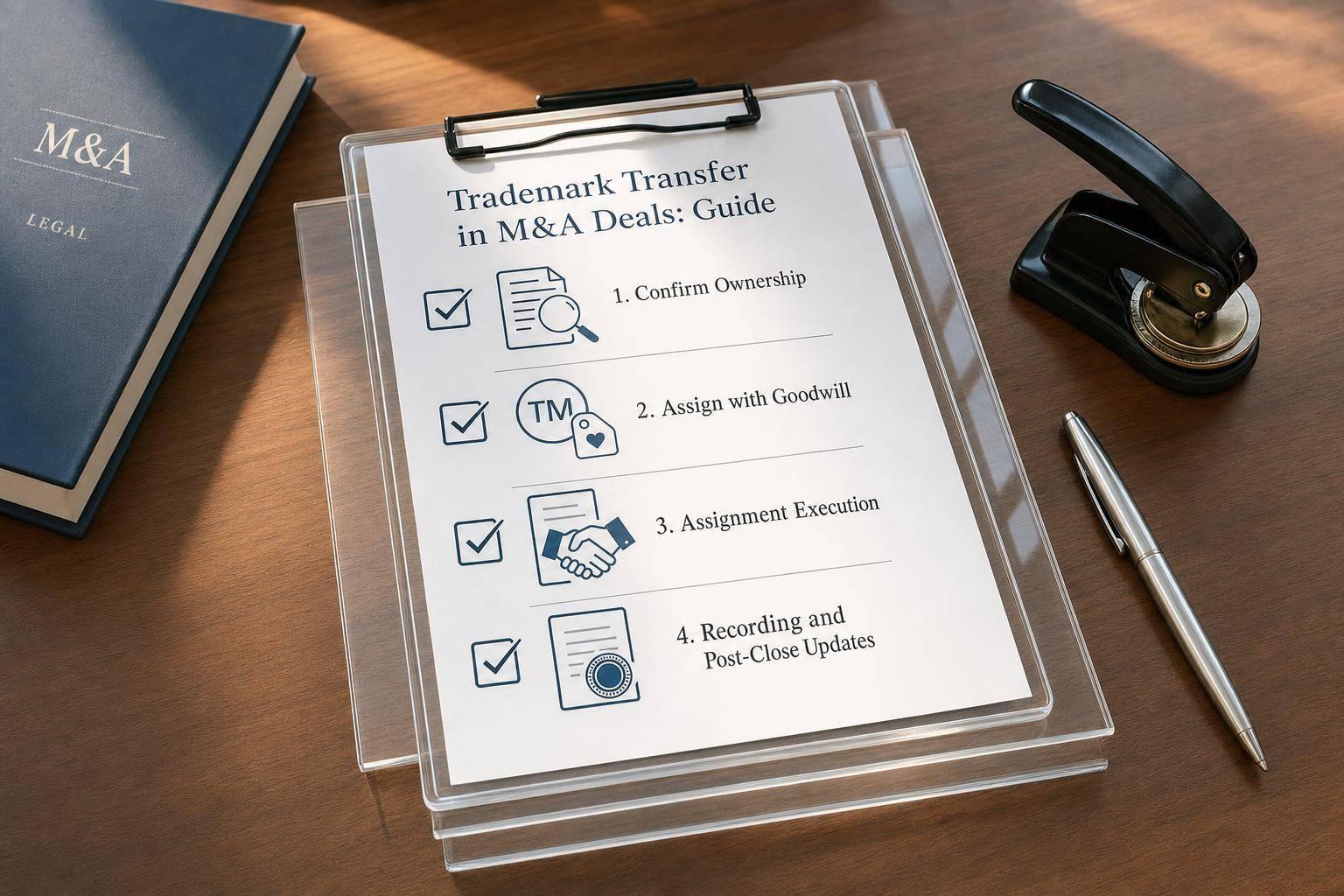
Miss one trademark step in an M&A deal, and closing can stall or ownership can get messy. I’d focus on five things right away: confirm who owns each mark, check the chain of title, make sure goodwill transfers, file the right papers based on deal type, and fix post-close records fast.
Here’s the short version: in an asset deal, trademarks usually need a written assignment. In a stock deal, the company still owns the marks, but I’d still review licenses, liens, and change-of-control terms. I’d also watch the 3-month USPTO recordation window, note that USPTO filing fees are about $40 per mark/property under the cited fee code, and expect electronic recordation to show up in about 7 days.
If I were preparing this for closing, I’d keep my checklist simple:
Quick comparison
| Deal type | Does trademark ownership change? | Separate assignment usually needed? | Main risk to check |
|---|---|---|---|
| Asset purchase | Yes | Yes | Bad chain of title, missing goodwill, filing delays |
| Stock purchase | No, the entity stays the owner | Usually no | Change-of-control clauses, license limits, liens |
So if you want the clean answer: the transfer works when the right owner signs the right document, goodwill goes with the mark, and the public records match the deal.
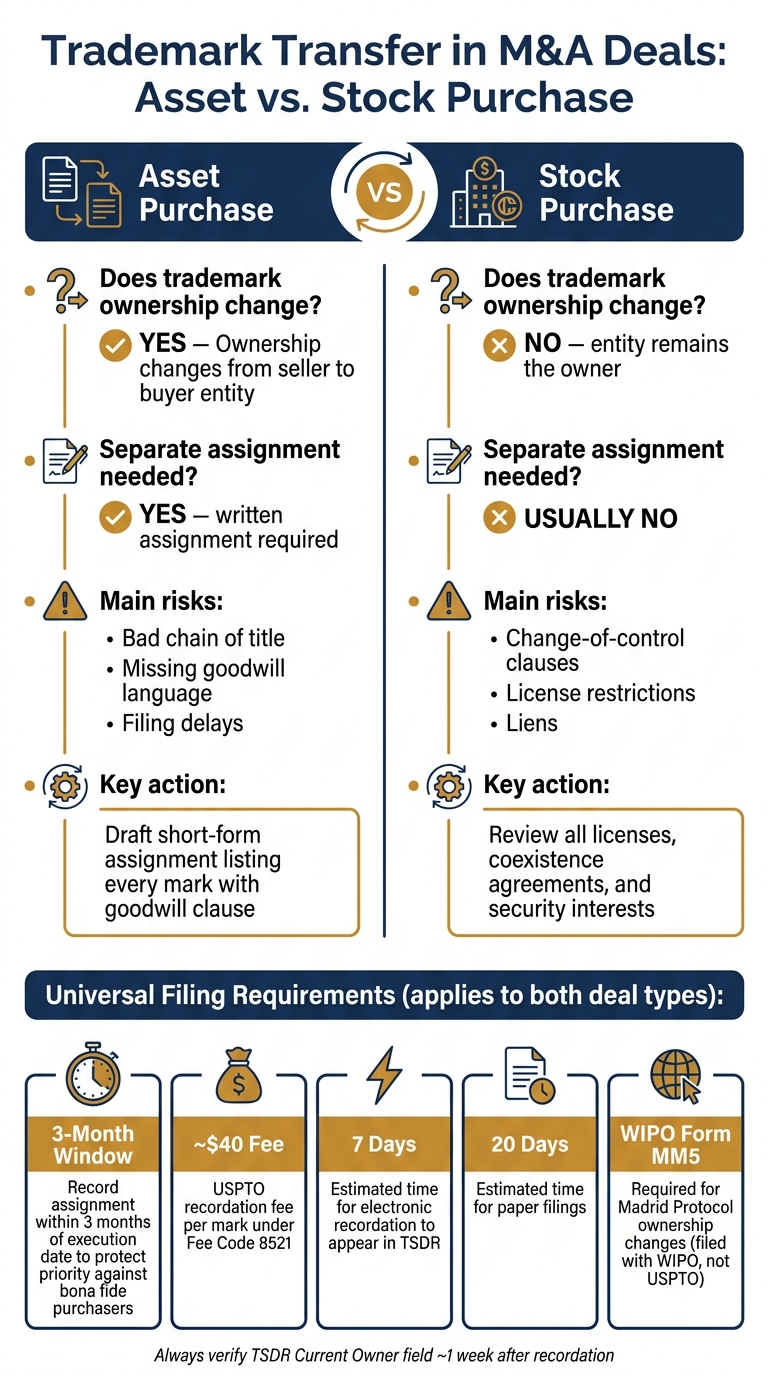
Asset vs. Stock Purchase: Trademark Transfer Comparison
Start with the marks that matter most: the ones the buyer will own, use, or depend on after closing. Trademark diligence should begin before the letter of intent is signed. The aim is simple: know what marks exist, confirm the right entity owns them, and spot anything that could delay or block the transfer.
Don’t rely only on the seller’s schedule. Check every mark against USPTO, state, and international records. Sellers often miss marks. In some cases, they list marks that are actually owned by a founder, an IP holding company, or a dormant LLC.
Your inventory should cover federal registrations, state registrations, pending applications, Madrid rights, common-law marks, and related digital brand assets like domain names, social media handles, and marketplace accounts such as Amazon Brand Registry. These assets are often set up in the name of IT or marketing staff instead of the legal entity. That may seem minor at first, but it can turn into an ownership mess after closing.
Flag ITU applications early. They usually transfer only with the entire business, and they can fail if assigned on their own [10][8].
Once the inventory is in place, trace the chain of title for each mark in the USPTO assignment database. Look for gaps. That might mean prior transfers that were never recorded, or marks still sitting in the name of a dissolved entity after a corporate reorganization. Internal restructurings often cause these problems because companies move assets between subsidiaries and skip the trademark paperwork [10][9].
Make sure each prior transfer included goodwill. If goodwill was left out, title can fail [9].
Then look beyond ownership history. Review any agreements that may limit transfer, including:
Any of these can block the transfer or force the parties to get third-party consent at closing [2][8].
With title sorted out, the next step is to draft transfer language around the exact assets identified here.
Check the maintenance status of every federal registration. Section 8 Declarations of Continued Use are due between years 5 and 6. Section 9 renewals are due between years 9 and 10. Section 15 declarations of incontestability may matter too [3]. If a registration has lapsed, closing risk goes up fast. Sellers should deal with any deadlines that fall within the next 18 months before opening the data room.
Review each mark’s prosecution history as well. Office Action responses can include arguments or amendments that narrow the scope of protection, even when the registration certificate looks fine on its face.
Then check for active disputes: oppositions or cancellation proceedings before the Trademark Trial and Appeal Board (TTAB), along with any cease-and-desist history. The marks that need the most attention are federal registrations with missed maintenance filings, pending ITU applications, and foreign marks held by local distributors instead of the selling entity.
Once the inventory and chain of title are clean, move to assignment drafting for the marks that will actually transfer.
After diligence, draft a short-form assignment that covers only the trademarks being transferred. Use the diligence schedule as your guide, and include only the marks that passed title review. At this stage, the first call is simple: decide whether the transfer language should sit inside the APA or in a separate assignment.
Use a short-form standalone assignment for recordation. It keeps deal terms private, lines up better with registry office practice, and is simpler to file than the full APA.
Once you pick that structure, the assignment should do two things clearly:
A U.S. trademark assignment must transfer the mark with its goodwill. List each registration, each pending application, and each relevant unregistered mark. Then state that the seller assigns all right, title, and interest in every listed mark [6][4].
If the buyer is supposed to get claims for earlier infringement, say that directly. If not, leave it out. The right to sue for past infringement transfers only when the document says so [1][4].
After those core terms are in place, turn to any pending applications and any consent-based licenses that could affect closing.
Treat intent-to-use applications with care. They usually transfer only to a successor to the applicant's active business, and related license agreements may need consent or may end on a change of control [1][5][11].
Go agreement by agreement and list anything that:
Also add a further assurances clause. That clause requires post-closing help, so the seller must sign any document needed to perfect the transfer or record it in other countries [4][7].
With the assignment signed, the next step is recordation and foreign filing.
Once the assignment is signed, don't let it sit. Move straight to recordation.
The assignment needs to be in writing, signed by an authorized assignor, and it must transfer the marks with goodwill. If any of that is off, the USPTO can refuse recordation. That can happen if the cover sheet conflicts with the assignment, the document can't be read, or the goodwill language is missing [1].
Be specific. List each registration, each application, and any common-law mark in the assignment itself or in an attached exhibit. For unregistered marks, also include the related goods and services [6].
After signing, file through the USPTO Assignment Center (ETAS). Electronic filings usually get a Notice of Recordation in about 7 days, while paper filings take about 20 days [1].
The cover sheet should include:
The recordation fee is about $40 under Fee Code 8521 [1].
This step is not just admin work. Recordation helps protect priority. It gives third parties constructive notice and sets priority against later bona fide purchasers [4]. Under U.S. law, an unrecorded assignment can be void against a later bona fide purchaser for value without notice unless it is recorded within 3 months of execution or before that later purchase [4].
That 3-month clock starts on the execution date. So if closing happens on Friday, the clock starts Friday. Filing soon after closing cuts down that risk.
If the deal also covers state registrations, file with each state registry that applies. USPTO recordation does not cover state marks [4].
After the USPTO issues the Notice of Recordation, check TSDR about a week later to confirm that the Current Owner Information has been updated. Also submit a TEAS Change of Address or Representation (CAR) form to update attorney and correspondence details, since recordation does not update those items by itself [1].
After the U.S. filings are done, handle any Madrid or foreign registrations on their own track.
For Madrid Protocol registrations, changes in ownership must be filed directly with the WIPO International Bureau, not the USPTO [1]. WIPO uses Form MM5 for a change in ownership, and the relevant member offices are then notified. Timing varies, and processing can take several months.
For direct national registrations outside the Madrid system, you need a separate filing in each country with the national IP office. In many places, the paperwork must be notarized, apostilled, or legalized. It's smart to pin down those rules early and work with local counsel when needed. If you wait until after closing, the transfer can be delayed by months [2].
Once recordation is done, the work shifts from transfer paperwork to cleanup and brand control. Filing the assignment isn't the finish line. A trademark transfer isn't complete until the ownership records and actual business use line up.
About a week after the USPTO issues the Notice of Recordation, check TSDR to make sure the Current Owner field shows the buyer's legal name [1]. If TSDR still lists the seller, file the correction form. Also confirm that any lien or security-interest release was recorded at closing [12].
The top post-close items are:
Clean records matter, but only if the brand is also being used by the right entity.
After the records are cleaned up, make sure day-to-day use matches the new owner. To avoid an invalid transfer that splits the mark from the business goodwill, the buyer should keep substantial continuity and maintain the quality of goods or services in line with the seller's use [13]. That also means updating domains, social accounts, and marketplace profiles to the buyer's legal name.
As soon as the records are updated, set up trademark monitoring under the new owner. Existing licenses may not transfer on their own, so review each agreement to see whether it needs a novation, a formal assignment, or third-party consent. It's also smart to brief internal teams, especially marketing and e-commerce, on proper trademark use so no one misuses the mark by accident [2][12].
Founders should build their trademark inventory early and fix chain-of-title gaps before closing. Then treat each post-close task - TSDR checks, foreign filings, licensee notices, and maintenance deadlines - as part of deal execution, not something to clean up later. That's what protects deal value and helps prevent post-close enforcement problems [1][12][3][13].
Under U.S. trademark law, a trademark can't be assigned on its own. It has to go with the business goodwill tied to it.
If someone tries to transfer the mark by itself, that's called a naked assignment or assignment in gross. And under the law, it isn't valid.
Why does that matter? Because a trademark stands for that goodwill. Without it, the buyer doesn't get valid rights in the mark.
To make the transfer enforceable, the assignment should clearly state that it includes the goodwill connected with the mark.
Yes. Check whether any third-party consent or approval is needed before transferring trademark assets in an M&A deal.
During due diligence, review trademark licenses and any other prior obligations to confirm that the transfer won’t breach contract terms. If you miss those limits, the deal can get messy fast - or spark legal problems after closing.
After closing, foreign trademark transfers are handled by filing ownership recordals in each country where the marks matter. Since rules change from one jurisdiction to the next, it helps to set priorities based on planned launch dates and local filing requirements.
Some countries ask for notarization, apostilles, or specific chain-of-title documents. That’s why it makes sense to finish the paperwork soon after closing, especially if the assignor may dissolve. Where local rules allow it, combine recordal steps to save time and cut extra admin work.