Published on
December 15, 2025


When companies merge or acquire others, regulatory approval is non-negotiable. In the U.S., agencies like the FTC and DOJ review deals to ensure fair competition. Regulatory advocacy helps shape how these agencies perceive your transaction, using data, market analysis, and clear arguments to avoid delays, scrutiny, or even deal rejection.
Here’s what you need to know:
Early preparation, precise filings, and expert advisors (antitrust counsel, economists, financial advisors) are essential to navigate these challenges and protect your transaction.
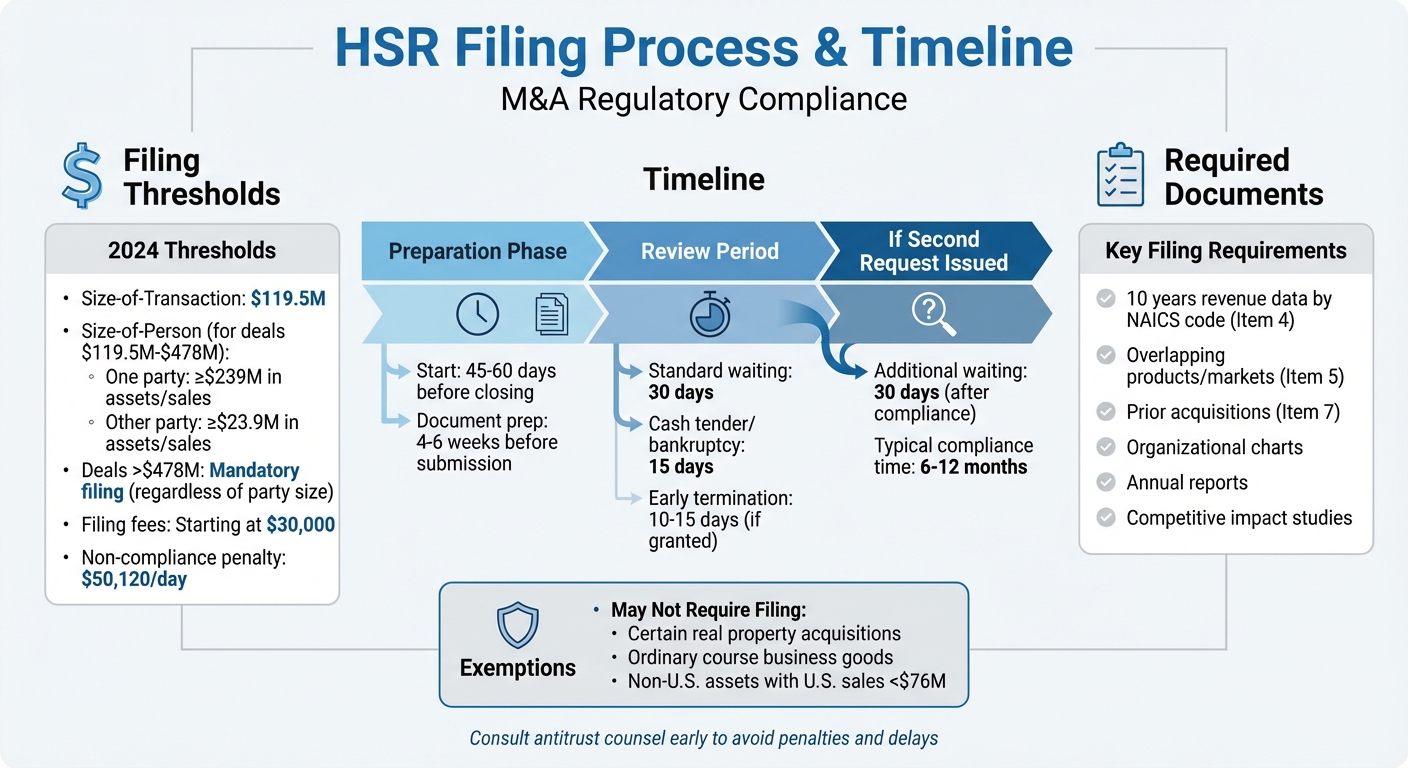
HSR Filing Timeline and Requirements for M&A Transactions
Once you’ve decided to move forward with a transaction, the clock starts ticking on regulatory filings. Getting these filings right is critical to avoid unnecessary delays. In the U.S., the Hart-Scott-Rodino Act lays out the rules for premerger notifications, but understanding the finer details - like thresholds, timelines, and required documentation - can be the difference between a smooth process and hitting roadblocks.
Under the Hart-Scott-Rodino (HSR) Act, certain transactions must be reported to the FTC and DOJ before closing. However, not all deals qualify. Your transaction must exceed the size-of-transaction threshold, which is updated annually for inflation. For 2024, this threshold is $119.5 million, with filing fees starting at $30,000 and increasing based on the deal size [1]. For transactions valued between $119.5 million and $478 million, additional size-of-person thresholds apply: one party must have assets or annual net sales of at least $239 million, while the other must have at least $23.9 million [1].
For deals over $478 million, filing is mandatory regardless of party size. Both parties must submit an HSR Form electronically, including details like revenues by NAICS code (Item 4), overlapping products or markets (Item 5), prior acquisitions (Item 7), and organizational charts. Once submitted, the agencies determine which one - FTC or DOJ - will review the transaction [1].
There are also exemptions that may apply, saving time and money. For example, acquisitions of certain real property, goods bought in the ordinary course of business, or non-U.S. assets with U.S. sales below $76 million might qualify [1]. But misjudging an exemption can be costly, with penalties reaching $50,120 per day for failing to file when required [1]. Working with antitrust counsel early can help avoid these pitfalls.
Timing is key, so make sure you align these filing requirements with your deal’s critical deadlines.
After filing, the standard waiting period is 30 days, during which you can’t close the transaction [1]. However, for cash tender offers or certain bankruptcy-related deals, this waiting period drops to 15 days [1]. During this time, the reviewing agency evaluates whether your deal raises any competitive concerns. If no issues are found, you can request an early termination of the waiting period, which is often granted within 10–15 days for straightforward cases [1].
To keep your deal on track, plan to submit filings 45–60 days before your expected closing date. This timeline accounts for the 30-day review period and any potential delays [5]. For deals involving multiple jurisdictions, like those requiring EU approval, coordinate timelines carefully. For example, the EU’s Phase I review takes 25 working days, so creating a global antitrust timeline can help you manage overlapping requirements [5]. Be prepared for possible extensions, as second requests can add another 30 days or more to the review process [1].
Getting your documentation in order is crucial for meeting these deadlines. Start preparing 4–6 weeks before your planned submission date [1]. You’ll need to gather 10 years of revenue data by NAICS code, lists of overlapping products, details of prior acquisitions, annual reports, and competitive impact studies [1]. Use secure data rooms to ensure consistency and confidentiality during this process.
Mistakes in your filing can lead to costly delays. For instance, incomplete Item 5 disclosures, such as leaving out minor product overlaps, can result in a "stop-the-clock" hold, pausing the review period until corrections are made [1]. Using outdated financial figures or failing to certify "substantial compliance" can also result in penalties. In 2023, one company paid $3.6 million for filing late [4]. Avoid these issues by conducting mock reviews with your antitrust counsel.
For transactions that require additional approvals - like FCC reviews for telecom deals, Federal Reserve approval for banking mergers, or FERC oversight for energy transactions - develop a regulatory matrix during due diligence [2][3]. This matrix should outline all required filings, their timelines, and how they intersect with your HSR submission. Financial and strategic advisors, such as Phoenix Strategy Group, can assist by providing transaction modeling, market data analysis, and data engineering to strengthen your filing materials and overall strategy. Careful preparation not only streamlines the regulatory process but also positions your deal for success with agencies and stakeholders alike.
When the FTC or DOJ identifies potential competition issues during the initial 30-day review, they may issue a Second Request. This formal demand for additional information effectively pauses your deal until you’ve met the agency’s requirements and completed another waiting period - 30 days for most deals or 10 days for cash tender offers and bankruptcy-related transactions. Unlike the initial HSR filing, a Second Request demands extensive data collection, often involving numerous custodians and advanced e-discovery tools. Compliance with these requests typically takes 6–12 months, creating significant delays and requiring careful coordination between your internal teams and external advisors. This process highlights the importance of proactively managing agency inquiries to keep your transaction on track.
Second Requests are usually issued when agencies detect high market concentration, notable horizontal overlaps between merging parties, or risks of eliminating a disruptive competitor. Key warning signs include HHI increases exceeding 200 points in concentrated markets, concerns about vertical integration that could harm competitors, or deals in industries like technology, healthcare, or telecommunications - sectors that often face closer scrutiny. Agencies also weigh factors such as your companies’ history of acquisitions and whether public complaints have been filed by competitors or customers.
Take the 2023 Microsoft-Activision Blizzard deal as an example. The transaction faced prolonged delays and substantial data demands, pushing closure back by over a year.
To anticipate a Second Request, consider conducting pre-filing antitrust analyses during due diligence. Calculate HHI indices for your markets, identify overlapping products or services early, and prepare voluntary documents addressing potential competitive concerns. Collaborating with antitrust counsel to simulate agency reviews can help pinpoint areas of scrutiny, allowing you to prepare arguments and data ahead of time. This proactive approach can reduce surprises and streamline compliance later.
Once you receive a Second Request, the task shifts to producing a large volume of documents - emails, internal reports, pricing data, and market studies - from custodians across both merging companies. Agencies expect thorough compliance, including certifications that you’ve met their requirements. "Substantial compliance" means providing enough material for the agency to conduct its review. If your submission is incomplete, the agency can refuse to start the 30-day clock, further delaying your deal.
To handle this, create a cross-functional response team led by legal counsel. This team should identify key custodians, set up secure data rooms, and use targeted searches with agreed-upon keywords. E-discovery tools are essential for managing the large data volume efficiently, while privilege logs ensure sensitive materials are flagged. Training employees on compliance requirements is also critical. Failing to comply can restart the review clock or result in fines of up to $50,120 per day, making disciplined document management and audit trails a must.
Develop a detailed Second Request workplan with clear steps: negotiating the scope with the agency, gathering documents, running searches, reviewing for relevance and privilege, producing materials, and certifying compliance. Focus on key custodians, such as senior executives and deal team members, and use data analytics to prioritize the most relevant documents. Financial and strategic advisors like Phoenix Strategy Group can assist by offering financial modeling, data analytics, and scenario analysis to support efficiency claims and demonstrate the deal’s competitive benefits, strengthening your case with the agencies and streamlining the compliance process.
For cross-border deals, compliance becomes even more complex as you navigate parallel reviews in multiple jurisdictions. In addition to U.S. Second Requests, you may face European Commission Phase II investigations and similar reviews in countries like the UK, China, Brazil, and Canada. Each authority has its own requirements, timelines, and focus areas, making strategic coordination essential to avoid duplicative work or conflicting positions.
Form a global steering team that includes internal stakeholders and external advisors to align arguments and evidence across jurisdictions. This approach builds on the pre-filing preparations mentioned earlier. Filing strategically - such as submitting to U.S. and EU regulators around the same time - can help avoid conflicting outcomes and use favorable decisions in one jurisdiction to support your case in others. When designing remedies, think globally. Asset packages, buyer qualifications, and carve-outs should address the concerns of multiple authorities, as solutions approved in one region may influence decisions in others.
Consider using information-sharing waivers to allow agencies to communicate directly, reducing redundant requests and aligning their reviews. Centralize your response efforts by using consistent e-discovery platforms and search terms across jurisdictions. External antitrust counsel and economists with experience in multi-jurisdictional cases can guide you through these challenges, negotiate request scopes, and ensure your advocacy is consistent across all relevant authorities.
Navigating the complexities of regulatory reviews demands a skilled external advisory team with expertise in antitrust law, economic analysis, and financial modeling. These specialists ensure you meet the timelines and documentation standards previously outlined. A typical team includes:
Each advisor plays a unique role: while the counsel focuses on legal strategy and negotiations, economists handle the data-driven foundation, and financial advisors ensure regulatory outcomes align with the deal’s financial goals. The success of this process hinges on selecting the right advisors.
Choosing advisors isn't just about credentials - it’s about their direct experience with the agencies overseeing your deal. For U.S. transactions, prioritize antitrust counsel with a proven track record at the FTC and DOJ, particularly in handling Second Requests and filing strategies. Economic experts should have a history of producing analyses that resonate with regulators, while financial advisors must demonstrate experience in managing high-stakes deals under regulatory scrutiny.
In addition to expertise, consider factors like responsiveness, team capacity, and transparent fee structures. Ask for detailed case studies, client references, and clearly defined roles. Watch out for potential red flags, such as overconfident promises, limited recent merger-control experience, weak global capabilities, or unclear billing practices.
Timing is critical - engage advisors as early as the deal strategy or pre-letter-of-intent stage. Early involvement allows for thorough risk assessments and narrative development. This is especially important for deals involving horizontal overlaps or sensitive industries like technology, healthcare, or telecommunications. Starting early enables counsel and economists to identify potential regulatory hurdles, shape the transaction to mitigate risks, and build a strong advocacy narrative.
Delaying engagement until after due diligence or post-signing might save on upfront costs but compresses timelines, increasing the risk of rushed filings, surprise Second Requests, and limited flexibility to adjust the deal structure based on agency feedback. Early advisory involvement often proves invaluable in avoiding these pitfalls.
Take the example of a mid-market software company acquiring a competitor. Financial advisors can play a pivotal role by creating audit-ready revenue datasets and modeling potential remedy scenarios. For instance, a firm like Phoenix Strategy Group, known for its FP&A, M&A support, and data engineering services, might begin by compiling a clean, audit-ready dataset of revenues segmented by product, customer, and geography. This foundation is essential for accurate HSR filings and market definition analyses.
Simultaneously, the advisor can model various remedy scenarios, such as divesting a non-core product line, selling a regional business, or adopting behavioral commitments. Each scenario is analyzed for its impact on EBITDA, leverage, and synergies, ensuring the remaining business aligns with key investment goals. By exploring outcomes like "no issues", "behavioral remedy", "major divestiture", or "deal blocked", the board gains a clear understanding of how regulatory decisions could affect metrics like IRR and payback periods. This analysis also informs negotiation strategies, break fees, and critical timelines.
Lauren Nagel, CEO of SpokenLayer, shared, "PSG and David Metzler structured an extraordinary M&A deal during a chaotic period, and I couldn't be more pleased with our partnership."
This testimonial highlights the value of experienced financial advisors in addressing complex regulatory and operational challenges, ensuring deals stay on track even in turbulent conditions.
After the regulatory review wraps up, the next step is hammering out remedies to secure final approval for the deal.
Once a deal clears the HSR process or complies with a Second Request, there are three possible outcomes:
Recent data shows that Second Requests impact 2–5% of filings, with remedies applied in 20–30% of cases [1]. Regulators focus on whether the merger would substantially reduce competition in the relevant markets. Conditional approvals, often tied to negotiated remedies, have become more common as a way to restore competitive balance.
When it comes to remedies, divestitures are often the go-to solution for regulators. This involves selling off specific assets or business units to eliminate competitive overlaps. Companies should identify potential buyers early, prepare financial documentation, and secure an approved purchase agreement. Regulators may negotiate directly with the proposed buyer - sometimes excluding the main transaction parties - which can create delays if concerns arise about the buyer’s financial stability or competitive viability.
Having an upfront buyer with a signed agreement helps reduce uncertainty after the deal closes. On the other hand, behavioral remedies - like setting up firewalls between competing divisions, protecting customers, or imposing pricing constraints - aim to address competitive concerns without requiring asset sales. However, regulators often view these measures with caution because they can be harder to enforce over time.
When a deal gets conditional approval, the obligations don’t end at closing. Consent decrees typically require ongoing reporting to ensure remedies are implemented correctly - such as completing divestitures or maintaining operational separations. Monitoring trustees are often appointed to oversee these processes, ensuring deadlines are met and competitive integrity is preserved.
Failing to meet these commitments can lead to financial penalties or even the unwinding of the transaction. To avoid this, companies need strong internal compliance systems, detailed records of remedy-related activities, and quick responses to agency inquiries. For deals involving multiple jurisdictions, coordination is key, as remedies required by U.S. authorities may differ from those mandated by other regulators, like the European Commission.
Navigating the regulatory landscape in mergers and acquisitions (M&A) calls for careful preparation and meticulous execution. Start by gathering comprehensive due diligence materials - such as financial and operational data - so you're ready to address regulatory inquiries without delay.
If a Second Request is issued, respond swiftly by organizing data efficiently and maintaining open communication with regulators. This approach not only helps avoid prolonged reviews but also improves the chances of securing negotiated consent agreements, steering clear of costly litigation. For deals spanning multiple jurisdictions, it's crucial to coordinate your strategy across different regulatory bodies. Keep in mind that what satisfies U.S. regulators may not align with the expectations of authorities in other regions. Additionally, plan for post-clearance requirements - like divestitures, operational separations, or ongoing reporting - from the very beginning to avoid penalties down the road.
When combined with the right external expertise, these strategies ensure you're well-prepared to tackle regulatory challenges effectively.
As highlighted in the earlier case study, the role of expert advisors goes beyond compliance - they can significantly enhance the overall value of your transaction. Attempting to navigate regulatory advocacy without specialized advisors increases the likelihood of missing critical details. External experts bring deep knowledge of antitrust regulations, filing processes, and strategies for engaging with authorities - expertise that most companies lack internally. They can identify potential regulatory roadblocks during early discussions, helping you address issues before they escalate into deal-breaking problems.
Phoenix Strategy Group is one example of a firm offering such expertise. With experience in over 100 M&A transactions [6], they provide regulatory compliance support alongside financial advisory and strategic planning services. They help growth-stage companies prepare for exits by implementing strong due diligence systems and ensuring readiness for regulatory filings.
The right advisors do more than help you clear regulatory hurdles - they can also maximize deal value. By streamlining the approval process, negotiating favorable remedies, and ensuring seamless post-deal integration, they play a critical role in safeguarding your transaction. In a climate of heightened regulatory scrutiny and extended approval timelines, expert guidance is not just helpful - it’s essential to protect and enhance the value of your deal.
Navigating the regulatory approval process for mergers and acquisitions can be a tricky path. Companies must work through detailed merger control regulations, address any concerns raised by competition authorities, and prove that their deal won’t harm market competition.
On top of that, the process often comes with lengthy review periods, making it essential to plan carefully. Proper preparation includes managing expectations, allocating resources wisely, and staying organized. Clear communication and well-prepared documentation can go a long way in keeping things on track and minimizing delays.
Managing a Second Request during an M&A process calls for thorough preparation and teamwork. Start by gathering all essential documents, including financial records, contracts, and compliance materials, so they’re easily accessible when needed. Partnering with skilled legal and regulatory advisors is crucial - they can help you navigate the intricate details of the process with confidence.
It’s also vital to maintain open and transparent communication with regulatory authorities like the FTC. Respond to their inquiries promptly and with clarity. Conducting internal audits ahead of time can uncover and address potential issues before they grow into larger problems. Additionally, seeking strategic advisory support, such as the services provided by Phoenix Strategy Group, can help you refine your strategy and face regulatory scrutiny with confidence.
Involving external advisors early in the M&A regulatory advocacy process is a smart move for addressing potential regulatory hurdles head-on. This early collaboration helps businesses pinpoint compliance risks, align their strategies with legal requirements, and prepare for more efficient interactions with competition authorities.
Starting early can prevent expensive delays, ensure the deal structure adheres to legal standards, and keep the focus on achieving the overall transaction objectives. It's a practical approach that saves time, minimizes risks, and boosts the chances of gaining approval for the deal.